Digital KYC & Loan Origination Systems: A Perfect Match
By Roopya
19 Views
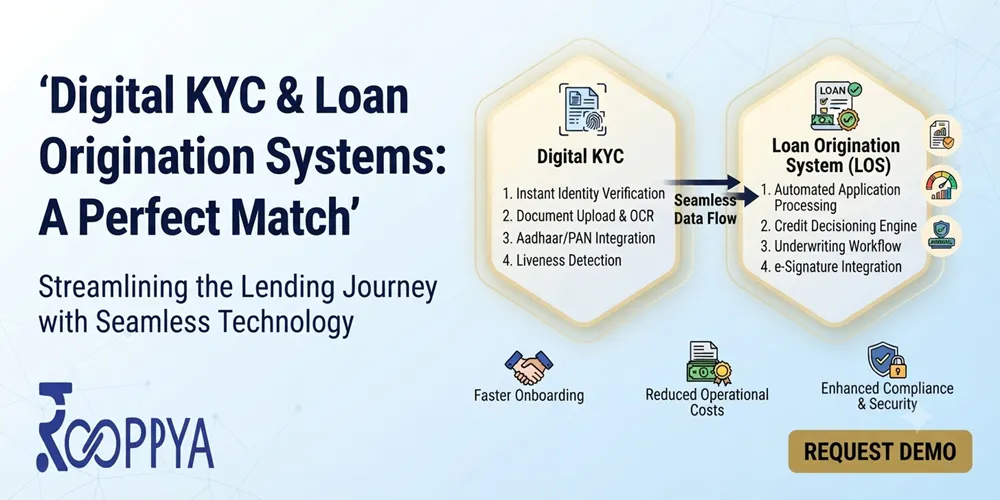
Two Technologies, One Seamless Lending Journey
Imagine a borrower sitting at home at 9 PM, deciding they need a personal loan to handle an unexpected medical expense. They open their phone, fill out a form, upload their Aadhaar, and receive a sanctioned loan offer — all within fifteen minutes. No branch visit. No courier. No callback scheduled for the next working day. Just an instant, frictionless experience powered by two technologies working in perfect harmony: Digital KYC and a modern Loan Origination System (LOS).
For lenders — NBFCs, banks, MFIs, and fintech platforms — this seamless borrower experience is not just good for customer satisfaction. It is the difference between winning the loan and losing it to a competitor who moved faster. And yet, behind that fifteen-minute journey is a sophisticated technology architecture that many lending institutions are still figuring out how to build and deploy.
This article breaks it all down. We will explore what Digital KYC is, how a Loan Origination System works, why these two technologies are best understood as a single integrated system rather than separate tools, and how platforms like Roopya are making this integration accessible to every lender in India — regardless of size or technical capability.
1. Understanding Digital KYC: Beyond the Paper Form
KYC — Know Your Customer — has been a regulatory requirement for financial institutions in India since the Prevention of Money Laundering Act (PMLA) came into force. Traditionally, KYC meant a borrower visiting a branch, submitting photocopies of identity and address documents, and waiting while a bank officer manually verified and filed those documents. The process was slow, expensive, error-prone, and deeply inconvenient for borrowers and lenders alike.
Digital KYC is the transformation of this process into a fully automated, paperless, and real-time verification workflow. It leverages a suite of government-issued identity infrastructure — Aadhaar, PAN, Digilocker — combined with modern APIs, biometric verification, and machine learning to verify a borrower's identity in seconds rather than days.
The Main Forms of Digital KYC in India
● Aadhaar eKYC (OTP-Based): The borrower enters their Aadhaar number and consents to an OTP-based authentication. The lender receives verified demographic data (name, address, date of birth, photograph) directly from the UIDAI database. This is the fastest form of KYC — completing in under 30 seconds.
● PAN Verification: The borrower's PAN is validated against the Income Tax database in real time, confirming identity and linking the application to the individual's tax profile for income assessment.
● Digilocker-Based KYC: Borrowers can share officially verified documents — driving licences, voter IDs, educational certificates — directly from their Digilocker account, eliminating the need for physical document uploads entirely.
● Video KYC (VKYC): For cases requiring a live identity check — such as high-ticket loans or new-to-bureau borrowers — VKYC allows a trained agent to conduct a real-time video verification, capturing the borrower's face, live location, and document authenticity on a recorded call. RBI has explicitly approved VKYC as a valid KYC method.
● Facial Recognition and Liveness Detection: AI-powered facial matching compares a selfie taken during the application with the photograph on the borrower's identity document, confirming that the applicant is who they claim to be and is physically present (not using a photograph of a photograph).
Each of these methods has specific RBI-prescribed use cases and borrower consent requirements. A robust digital KYC system — like the one embedded in Roopya's platform — intelligently selects and sequences the appropriate KYC method based on the product type, loan amount, borrower profile, and lender-configured risk parameters.
2. Understanding Loan Origination Systems: The Engine Behind Every Loan
A Loan Origination System (LOS) is the technology platform that manages the complete lifecycle of a loan application — from the moment a borrower submits their first detail to the moment funds are disbursed. Think of it as the operational brain of your lending business: it receives applications, routes them through verification and assessment workflows, makes or facilitates credit decisions, generates loan agreements, and triggers disbursement — all in a coordinated, auditable sequence.
A modern LOS handles far more than a digital form. It orchestrates dozens of integrations, manages complex decisioning logic, enforces compliance rules, tracks every application through its workflow stages, and gives your operations team complete visibility into the health of your loan pipeline. For large lenders, it processes thousands of applications simultaneously. For newer NBFCs, it provides enterprise-grade infrastructure that would otherwise take years and crores of rupees to build in-house.
The Core Stages of Loan Origination
● Application Capture: Borrower information is collected through a digital form — personal details, employment information, loan requirement, and income declaration.
● Document Collection: The borrower uploads supporting documents — salary slips, bank statements, ITR, GST returns — which are processed by the system's AI-powered document analysis engine.
● Identity and KYC Verification: This is where Digital KYC integrates directly with the LOS. The system automatically triggers the appropriate KYC checks without any manual handoff.
● Credit Assessment: The LOS pulls bureau reports, runs the application through its Business Rule Engine (BRE), applies credit scoring models, and generates a risk assessment.
● Credit Decision: Based on the assessment, the LOS either auto-approves, auto-rejects, or flags the application for manual underwriter review — following the lender's configured credit policy precisely.
● Offer Generation: For approved applications, the LOS generates a personalised loan offer — amount, rate, tenure, EMI — and presents it to the borrower for acceptance.
● Agreement Execution: The borrower digitally signs the loan agreement using eSign, legally binding the contract without physical paperwork.
● Disbursement: The LOS triggers fund transfer instructions to the payment gateway or banking partner, completing the origination cycle.
3. Why Digital KYC and LOS Are a Perfect Match
Here is the insight that changes how lenders should think about these two technologies: Digital KYC is not a pre-step before loan origination begins. It is an integral stage within the origination workflow — and treating it as such has profound implications for speed, accuracy, compliance, and borrower experience.
When KYC is handled separately from the LOS — through a standalone tool, a manual process, or an external vendor with no direct integration — the following problems emerge:
● Data silos: KYC-verified borrower data must be manually re-entered or file-transferred into the LOS, introducing errors and delays.
● Broken workflows: The loan application pauses while KYC is completed elsewhere, creating drop-offs as borrowers lose patience or intent.
● Compliance gaps: Without a unified audit trail, proving that proper KYC was conducted for each application becomes an operational and regulatory challenge.
● Duplication of effort: Operations teams spend time reconciling KYC statuses with application statuses across two separate systems.
When Digital KYC is natively integrated within the LOS — as it is in Roopya's platform — all of these problems disappear. KYC checks are triggered automatically at the right stage of the application workflow, verified data flows directly into the borrower's application record without re-entry, the audit trail is complete and unified, and the borrower never experiences a pause or a handoff. The journey is seamless because, under the hood, it is one system — not two.
The Data Advantage: How KYC Data Enriches Credit Decisions
There is another dimension to this integration that is often overlooked: the data that Digital KYC generates is not just useful for identity verification. It actively enriches the credit assessment process.
Consider Aadhaar eKYC: the verified address data can be cross-referenced against the applicant's declared address to flag inconsistencies. The PAN verification confirms tax filing history linkages that inform income assessment. Facial recognition liveness data adds a fraud signal to the risk profile. Bank statement data retrieved via Account Aggregator — itself a KYC-adjacent consent framework — provides the richest possible picture of a borrower's financial behaviour.
When all of this data flows natively into the LOS's credit assessment engine, the result is a richer, more accurate, more fraud-resistant underwriting decision — one that manual processes or disconnected tools simply cannot replicate.
4. The Compliance Imperative: Why Integration Is Non-Negotiable for Indian Lenders
India's regulatory environment for digital lending has evolved significantly over the past three years. The RBI's Digital Lending Guidelines (2022) introduced clear requirements around borrower consent, data collection, KYC standards, and audit trail maintenance. The PMLA and its amendments continue to impose strict obligations on customer verification. The Account Aggregator framework introduced new consent-based data sharing standards.
For lenders, navigating this regulatory landscape with disconnected tools is genuinely risky. If KYC records exist in one system and loan application records exist in another, demonstrating compliance during an RBI examination becomes a complex, time-consuming exercise — and gaps in the documentation can lead to significant penalties.
A unified Digital KYC and LOS platform like Roopya solves this by design. Every KYC action — consent capture, data retrieval, verification outcome, timestamp, agent ID for VKYC — is logged within the same system that holds the loan application record. Regulatory audit reports can be generated at the click of a button. Compliance is not a retrospective exercise; it is built into every workflow step.
5. How Roopya Delivers Digital KYC-Integrated Loan Origination
Roopya is a no-code lending infrastructure platform designed specifically for the Indian market. Its loan origination system comes with Digital KYC fully embedded — not as an optional add-on, but as a core, pre-integrated component of every application workflow.
Pre-Integrated KYC Stack
Roopya's platform connects out of the box with all major KYC service providers in India — Aadhaar eKYC via UIDAI-authorised sub-AUAs, PAN verification through NSDL and Protean, Digilocker integration, VKYC providers, and facial recognition engines. Lenders do not need to negotiate separate API contracts, manage integration projects, or worry about keeping up with API changes. Roopya maintains and updates all integrations centrally, so every lender on the platform benefits automatically.
Intelligent KYC Routing
Not every borrower needs the same KYC method, and not every product has the same KYC requirements. Roopya's no-code workflow engine allows lenders to configure KYC routing rules — for example, routing high-value applications to VKYC while processing standard personal loans through Aadhaar eKYC only. These rules can be updated by business users without developer involvement, allowing lenders to respond quickly to regulatory changes or product strategy shifts.
Real-Time Data Flow
When a KYC check completes on Roopya's platform, the verified data is immediately and automatically populated into the borrower's loan application record. There is no manual step, no file transfer, no waiting period. The loan application workflow continues instantaneously — triggering the next step (bureau pull, document analysis, or BRE evaluation) the moment KYC is confirmed. This real-time data flow is what enables Roopya-powered lenders to achieve complete application-to-sanction journeys in under fifteen minutes.
Unified Audit Trail
Every KYC action on Roopya is time-stamped, agent-attributed (for VKYC), consent-linked, and stored against the specific loan application record. The complete history of every application — including exactly what KYC was performed, when, with what outcome, and based on what borrower consent — is available for regulatory examination at any time.
Account Aggregator (AA) Integration
Roopya's platform is AA-enabled, allowing lenders to request borrower financial data — bank statements, investment accounts, insurance policies — through the RBI-regulated Account Aggregator network. This consent-based data enrichment, triggered within the loan application workflow, dramatically improves underwriting quality for thin-file and self-employed borrowers who may have limited bureau history but strong demonstrated financial health.
6. Real-World Impact: What This Integration Means for Lenders
For NBFCs Scaling Digital Origination
An NBFC moving from branch-based to digital origination faces the challenge of replacing manual KYC workflows without sacrificing compliance. Roopya's integrated platform provides a compliant, pre-built digital KYC workflow that slots directly into the origination process — allowing the NBFC to go fully digital without building anything from scratch. Lenders on Roopya have reported reducing their average application processing time from three to five days to under thirty minutes.
For MFIs Serving Rural Borrowers
Microfinance institutions often serve borrowers with limited digital literacy in areas with inconsistent internet connectivity. Roopya's platform supports offline data capture with synchronisation capabilities, and its VKYC implementation is optimised for low-bandwidth connections. Group lending workflows — including JLG (Joint Liability Group) KYC processes — are pre-configured and ready to deploy.
For Fintech Lenders Building Embedded Finance Products
Fintech lenders embedding credit into partner platforms — e-commerce checkouts, payroll systems, B2B marketplaces — need KYC and origination to happen invisibly within the partner's user experience. Roopya's API-first architecture enables exactly this: the full KYC and origination workflow can be embedded within a partner's interface through clean API calls, with the borrower never knowing they are interacting with a separate lending infrastructure.
7. Common Myths About Digital KYC in Loan Origination
Myth 1: 'Digital KYC is only for tech-savvy borrowers.'
Reality: Modern digital KYC — particularly Aadhaar OTP-based eKYC — works on any smartphone with a basic internet connection and requires no special technical knowledge. The OTP-based flow is straightforward enough that lenders successfully use it for first-generation digital banking customers in Tier 3 and Tier 4 markets.
Myth 2: 'We need a separate KYC vendor — it cannot be part of our LOS.'
Reality: This was true five years ago. Today, platforms like Roopya embed complete, multi-method digital KYC directly within the LOS. A separate KYC vendor creates data silos, compliance gaps, and workflow friction that are entirely avoidable.
Myth 3: 'Digital KYC is not as legally valid as physical KYC.'
Reality: Aadhaar eKYC performed through a UIDAI-authorised AUA, VKYC conducted per RBI guidelines, and Digilocker-based document verification are all legally valid KYC methods under Indian law. The RBI has explicitly recognised and regulated each of these methods.
Myth 4: 'Implementing digital KYC-LOS integration requires months of IT work.'
Reality: With a no-code platform like Roopya, lenders can go live with a fully integrated digital KYC and loan origination workflow in a single day. Pre-built integrations, pre-configured workflows, and a no-code setup interface eliminate the traditional implementation timeline entirely.
8. The Future: Where Digital KYC and Loan Origination Are Heading
The integration of Digital KYC and Loan Origination Systems is not a destination — it is a moving frontier. Several emerging developments are set to deepen this integration further:
● Perpetual KYC (pKYC): Rather than point-in-time KYC at application, pKYC frameworks continuously monitor borrower identity data for changes — address updates, document expiry, or fraud alerts — allowing lenders to maintain a current, always-valid KYC record without periodic re-verification exercises.
● UPI-Linked Identity: As UPI's identity layer matures, it is likely to become a KYC-adjacent verification tool, allowing lenders to confirm account ownership and transaction history as part of the application workflow.
● AI-Driven Fraud Detection: Machine learning models trained on KYC data patterns will increasingly identify synthetic identities, document tampering, and application fraud in real time — with accuracy levels that manual review cannot approach.
● Cross-Lender KYC Sharing: Regulatory frameworks enabling borrowers to share completed KYC from one lender with another — avoiding repetitive verification — will reduce friction further while maintaining compliance.
Roopya's platform is architected for this future — with an open API layer that can absorb new KYC methods and data sources as they become available, and a no-code workflow engine that lets lenders adapt their processes without IT projects.
Conclusion: Integrate, Don't Separate
The question for Indian lenders is no longer whether to adopt Digital KYC — regulatory requirements and competitive pressure have made that decision for them. The real question is how to implement it: as a disconnected bolt-on that creates friction and compliance gaps, or as a native, seamlessly integrated component of a modern Loan Origination System.
The answer is clear. Digital KYC and loan origination are not separate processes that happen to occur near each other in the lending timeline. They are a single, unified workflow — and the lenders who treat them as such will be faster, more compliant, more cost-efficient, and more competitive than those who do not.
Roopya's platform brings this unified vision to life — with pre-integrated digital KYC, a no-code origination workflow, 300+ ready-to-use API connections, and a 1-day go-live promise. Whether you are an established NBFC modernising your operations, a new lender building from scratch, or a fintech embedding credit into a partner platform, Roopya gives you the infrastructure to make Digital KYC and LOS work as one.
Ready to see it in action? Request a free demo at roopya.money and experience the difference a truly integrated platform makes.
FREQUENTLY ASKED QUESTIONS (FAQ)
Q1: What is digital KYC in the context of loan origination?
Digital KYC in loan origination is the automated, paperless process of verifying a borrower's identity at the point of application. It includes methods like Aadhaar eKYC, PAN verification, Digilocker document sharing, video KYC (VKYC), and facial recogni
Q2: Is digital KYC legally valid for loan applications in India?
Yes. The Reserve Bank of India has formally recognised and regulated multiple forms of digital KYC — including Aadhaar OTP-based eKYC (via UIDAI-authorised entities), Video KYC per RBI's VKYC guidelines, and Digilocker-based document verification. These methods carry the same legal validity as in-person physical KYC under Indian law.
Q3: Why should digital KYC be integrated within the LOS rather than handled separately?
Handling KYC outside the LOS creates data silos, broken workflows, manual re-entry errors, and compliance documentation gaps. When digital KYC is natively integrated within the LOS — as in Roopya's platform — verified data flows automatically into the application record, the audit trail is unified, workflow continuity is maintained, and the borrower experiences a seamless, uninterrupted journey from application to approval.
Q4: What KYC methods does Roopya's platform support?
Roopya supports the full spectrum of digital KYC methods: Aadhaar eKYC (OTP-based via UIDAI-authorised AUA), PAN verification through NSDL and Protean, Digilocker-based document sharing, Video KYC (VKYC), facial recognition with liveness detection, and Account Aggregator (AA) consent-based financial data retrieval. All methods are pre-integrated — no separate vendor contracts or IT projects are required.
Q5: How long does digital KYC take within Roopya's loan origination workflow?
Aadhaar OTP-based eKYC and PAN verification complete in under 30 seconds. Facial recognition liveness checks add another 20-30 seconds. VKYC, which requires a live agent, typically takes 3-5 minutes. For most standard loan products, the complete KYC process within a Roopya-powered application journey takes under two minutes — with no borrower wait time between steps.
Q6: Can digital KYC handle borrowers who are new to credit or have thin bureau files?
Yes. Digital KYC, particularly when combined with Account Aggregator (AA) integration, is especially valuable for thin-file borrowers. While their bureau history may be limited, AA-enabled data sharing allows lenders to access verified bank statement data, insurance records, and investment information — providing a rich financial profile that supports credit assessment even without a traditional credit score.
Q7: What happens if a borrower fails digital KYC verification?
Roopya's platform supports configurable fallback workflows. If Aadhaar eKYC fails — for example, due to biometric mismatch or connectivity issues — the workflow can automatically route the borrower to an alternative method such as VKYC or Digilocker-based verification. If all digital methods fail, the application can be flagged for branch-assisted KYC completion, ensuring no eligible borrower is lost due to a technical failure.
Q8: How does digital KYC integration support RBI compliance?
Roopya's integrated platform maintains a complete, time-stamped audit trail of every KYC action against each loan application — including consent capture, the method used, the data retrieved, the verification outcome, and the agent ID for VKYC. This unified record satisfies RBI examination requirements, PMLA record-keeping obligations, and Fair Practice Code documentation standards without any manual compilation effort.
Q9: Is digital KYC suitable for rural and semi-urban borrowers with limited digital literacy?
Yes. Aadhaar OTP-based eKYC works on any basic smartphone with mobile data and requires only the ability to read and enter a 6-digit OTP — making it accessible to first-time digital users. Roopya's platform also supports agent-assisted digital KYC workflows, where a field agent guides the borrower through the process using a tablet or smartphone, combining digital efficiency with human support for populations that need it.
Q10: How quickly can a lender go live with Roopya's digital KYC-integrated LOS?
Roopya is designed for a 1-day go-live. All KYC integrations are pre-built, all product workflows are pre-configured, and the platform's no-code setup interface allows business users to configure and launch their lending product without any developer involvement. Most lenders are processing live applications within 24 hours of completing onboarding.