Why Your Topic Cluster Is Not Ranking After Six Months and How to Diagnose It
By Amir
117 Views
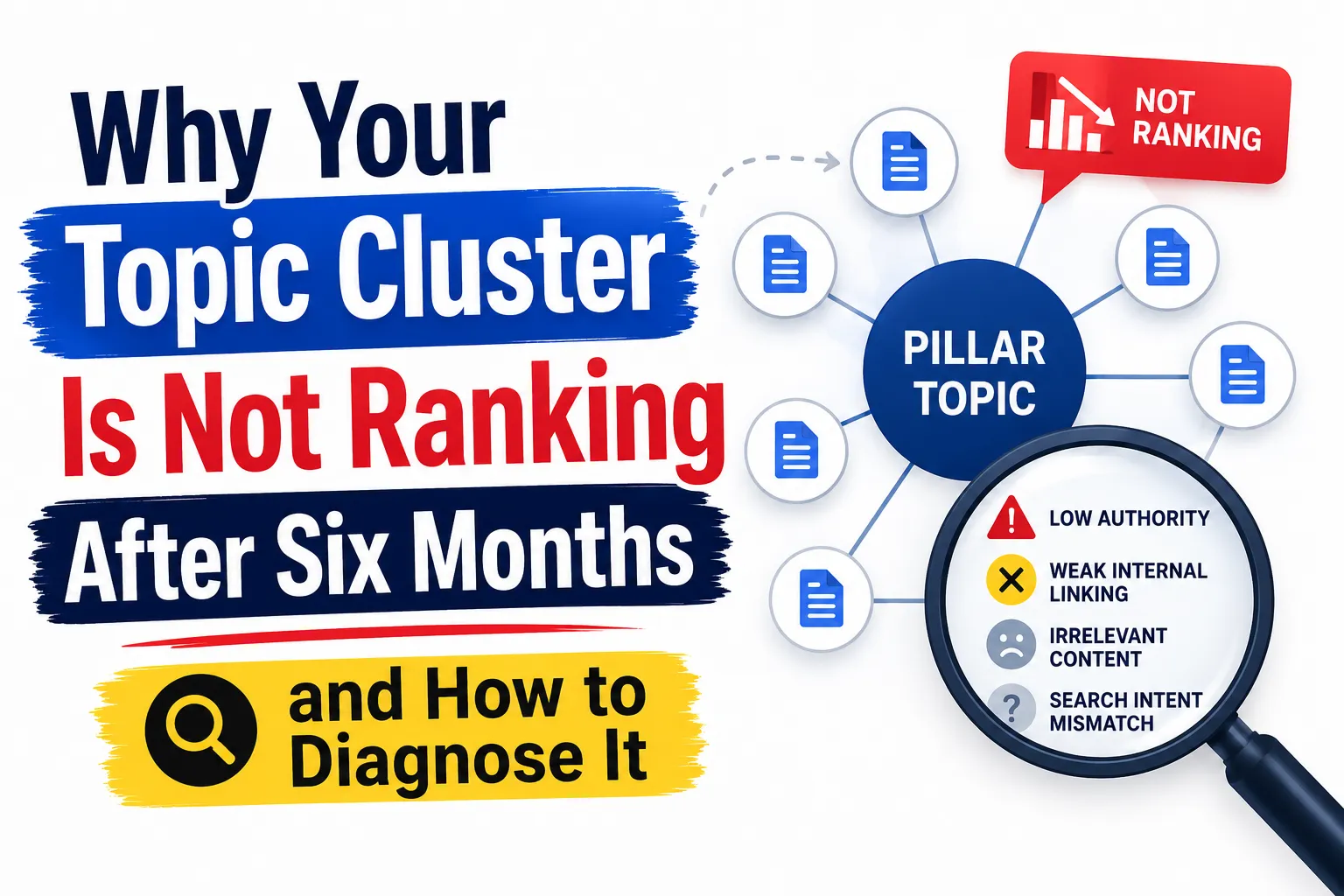
Six months ago you built the cluster. Pillar page, cluster articles, internal links connecting everything exactly like every SEO resource told you to. The rankings haven't moved.
Most site owners at this point blame the competition. That assumption is almost never accurate.
The Structural Lie Hidden in Most Topic Cluster Guides
You Built It Right, and That Is Exactly the Problem
Topic cluster diagrams look satisfying in slide decks. Pillar in the center, cluster articles fanning outward, links connecting everything like a reasonably clean metro map. The visual makes the method feel solved. And that's the trap.
Google doesn't read your site like a diagram.
It reads signals. Entity signals, behavioral signals, semantic coherence signals. Architectural correctness is the minimum requirement, not a ranking catalyst. Building a technically sound cluster is kind of like pouring a concrete foundation before you've decided what the building actually needs to do, well, more like assuming the foundation itself is the building.
It isn't.
When Google Cannot Classify What Your Site Actually Knows
Most cluster audits skip the failure point that matters most. Topical authority is not granted because you published fifteen articles under a shared content category. It's built when Google can confidently classify your domain as a reliable reference on a specific subject.
Fifteen cluster articles that each cover a broad angle without going three layers deep on any single one tell Google you have coverage. Coverage doesn't rank in 2026. Depth backed by named entities, specific data, and verifiable claims does. These are measurably different things and most clusters never distinguish between them.
Six Months In and Still Flat: How to Diagnose It
Start With Crawl Frequency, Not Your Rankings Dashboard
Before you open the rankings tab, pull the URL inspection data for each cluster page in Search Console. Check when each was last crawled, not just whether it appears as indexed.
That number is telling you something your rankings report cannot.
A cluster article getting crawled once every three to four weeks is an article Google has not priotized for a second look. Low crawl frequency is a direct signal that the content didn't earn continued attention. Crawl budget distribution across your cluster is one of the clearest early indicators of whether the structure is building momentum or just occupying server space.
Index Coverage Is Not the Same as Ranking Coverage
Your article can sit in Google's index and still land on page six for every query you're targeting. Indexed means found. Ranked means chosen.
A lot of site owners conflate these two and conclude the cluster is working because nothing shows a coverage error in Search Console.
Use the site search operator on your domain and narrow results to your cluster topic. Count what shows up. Then pull the actual SERP for your target keywords and compare. The gap between what's indexed and what's ranking tells you whether Google reads your cluster as expertise or just content quantity sitting in an index.
Internal Links Are Signal Transmission, Not Navigation
Internal links serve stuctural purposes, yes. Their actual SEO function is passing topical relevance, crawl priority, and PageRank to the pages they point to. That's three distinct signals carried in a single link.
If your cluster articles receive internal links only from the pillar and from nowhere else on your site, you've built a spoke-and-hub with no signal amplification from outside the cluster itself. Links from thematically adjacent pages elsewhere on your domain carry substantially more weight than another link from within the same cluster.
Check whether your cluster articles receive links from posts in other topical areas. If the answer is no across the board, that absence is compounding your signal problem every week.
The Actual Reason Your Pillar Page Is Not Gaining Traction
Intent Gravity Collapse Across the Cluster
What I call Intent Gravity Collapse is the most underdiagnosed failure pattern in topic cluster SEO. Your pillar is written for informational intent. Two cluster articles are half-optimized for commercial queries. One piece accidentally serves navigational searches for a competitor's tool.
Each piece was written to rank. None were written to reinforce a unified topical commitment.
Google reads this spread across intent stages as uncertainty about what your site actually serves. And when uncertain, it defaults to whichever competitor maintains the most consistent signal across their entire cluster, not the site with the most articles.
The Keyword Cannibalization You Haven't Spotted Yet
Cannibalization in a topic cluster is not always two pages targeting the identical keyword. The subtler version does more damage.
When cluster articles all target variations of the same parent keyword without distinguishing intent level or specificity, they compete internally and dilute the pillar's authority signal. You're not sending Google stronger evidence of topical expertise. You're splitting the vote across multiple URLs and making each one weaker.
Run each cluster URL through a keyword overlap audit in Ahrefs or Semrush. If three or more pages are sharing secondary keyword rankings, your cluster is undercutting its own authority from the inside.
Thin Content in 2026 Is Not a Length Problem
A cluster article is thin when it adds no new fact, angle, or data point that doesn't already exist on the top five ranking pages for the same query. Length is irrelevant. A 2,800-word article that restates what the top competitors published is thinner than a 900-word post that introduces one specific, original insight.
Pull the top five ranking pages for each cluster keyword. List every specific claim each one makes. Then identify what your article says that none of them do. If that column is empty, the article is thin and ranking it means outcompeting stronger pages for the same undifferentiated content.
Topical Authority Is Built by Depth, Not Output Rate
Why Publishing More Into a Broken Cluster Backfires
When rankings plateau, the reflex is to publish more and wait for volume to signal authority.
It doesn't work that way.
Every new article you add to an underperforming cluster asks Google to evaluate more content from a domain that hasn't yet demonstrated topical credibility on this subject. You're widening the surface area of a weak signal. Publishing into a broken cluster is, and I want to be precise here about what I mean, it's closer to adding more exhibits to a museum that hasn't earned critical attention yet. More content doesn't fix a signal problem. It buries the signal further.
The Semantic Coherence Gap Nobody Mentions
Take your cluster articles and ask one question about each. Does this article use the same vocabulary, entity references, and conceptual framing as the pillar page?
If your pillar targets SEO content strategy and one cluster article uses a completely different vocabulary set because a different writer handled it on a different week, Google may not semantically connect them. Consistent entity vocabulary across a cluster is how search engines build a topical map of your domain. This is not a theoretical point. It's how entity-based ranking evaluation actually operates.
The team at Clienvora refers to this as the semantic coherence gap, and closing it consistently moves stalled clusters faster than rebuilding internal link architecture. It's the fix that gets skipped most often because it doesn't appear in standard crawl or coverage reports.
The Fix Starts With an Audit, Not More Content
What the Cluster Audit Actually Looks Like
List every URL in the cluster. For each one, record its current ranking position, crawl frequency from Search Console, the number of internal links pointing to it from outside the cluster, and its primary target keyword.
Look at that table.
Patterns will surface that are invisible from inside a single article. Pages getting crawled but never ranking. Pages ranking for the wrong query. Pages generating zero Search Console impressions, meaning Google isn't surfacing them for any queries at all, including the ones they were written to target.
Intent Realignment Before Anything Else
Take each cluster URL and manually run its target keyword. Look at what Google is returning in the top three positions. Is it a listicle? A comparison? A step-by-step guide? A product category? Whatever format dominates the top three is the format Google has decided matches the intent behind that query.
If your article format doesn't match that, well-written content will still not rank.
Realigning format to intent, before touching word count or adding links or changing anything structural, has moved pages from position forty to position nine in under sixty days across several sites that Clienvora has audited. Not on every site and not every time. But consistently enough that it should be the first fix you test.
Consolidate, Expand, or Cut
After the audit, every cluster piece needs one of three verdicts. Consolidate means merging two articles covering overlapping intent into one stronger page and redirecting the weaker one. Expand means adding original data, specific entity references, or a distinct angle to a page that's structurally correct but informationally shallow. Cut means removing content that generates no impressions, has no ranking signal, and is consuming crawl attention that should go to pages that actually have traction.
The cutting step is where most site owners stall. The professional SEO services that drive measurable results in 2026 treat content removal as a core diagnostic recommendation, not a last resort. The clusters that break out of a six-month plateau are almost always the ones where unnecessary pages were removed before new ones were added.
What Standard Audits Still Miss
Entity Recognition and the Factor Most Tools Don't Measure
Google's evaluation of topical authority has evolved considerably over the past eighteen months. Your cluster is no longer assessed purely on link architecture and content volume. It's assessed on whether the entities in your content, the named tools, cited studies, specific methodologies, verifiable data points, and referenced publications, form a coherent knowledge graph that aligns with what authoritative sites in your niche consistently reference.
Cluster articles that rarely cite named research, specific tools, or verifiable data lack entity anchoring.
And this is harder to fix than adjusting anchor text, which is exactly why most audits don't surface it. At Clienvora, entity optimization is treated as a core diagnostic layer in every cluster audit rather than an optional refinement. The clusters that lack entity anchoring tend to plateau early and stay there regardless of how many structural changes get applied afterward.
The Diagnosis Is More Useful Than Any Individual Fix
What Six Months of Published Content Is Actually Telling You
If your topic cluster hasn't moved in six months, a single broken element is rarely the full explanation. It's almost always a combination of intent fragmentation across the cluster, semantic drift between individual articles, insufficient entity anchoring, and a crawl signal that never built enough frequency to trigger deeper evaluation.
The audit step, specifically reviewing crawl frequency, intent alignment, keyword overlap, and semantic vocabulary consistency, is where months of publishing effort either gets redirected toward results or gets buried under the same structural problems.
Skip the audit and publish more content into an undiagnosed cluster, and six months from today you'll be asking the same question with more pages and the same rankings. That's not a prediction made to alarm you. It's just the pattern that repeats.