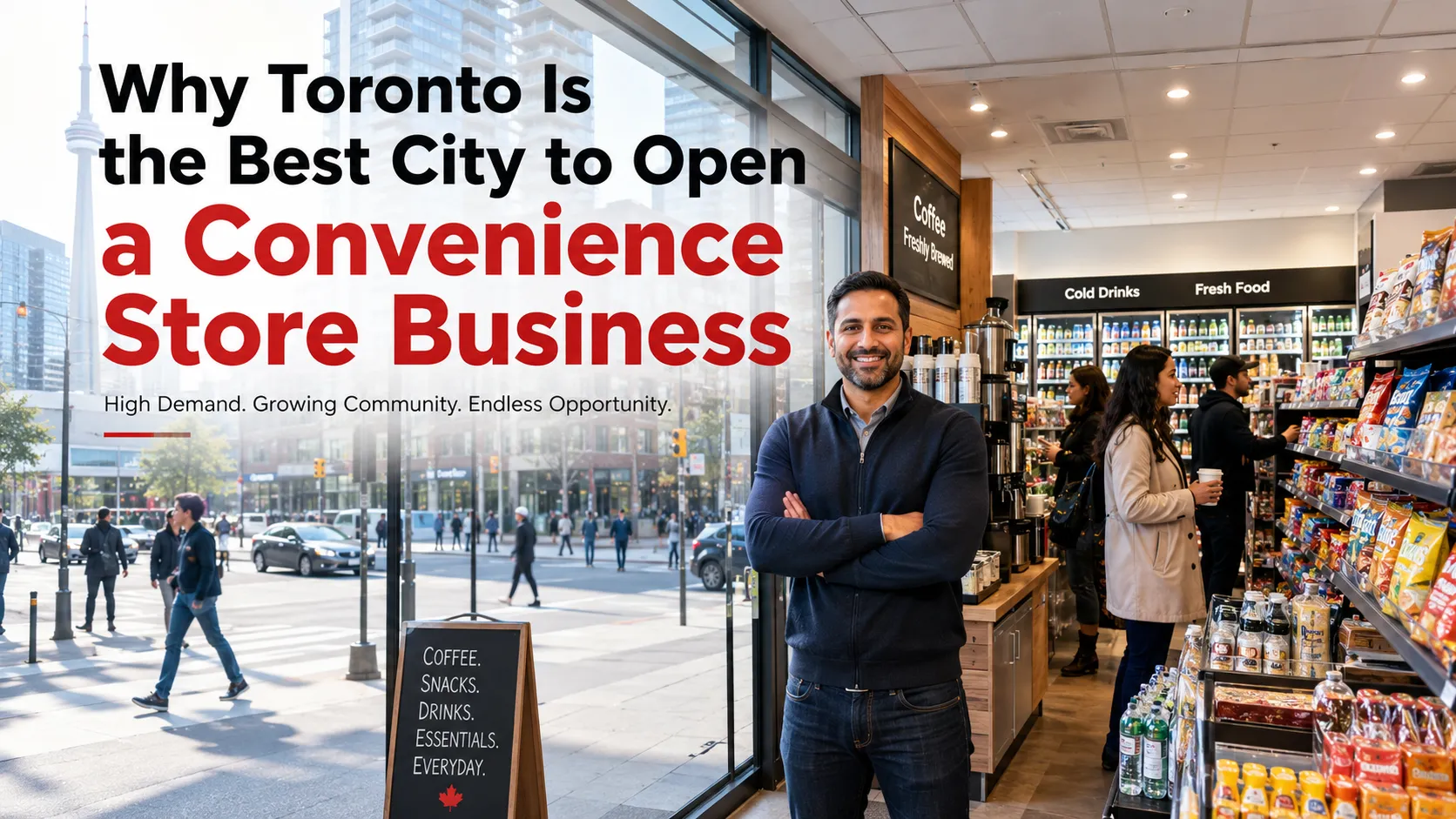
Why Toronto Is the Best City to Open a Convenience Store Business
By John Clark
81 Views
DIRECT ANSWER
Toronto is the best city in Canada to open a convenience store because of its population density exceeding 4,300 people per square kilometre in the core, transit ridership over 1.7 million daily TTC trips, and annual immigration of more than 100,000 new residents to the Greater Toronto Area. Well-positioned urban Toronto convenience stores generate annual revenue between $1.2 million and $2.1 million, well above the national average for the format.
Introduction
For business owners already operating in the Ontario market, the question is rarely whether to expand, but where. Toronto's position as Canada's most densely populated urban centre, combined with a structural shift in how residents shop for everyday essentials, creates a market environment that favours the convenience store model more than any other city in the country.
This is not a general observation. The numbers behind Toronto's retail landscape tell a specific story about foot traffic density, demographic growth, and consumer spending patterns that make the city a compelling destination for operators looking to open a convenience store or expand through a convenience store franchise in Ontario.
1. Population Density Creates Built-In Foot Traffic
Toronto's urban density is the single most important structural advantage for a convenience store operator. With over 4,300 people per square kilometre in the city core, and transit ridership exceeding 1.7 million TTC trips per day, according to Toronto Transit Commission ridership data, the foot traffic patterns that sustain convenience retail are baked into Toronto's physical layout.
Unlike suburban or mid-size Ontario markets where convenience stores depend heavily on vehicle traffic and drive-past visibility, Toronto locations near transit hubs, apartment towers, and mixed-use corridors generate consistent walk-in customer volume throughout the day. The morning commuter, the lunch-hour worker, and the evening shopper represent three distinct revenue windows in a single 12-hour operating period.
Business owners transitioning from other retail formats often underestimate how much of convenience store revenue is impulse-driven. In high-density urban environments, that impulse frequency multiplies. A store in a busy Toronto neighbourhood can serve 400 to 800 individual transactions per day, a throughput figure that most suburban formats cannot replicate.
Key Insight: Toronto's average urban convenience store processes significantly more daily transactions than the national average, with high-footfall locations near transit stations and residential towers consistently outperforming suburban equivalents.
2. Toronto's Demographics Align With Convenience Retail Growth
Toronto receives more than 100,000 new permanent residents through the Greater Toronto Area each year, according to Statistics Canada population estimates, making it the fastest-growing major city in North America by absolute population gain. That growth is not spread evenly. It concentrates in mid- and high-rise residential corridors where new residents, often without vehicles, rely on nearby retail for everyday purchases.
New Canadians represent a disproportionately large share of convenience store customers in the city. This is partly practical, as newcomers in transit-oriented neighbourhoods shop locally by necessity, and partly cultural. Convenience formats that carry diverse product assortments, including international snacks, beverages, and household staples, consistently outperform those offering only standard North American SKUs in Toronto's multicultural neighbourhoods.
For existing business owners evaluating a convenience store franchise in Ontario, Toronto's demographic trajectory is a forward-looking advantage, not just a current one. The population base driving convenience retail demand today is still growing, and the residential construction pipeline across the inner suburbs ensures that new customer density will continue to be added to the market for years.
Toronto Market Factor
Data Point
Business Implication
Population (2024)
3.0 million (city) / 7.0 million (GTA)
Largest metro market in Canada
Daily transit ridership
1.7 million+ TTC trips per day
Captive foot traffic near stations
International immigrants
100,000+ per year settle in GTA
Growing multicultural consumer demand
Convenience store avg. revenue
$1.2M - $2.1M annually (urban)
Higher-than-national urban average
Average store payback period
3 - 5 years (franchise model)
Franchise support reduces risk
3. Toronto's Economy Supports Resilient Retail Spending
Convenience stores occupy a unique position in the retail economy. They are largely recession-resistant because the category of goods they sell, beverages, snacks, tobacco, lottery, and household staples, represents necessity and low-cost indulgence rather than discretionary spending. When consumers tighten budgets, they do not stop buying a morning coffee or a pack of gum. They stop buying electronics and apparel.
Toronto's economy reinforces this resilience. As the financial and technology capital of Canada, the city maintains a high base of salaried employment that sustains day-to-day consumer spending even during broader economic contractions. The corridor between the Financial District, the hospital and university cluster along University Avenue, and the tech offices expanding into the King-Spadina neighbourhood generates consistent daytime foot traffic from workers with disposable income and limited time.
Annual convenience store revenue for well-positioned urban Toronto locations ranges from $1.2 million to over $2.1 million, a figure substantially above the national average for the format. For operators with an existing understanding of retail fundamentals, that revenue ceiling represents a meaningful upside relative to other franchise categories at similar investment levels.
$1.2M - $2.1M+ : Annual revenue range for well-positioned urban Toronto convenience stores
4. The Franchise Model Reduces the Risk of Entry in a Competitive Market
Opening a convenience store independently in Toronto is possible but carries meaningful risk. Supplier relationships, planogram compliance, inventory management systems, and brand recognition all require time and capital to build from scratch in a market where established competitors already hold those advantages.
A convenience store franchise in Ontario addresses these gaps directly. Franchise operators enter with an established supply chain, a tested store format, brand recognition that drives initial customer trial, and operational support that shortens the learning curve for new location operators. For business owners who already understand unit economics and staff management, a franchise structure allows them to focus on execution rather than brand-building.
The payback period for a franchise-model convenience store in a strong Toronto location typically falls between 3 and 5 years. That timeline is competitive against comparable franchise categories in food service and specialty retail, particularly given the lower labour intensity and longer operating hours that characterize the convenience format.
For Existing Business Owners: If you already manage staff, suppliers, and a physical retail location, the operational skills required to run a convenience store franchise transfer directly. The franchise system provides the brand, supply chain, and proven format, you provide the execution.
5. Toronto Zoning and Neighbourhood Diversity Create Multiple Entry Points
One practical advantage Toronto offers over smaller Ontario markets is the variety of viable store locations across different neighbourhood types. A 400-square-foot express format near a transit station serves a different customer profile than a 1,200-square-foot full-format store in a mid-rise residential neighbourhood, but both are viable convenience store models within the same city.
Toronto's zoning framework supports mixed commercial and residential use across a wide range of neighbourhoods, meaning that operators are not competing exclusively for the same high-street corner locations. Basement-level retail in residential towers, mid-block locations in dense walkable neighbourhoods, and transit-adjacent kiosks all represent entry formats that suit different capital positions.
This range of entry points is particularly relevant for business owners looking to open a convenience store without committing immediately to a flagship high-street investment. A smaller initial footprint in a strong residential neighbourhood can validate the model and generate the operating cash flow needed to support a larger location or a second unit.
Toronto Is Not Just a Market, It Is a Multiplier
For business owners evaluating where to open a convenience store or invest in a convenience store franchise in Ontario, Toronto offers a combination of conditions that no other Canadian market replicates: population density that generates foot traffic by default, demographic growth that expands the customer base annually, economic resilience that protects convenience retail during downturns, and a franchise ecosystem that reduces entry risk.
The operators who perform best in Toronto's convenience retail market are not necessarily those with the most capital. They are the ones who combine a well-located store with a proven operational system and the discipline to execute consistently. The city provides the demand. The franchise model provides the structure. The business owner provides the management.
That combination, in Toronto's specific market context, is why the convenience store category continues to attract experienced retail operators who are ready to expand beyond their current format.
Legal Note for Ontario Franchise Buyers
Any business owner evaluating a convenience store franchise in Toronto or elsewhere in Ontario is protected under the Arthur Wishart Act (Franchise Disclosure), 2000, which requires franchisors to provide a complete Franchise Disclosure Document at least 14 days before any agreement is signed. This applies regardless of store format or neighbourhood. Reviewing the FDD with a franchise lawyer remains the standard due diligence step before any Toronto location decision is finalized.
Infinity Mart in Toronto: A Proven Model for This Market
Infinity Mart offers a convenience store franchise model built for the Ontario market, with available locations across the Greater Toronto Area and support structured around exactly the kind of population density, transit access, and neighbourhood diversity covered in this guide.
Business owners interested in opening a convenience store in Toronto can learn about available locations, franchise investment levels, and how the support system works for operators expanding into Toronto at infinitymart.co/franchise-opportunities/.
Frequently Asked Questions
Why is Toronto considered the best city for a convenience store franchise in Ontario?
Toronto combines population density exceeding 4,300 people per square kilometre in the core, transit ridership over 1.7 million daily TTC trips, and over 100,000 new GTA residents annually. These factors create consistent foot traffic and a growing customer base that most other Ontario markets cannot replicate at the same scale.
How much revenue can a convenience store generate in Toronto?
Well-positioned urban Toronto convenience store locations generate annual revenue between $1.2 million and $2.1 million, which is substantially above the national average for the format. Revenue depends heavily on specific location, foot traffic patterns, and product mix.
Is a convenience store a good investment during an economic downturn?
Convenience stores are generally considered recession-resistant because they sell daily essentials and low-cost indulgences rather than discretionary goods. Toronto's high base of salaried employment further supports consistent spending on convenience retail even during broader economic contractions.
What is the typical payback period for a convenience store franchise in Toronto?
The payback period for a franchise-model convenience store in a strong Toronto location typically falls between 3 and 5 years, which is competitive against comparable franchise categories in food service and specialty retail.
Do I need significant retail experience to open a convenience store franchise in Toronto?
Existing business owners who already manage staff, suppliers, and a physical retail location can transfer those operational skills directly to a convenience store franchise. The franchise system provides the brand, supply chain, and proven store format, while the operator focuses on day-to-day execution.
What legal protections do convenience store franchise buyers have in Ontario?
Ontario's Arthur Wishart Act (Franchise Disclosure), 2000 requires franchisors to provide a complete Franchise Disclosure Document at least 14 days before any agreement is signed. This applies to any convenience store franchise opportunity in Toronto or elsewhere in the province, and buyers should always have the FDD reviewed by a franchise lawyer.
Final Thoughts
Toronto's combination of population density, demographic growth, economic resilience, and zoning flexibility makes it the strongest convenience store market in Canada for both first-time operators and existing business owners looking to expand. The data points in this guide, population, transit ridership, immigration, and revenue benchmarks, all point in the same direction: the city provides structural demand that few other Canadian markets can match.
For operators ready to act on that demand, the next step is evaluating specific neighbourhoods, reviewing franchise disclosure documentation, and modelling realistic revenue projections against the investment levels available in the market.
Related Reading
Top 10 Hidden Secrets About Business & Finance You Need to Know
Welcome to our in-depth exploration of Business & Finance. In an era defined...
Why Business & Finance is Transforming the Global Industry Landscape
Welcome to our in-depth exploration of Business & Finance. In an era defined...