Why Should You Choose a Reverse Engineering Services Company in India for Industrial Projects
166 Views
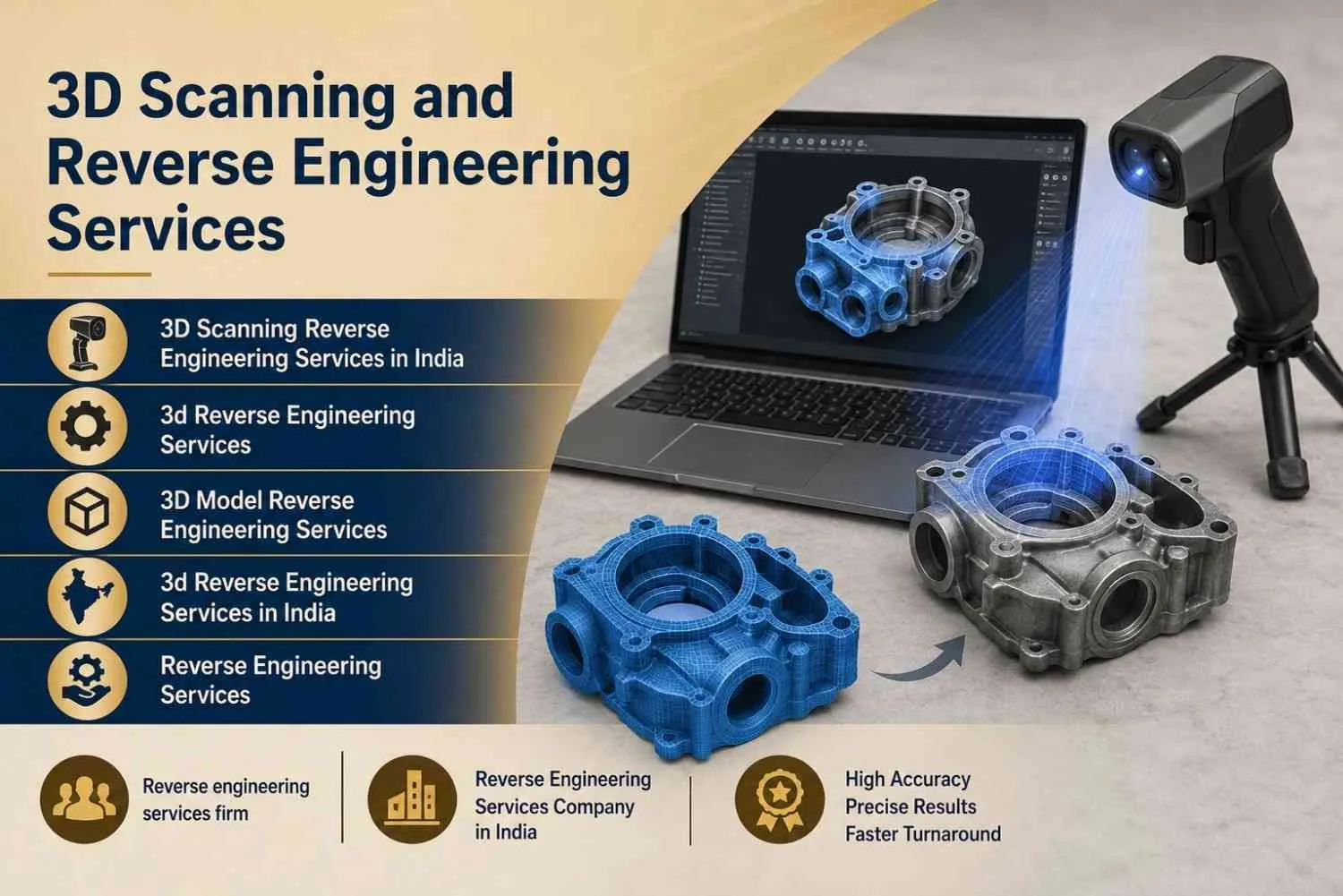
A casting fails during assembly, the OEM no longer supports the machine, and suddenly the procurement team is searching for Reverse Engineering Services with production already behind schedule. That pressure is real in Indian manufacturing. Especially in automotive plants, process industries, heavy machinery units, and tool rooms where one unavailable component can delay dispatches worth lakhs per day.
Most buyers assume scanning a part and rebuilding it are the same thing. They are not. Proper 3d Reverse Engineering Services involve engineering interpretation, tolerance validation, CAD reconstruction, and manufacturability checks—not just creating a digital shape file.
Rejection rates slowly rise due to the combined effects of mold wear, casting shrinkage, and dimensional drift. With adequate 3D Model Reverse Engineering Services, manufacturers reshape tooling geometry, helping to circumvent costly assembly replacements.
The Technical Details Buyers Usually Ignore Until Production Stops
3D Scanning Accuracy Is Only One Part of the Process
Modern 3D Scanning and Reverse Engineering Services use laser scanners, structured-light systems, and CMM inspection methods capable of capturing fine geometry within tight tolerances. Many industrial projects today require accuracy within ±20 microns depending on material and application.
Which means the equipment matters. But the engineering team matters more.
A scan file without proper surface reconstruction creates machining problems later. Tool paths fail. Assemblies misalign. Vendors blame CAD data while buyers lose production time.
Editable CAD Models Matter More Than Mesh Files
Professional 3D Model Reverse Engineering Services generally include the following:
- STL mesh generation
- Surface reconstruction
- Parametric CAD modeling
- GD&T interpretation
- Dimensional inspection reports
- Prototype validation support
- Manufacturing feasibility checks
Most buyers overlook one critical detail: whether the final CAD file remains editable for future revisions. A non-parametric model may look correct visually but becomes difficult to modify during tooling updates or design changes.
Damaged Parts Create More Engineering Work Than Buyers Expect
Older industrial components rarely arrive in perfect condition. Wear marks, corrosion, vibration damage, and previous repair attempts distort the original geometry. Reconstructing accurate dimensions from worn parts takes engineering judgment.
Nobody tells you how often suppliers simply “fill the missing areas” without validating the original design intent.
That mistake becomes expensive during assembly.
Five Supplier Evaluation Points That Actually Matter
1. Ask How They Validate Final Dimensions
Good answer:
The supplier explains deviation analysis, inspection procedures, and tolerance verification against reference geometry.
Bad answer:
“We use high-end scanners.”
A scanner alone does not guarantee usable engineering data.
2. Ask What File Formats You Will Receive
Good answer:
STEP, IGES, SolidWorks, CATIA, NX, or editable parametric CAD files.
Bad answer:
“We mostly deliver STL.”
STL files are useful for visualization. They are not enough for long-term engineering control.
3. Ask Who Reviews Manufacturability
Good answer:
An engineering team evaluates machining feasibility, casting draft, wall thickness, and assembly fitment.
Bad answer:
“We only handle scanning.”
That usually means your internal engineers will spend days correcting avoidable issues.
4. Ask About Industry Experience
Good answer:
Specific project experience in pumps, molds, castings, automotive assemblies, turbine parts, or heavy equipment.
Bad answer:
“We serve every industry.”
Most suppliers saying that have limited technical depth in complex industrial applications.
5. Ask How They Handle Missing or Worn Geometry
Good answer:
They explain reconstruction methods using symmetry, historical references, or engineering assumptions.
Bad answer:
“We recreate whatever we scan.”
That approach fails regularly on worn industrial parts.
Why Manufacturers Depend on 3d Reverse Engineering Services
Downtime Costs Usually Exceed Engineering Costs
A delayed production line can cost far more than the reverse engineering project itself. According to industrial maintenance studies, imported spare-part lead times can extend beyond 10 weeks during supply disruptions.
That is why manufacturers increasingly choose 3d Reverse Engineering Services in India to recreate obsolete or unavailable components quickly.
Legacy Equipment Still Runs Many Indian Factories
A large percentage of manufacturing units still operate machines installed more than a decade ago. OEM documentation disappears. Spare support becomes inconsistent. Reverse engineering becomes the only realistic maintenance option.
Tooling Corrections Safeguard Production Margins
Over time, mold wear, casting shrinkage, and dimensional drift lead to higher rejection rates. "3D Model Reverse Engineering Services" can help manufacturers avoid the costly process of assembling new bits of tooling by recreating the geometry of the tooling to preserve the contours of the existing assembly and molds.
Importance of Faster Product Development Cycles
Many reverse engineering services firm have the capability of delivering parts, assemblies, and prototypes quickly for the purpose of redesigning and enhancing the product/service. Engineering teams face intensified stress due to the substantial reduction of development timelines in many industries over the past decade.
Digital Part Libraries Reduce Supplier Dependency
Once parts are reverse engineered correctly, buyers gain reusable CAD data for future production, sourcing, and maintenance requirements.
One scanned and validated model today can prevent multiple supply-chain problems later.
Why Indian Engineering Support Has Become More Competitive Globally
Reverse Engineering Services Company in India: Faster Coordination Across Vendors
India now supports a strong industrial ecosystem connecting scanning providers, CAD engineers, machine shops, foundries, and inspection facilities within relatively short supply chains.
That operational proximity matters.
A project involving scanning, CAD reconstruction, machining, and fitment validation can move faster when suppliers coordinate locally instead of across multiple countries and time zones.
3D Scanning Reverse Engineering Services in India Reduce Import Dependency
Global buyers started diversifying manufacturing support after supply-chain disruptions exposed the risk of relying on single-region sourcing. India benefited heavily from that shift.
Today, a capable Reverse Engineering Services Company in India can support:
- Aerospace component redevelopment
- Automotive part analysis
- Industrial maintenance projects
- Mold redesign
- Casting optimization
- Plant equipment restoration
Most procurement teams compare only hourly pricing. Experienced buyers evaluate communication speed, engineering capability, revision handling, and inspection discipline.
Engineering Communication Still Separates Good Suppliers From Weak Ones
Some suppliers disappear after sending the initial quotation.
That is a serious operational problem in reverse engineering projects where technical clarifications affect manufacturing timelines directly.
A reliable Reverse engineering services firm keeps engineers involved throughout the project instead of routing every discussion through non-technical sales staff.
About Integrated Solutions
At Integrated Solutions, we work with manufacturers, tooling companies, maintenance teams, and industrial buyers who need accurate engineering reconstruction for production use — not just visual CAD outputs.
We handle 3d Reverse Engineering Services with a practical manufacturing approach. Our work includes CAD reconstruction, dimensional inspection support, editable modeling, and production-oriented engineering outputs for industrial applications.
We learned something early while working on reflective machined components: improper surface preparation creates unstable scan noise that affects downstream geometry accuracy. Small oversight. Expensive correction later.
Our team supports industrial clients across India with responsive engineering communication and project-focused technical support.
If you contact Integrated Solutions for Reverse Engineering Services, send the following:
- Component photographs from multiple angles
- Approximate dimensions
- Existing drawings if available
- Material information
- Required tolerances
- Quantity requirement
- Application details
We typically respond within one working day for standard industrial inquiries. MOQ depends on whether the requirement involves prototyping, low-volume redevelopment, or batch production support.
And yes, damaged parts can often be reverse engineered successfully. But severely worn components sometimes require engineering assumptions during reconstruction. Buyers should know that before approving timelines.
Conclusion
Industrial buyers choosing Reverse Engineering Services today are evaluating more than scanning capability. They are evaluating engineering accuracy, production readiness, and supplier accountability. An effective partner assists manufacturers in minimizing production downtime, retrieving out-of-production components, and retaining control over manufacturing timetables without total reliance on OEM offerings.
As more and more industrial equipment is pushed into service longer than initially intended, there will be a greater need for precision engineering reconstruction within the Indian manufacturing sector.
Here is another blog you might be interested in
What Makes a Reliable Tool Fixture Designing Service Provider in India
FAQs
Why do manufacturers hire a Reverse engineering services firm instead of replacing parts?
Replacement is not always practical. OEM lead times may extend for weeks, and some parts are discontinued entirely. Reverse engineering allows manufacturers to recreate usable production data faster.
Can worn or damaged components still be reverse engineered?
Yes, although there is a limitation. If the original geometry is heavily distorted, engineers may need to rebuild certain features using reference assumptions or symmetry analysis.
What deliverables should a Reverse Engineering Services Company in India provide?
Editable CAD formats like STEP, IGES, SolidWorks, or CATIA files are preferred. Buyers should avoid suppliers who only provide mesh outputs without engineering reconstruction.
How accurate are 3D Scanning Reverse Engineering Services in India?
Modern industrial scanners can capture highly detailed geometry. Final accuracy still depends heavily on CAD reconstruction quality and dimensional verification methods.
Related Reading
Top 10 Hidden Secrets About Business & Finance You Need to Know
Welcome to our in-depth exploration of Business & Finance. In an era defined...
Why Business & Finance is Transforming the Global Industry Landscape
Welcome to our in-depth exploration of Business & Finance. In an era defined...