Why Projects Stall Even When Everyone Is Working on Them
14 Views
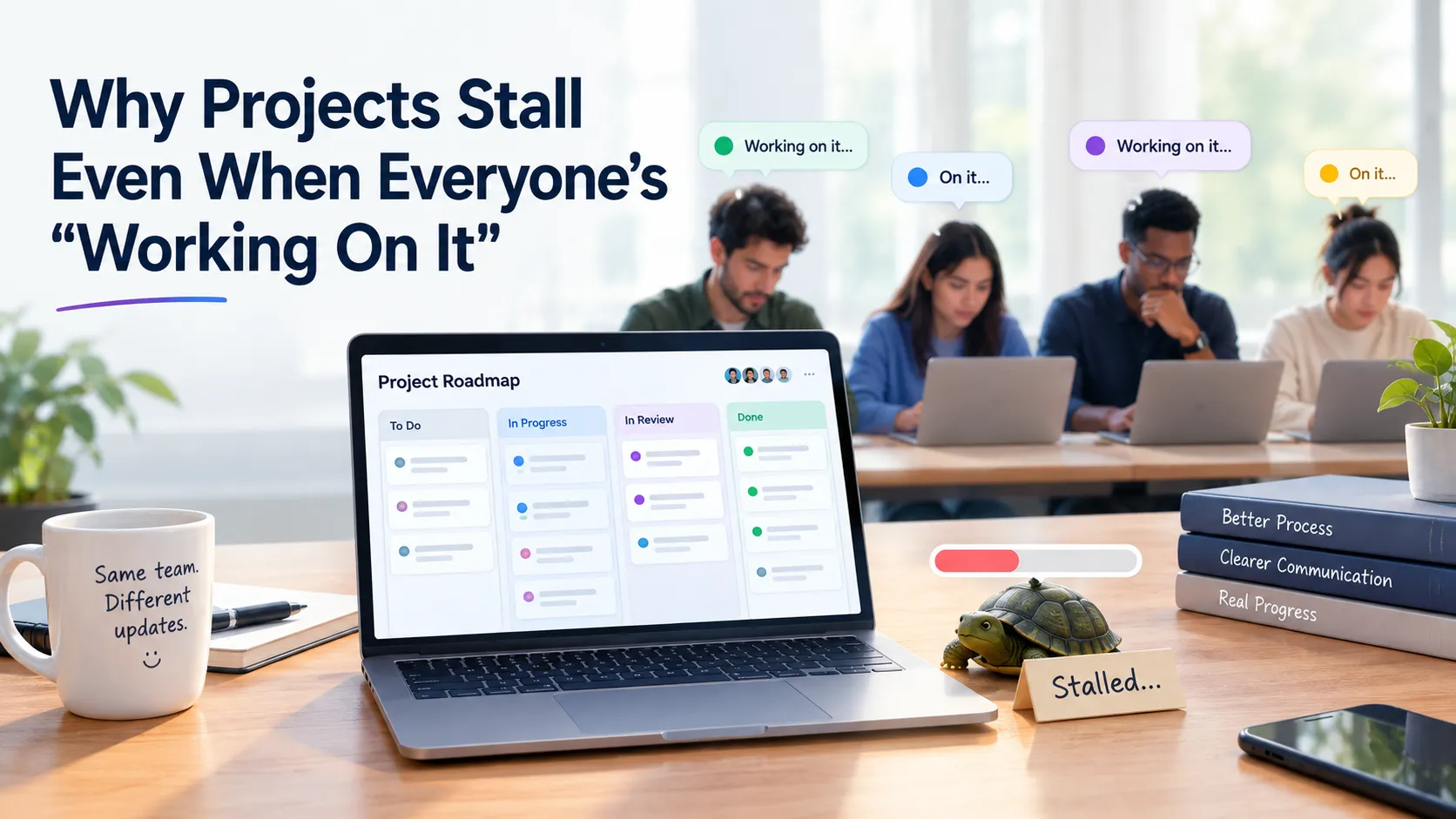
Short answer: Projects stall despite active work because tasks lack a single clear owner — when responsibility is shared or implicit, no one feels accountable for moving a task forward, and it quietly sits until someone finally asks why nothing's changed. The fix isn't more check-ins; it's assigning one clear owner to every task from the start.
Every manager has had this exact moment: a project looks fine on the status update, three people say they're "on it," and a week later nothing has actually moved. Nobody lied. Nobody was idle. The work just had no single owner, so everyone assumed someone else had it covered — and a task with three assumed owners has zero real ones.
Why Do Tasks Stall Even When People Are Busy?
Direct answer: Tasks stall when ownership is implicit or shared, because diffuse responsibility means no one individually feels accountable for the task moving forward — everyone's doing real work, just not necessarily on the thing that's actually stuck.
This is a well-documented pattern in group work generally: when a responsibility is assigned to a group rather than a person, each individual's sense of personal accountability drops, even if everyone involved is conscientious. Applied to a project board, this shows up as a task with multiple people tagged, a vague "team" assignment, or an owner who was accurate when the task was created but is no longer the right person three weeks later. The task isn't abandoned — it's just nobody's specific job to push it forward today.
What Does This Actually Look Like on a Real Project Board?
Direct answer: It shows up as tasks with no single assignee, tasks assigned to a role or team rather than a person, and tasks where the original owner has moved on to other work without a formal handoff.
-
Multi-person assignment. A task tagged to three people often gets worked by none of them with urgency, because each assumes the others have it.
-
Role-based rather than person-based ownership. "Design team" owning a task is different from a named individual owning it — the former diffuses responsibility, the latter concentrates it.
-
Silent ownership drift. A task's original owner gets pulled onto something more urgent, and the task quietly becomes unowned without anyone updating the board to reflect that.
-
Dependencies with no accountable party. When a task depends on another team's output, and no one on either side is explicitly responsible for flagging delay, the dependency itself becomes the stall point.
Why Doesn't Checking In More Often Fix This?
Direct answer: More check-ins add visibility into the fact that a task is stuck, but they don't fix the underlying ownership gap — the task is still nobody's clear responsibility between check-ins, so the same drift recurs.
A weekly status meeting can surface that something hasn't moved, but by the time it comes up, days have already been lost. And the meeting itself doesn't change who owns the task tomorrow — it just produces a conversation about why it's late. Teams that rely on check-in frequency to catch stalled work are treating a structural problem (no clear owner) with a monitoring solution (more frequent look-ins), which explains why the same tasks tend to stall repeatedly even on teams that meet constantly.
What Actually Fixes Stalled Projects?
Direct answer: Fixing this requires assigning exactly one named owner per task from the start, making ownership visible to the whole team (not just the owner), and updating ownership explicitly whenever it needs to change — rather than letting it drift silently.
-
One owner per task, always a named person. Not a team, not a role — a specific individual who is unambiguously responsible for that task's progress.
-
Ownership visible to everyone, not just the assignee. When the whole team can see who owns what, peer awareness catches drift faster than any manager-led check-in could.
-
Explicit handoffs when ownership changes. If a task needs to move to someone else, that should be a deliberate, visible update — not something that happens by default because the original owner got busy.
-
Dependencies tied to a person on each side. When one task depends on another, both sides should have a named owner, so a delay has someone accountable for flagging it early.
This is the structural value of project management software done properly: not just a list of tasks, but a system where ownership is explicit, visible, and tracked as a first-class part of every task — not an afterthought written in a comment once and never revisited.
How Do You Know If Ownership Is the Real Problem on Your Team?
Direct answer: If tasks regularly stall despite nobody being idle, if status updates reveal surprises rather than confirm progress, or if "who owns this" doesn't have an instant, obvious answer, ownership — not effort — is the gap.
-
Can you look at any active task right now and name exactly one person responsible for moving it forward?
-
Have tasks stalled recently even though everyone involved was genuinely busy with other work?
-
Do status meetings regularly surface surprises, rather than confirm what you already expected?
-
Are there tasks currently assigned to a team or role, rather than a specific person?
If these point to gaps, the issue isn't that your team needs to work harder — it's that the system isn't making individual accountability visible.
FAQs
Isn't assigning one owner unfair when a task genuinely needs multiple people?
A task can involve multiple contributors while still having one owner accountable for its overall progress. Collaboration and clear ownership aren't in conflict — ownership just means someone is responsible for making sure the collaboration actually produces movement.
Doesn't this put too much pressure on one person?
It's pressure that already exists implicitly — someone always ends up being the person who should have caught the delay. Making ownership explicit just means that pressure is clear and fairly distributed in advance, rather than discovered after the fact when something's late.
What's the fastest way to audit whether this is happening on my team right now?
Scan your active task board and count how many tasks have no single named owner, or are assigned to a group rather than a person. That number alone usually explains a large share of your team's stalled work.
Does this apply to small teams too, or only larger ones?
It applies at any size, but it compounds with scale. A 4-person team can often recover from diffuse ownership through informal conversation; a 40-person team usually can't, because there isn't enough shared context to catch the drift informally.
Quick Summary
-
Projects stall from diffuse ownership, not lack of effort — shared or implicit ownership lets accountability slip through the cracks.
-
This shows up as multi-person assignments, role-based ownership, and silent ownership drift when someone gets pulled elsewhere.
-
More frequent check-ins catch the symptom late; they don't fix the structural gap.
-
The fix: one named owner per task, visible to the whole team, with explicit handoffs whenever ownership changes.
-
A quick audit — counting tasks with no single named owner — usually reveals how much of this is happening right now.
Want task ownership that's clear and visible by default, not reconstructed in a status meeting?
Explore project management software from Prime Teams, or start a free trial to see how it fits your team.