Why Manufacturing Capacity Alone No Longer Defines the Best License Plate Manufacturer
By CelexHsrp
38 Views
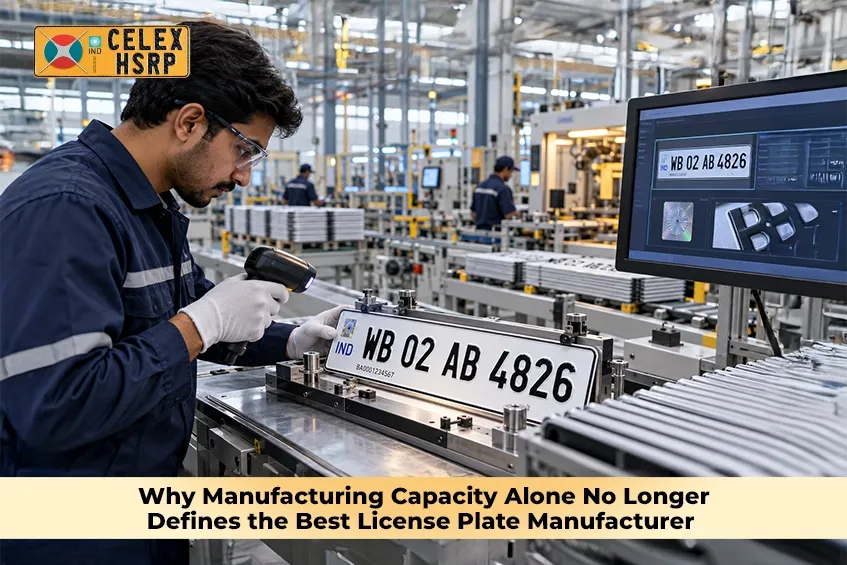
Every buyer loves a big number. A factory that claims it can stamp out lakhs of plates sounds unstoppable, and a procurement manager can finally relax. Then the delivery slips by two weeks. A batch fails inspection. A rush of orders lands, and the shiny capacity figure vanishes. That is the problem this blog tackles.
A license plate manufacturer with huge machines can still disappoint, because capacity on paper rarely matches output on the floor. The stakes feel higher in 2026. Lakhs of older vehicles in several states still need compliant plates, counterfeits keep surfacing, and dealers and fleets want predictable timelines.
This guide connects installed capacity, actual throughput, equipment utilisation, production bottlenecks, rejection rates, and delivery performance. You will learn to separate theoretical output from consistent commercial production. You will also see how machines, people, maintenance, and inspection must work together. Read on, and you will ask sharper questions before your next supply contract.
Installed Capacity Is a Brochure Number, not a Delivery Promise
Installed capacity describes the most a plant could produce if everything ran perfectly, all day, with zero stops. It comes from machine ratings, and equipment makers publish those ratings under ideal conditions. One European supplier, for example, rates its automated blank plate line at 80 plates per minute. That figure sounds thrilling. Yet a rating works like a speed limit on a test track. It does not describe an average Monday shift with a power dip, a material delay, and a tired press.
What Is the Difference Between Installed Capacity and Actual Throughput?
Installed capacity sets the ceiling. Actual throughput counts the good plates that leave the line in a given period. The gap between the two includes downtime, changeovers, tool wear, material shortages, and rework. Consider a simple illustration. A line rated for 10,000 plates a day that runs at 70% effectiveness delivers 7,000 good plates. A smaller plant rated for 8,000 that runs at 90% delivers 7,200. The smaller plant wins, and it also surprises its customers less often.
Buyers often compare ratings because ratings are easy to compare. Throughput data takes more effort to collect, yet it tells the truth. A serious government-approved HSRP manufacturer should share throughput trends over months, not just a headline number from a presentation slide.
Equipment Utilisation and the Hidden Math of OEE
Equipment utilisation shows how much of a machine's potential the plant actually uses. The cleanest way to measure it is overall equipment effectiveness, usually shortened to OEE. The formula multiplies three factors, which are availability, performance, and quality. Multiplication makes the score brutal. Three factors at 90% each produce an OEE of only 73%.
The benchmarks add useful context. A score of 85% or higher counts as world-class, while the typical manufacturer sits near 60%. One industry analysis suggests that only about 6% of manufacturing organisations reach the 85% mark. Those numbers show why a plant with big machines can still run poorly.
|
OEE Factor |
What It Measures |
Plate Plant Example |
|
Availability |
Planned time versus actual running time |
An embossing press stops for an unplanned repair |
|
Performance |
Actual speed versus rated speed |
Operators slow the press to avoid cracked characters |
|
Quality |
Good plates versus total plates |
Misaligned characters force a scrap pile |
Why does OEE matter more than machine count? Because it exposes hidden losses. Ten machines at 55% effectiveness produce less than seven machines at 80%. A manufacturer that tracks OEE shift by shift usually fixes problems faster, and that discipline shows up in delivery dates.
Production Bottlenecks Hide in the Boring Places
A production line moves at the speed of its slowest step. That rule holds for every factory, and it holds for plates too. A typical plate passes through blank preparation, retro reflective sheeting application, hologram hot stamping, embossing, laser coding, inspection, packing and dispatch. Add a fast-embossing press to a slow coding station, and the extra speed disappears into a queue.
Bottlenecks do not always live inside a machine. A shortage of reflective film or holograms can stall the entire plant. A slow data verification step can delay laser coding, because each plate must match its record. A single overloaded inspector can hold up a full shift of finished plates. Even a poorly planned truck schedule can turn a fast factory into a slow supplier.
Strong plants map their flow and measure each station. They look for work in progress piling up in front of one step, which signals a bottleneck. They then add buffer stock, cross-train staff, or upgrade the slow station. This approach beats buying more machines that simply feed the same choke point. Smart production planning also schedules maintenance and material arrivals, so the slowest step never starves.
Rejection Rates Quietly Eat Your Capacity
Every rejected plate wastes aluminium, reflective film, machine time and labour. High security features raise the cost of each scrap plate, because holograms and laser codes belong to one plate and one record. A plant that rejects 5% of 10,000 plates loses 500 plates, then spends extra hours on replacements. That hidden work steals capacity from fresh orders.
First pass yield tells you how many plates come out right the first time. A high yield means the process stays stable. A low yield means the plant runs the same plate twice and calls it volume. Rejection rates also reveal root causes. Misaligned embossing points to tooling wear. Poor film adhesion points to process control. Coding errors point to data handling.
Quality also protects the public. Reports from 2026 describe counterfeit plates that copy visible security features and some fitments that use ordinary screws instead of tamper-proof locks. A careless plant makes copying easier, because sloppy plates look less distinctive. Tight quality inspection keeps genuine plates genuine, and it keeps the manufacturer's name clean. Buyers should ask for rejection data, defect categories and corrective actions, not just a promise of good quality.
Delivery Performance Is the Real Scoreboard
Customers rarely ask how many plates a factory could make. They ask when their plates will arrive. Delivery performance answers that question through measures such as on time in full percentage, turnaround time and order cycle time. These numbers reflect everything upstream, from material supply to inspection to dispatch.
Demand also swings hard. A May 2026 report from one state said nearly half of eligible vehicles there still lacked HSRP, and another state set 30 June 2026 as the deadline for vehicles registered before April 2019, with enforcement drives planned from 1 July 2026. Deadlines like these create sudden surges. A plant with a stable process absorbs the surge. A plant that runs at its limit every day collapses under it.
What does a government-approved HSRP manufacturer actually guarantee? Approval confirms that the design and the manufacturing facility meet required standards. It does not promise on-time delivery in a busy month. That promise comes from planning, reserve capacity and disciplined operations. Smart buyers ask how the plant handled its last surge. They also ask what safety stock of films, holograms and blanks it keeps, because shortages cause more delays than machine failures.
Skilled Operators, Maintenance Schedules and Inspection Must Match the Machines
Machines create potential. People turn potential into plates. Skilled operators adjust press pressure, spot early signs of tool wear and catch alignment drift before it fills a pallet with scrap. A new machine in untrained hands produces expensive mistakes at impressive speed.
Maintenance matters just as much. Preventive maintenance follows a schedule, and it replaces worn parts before they fail. Reactive maintenance waits for a breakdown, which hits availability and delays orders. Calibration also counts. Laser coding and embossing equipment must hold tight tolerances, and drift can cause errors across thousands of plates.
Inspection completes the triangle. Good plants check quality at several points, not only at the end. In-process checks catch defects early, which saves material and time. Final checks confirm that each plate meets specification before dispatch.
A balanced plant keeps these elements in step.
- Machines that suit the volume and the product range.
- Operators who receive regular training and clear standard procedures.
- Maintenance plans that protect uptime through scheduled servicing.
- Inspection stages that stop defects before they travel downstream.
Remove any one element, and the capacity number stops meaning anything.
How to Separate Theoretical Output from Consistent Commercial Production
Smart buyers treat capacity claims as a starting point for questions. Celex Technologies Pvt Ltd offers a useful example. The company describes itself as a PAN India manufacturer of high-security registration plates, based in Kolkata and operating since 2003. A public business profile also lists its work across HSRP, embossing machines and software for the scheme. Those stated capabilities give buyers a starting point to discuss scalability and operational reliability. The real test follows. A buyer should ask for evidence behind any capability, which is a fair request for every supplier.
A practical checklist helps.
- Ask for OEE or utilisation trends over several months.
- Ask for rejection rates and the main defect causes.
- Ask for on-time, in-full delivery data for recent peak periods.
- Ask how the plant schedules preventive maintenance.
- Ask how many inspection points the process includes.
- Ask what reserve plan exists for demand surges and material shortages.
- Ask whether the plant keeps batch traceability for every plate.
Consistent commercial production leaves a paper trail. It shows steady numbers across ordinary weeks and busy weeks. Theoretical output leaves only a brochure.
Conclusion
Capacity still matters, but it no longer defines the best license plate manufacturer. A rated number describes a perfect day, and real plants rarely enjoy perfect days. Actual throughput, equipment utilisation, bottlenecks, rejection rates, and delivery performance describe the days that matter.
OEE links these ideas into one honest score, and the gap between an average 60% and a world class 85% shows how much capacity hides inside ordinary plants. Strong manufacturers balance four things. They pair machines with skilled operators, protect uptime through preventive maintenance, and catch defects through layered inspection.
They also plan for surges, because 2026 deadlines and enforcement drives create sudden demand. A government approved HSRP manufacturer earns trust by proving steady output, not by quoting a big figure. Buyers who ask for data, trends, and traceability will choose better partners. The best supplier is the one whose plates arrive on time, pass checks and protect vehicles, order after order.
Frequently Asked Questions
1. What is installed capacity in plate manufacturing?
Installed capacity is the maximum output a plant could produce if all machines ran perfectly without stops. It comes from machine ratings and ignores downtime, defects, shortages, and real-world delays.
2. Why does actual throughput matter more than capacity?
Actual throughput counts the good plates that really leave the factory. It reflects downtime, rejections, and bottlenecks, so it predicts delivery reliability far better than a theoretical capacity figure.
3. How does OEE help in choosing a license plate manufacturer?
OEE combines availability, performance, and quality into one score. A higher, steadier score shows disciplined operations, fewer losses, and a stronger chance of consistent output and on-time delivery.
4. Can a smaller plant outperform a larger one?
Yes. A smaller plant with better utilisation, lower rejection rates and tighter maintenance can deliver more good plates on time than a larger plant that loses output to breakdowns and rework.
5. What should buyers ask a supplier before ordering?
Ask for throughput trends, rejection rates, on-time delivery data, maintenance schedules, inspection stages, and surge plans. Clear evidence signals reliability, while vague answers signal risk.