Why LinkedIn Automation? A Guide to Smarter B2B Lead Generation
By Tara Rogers
2 Views
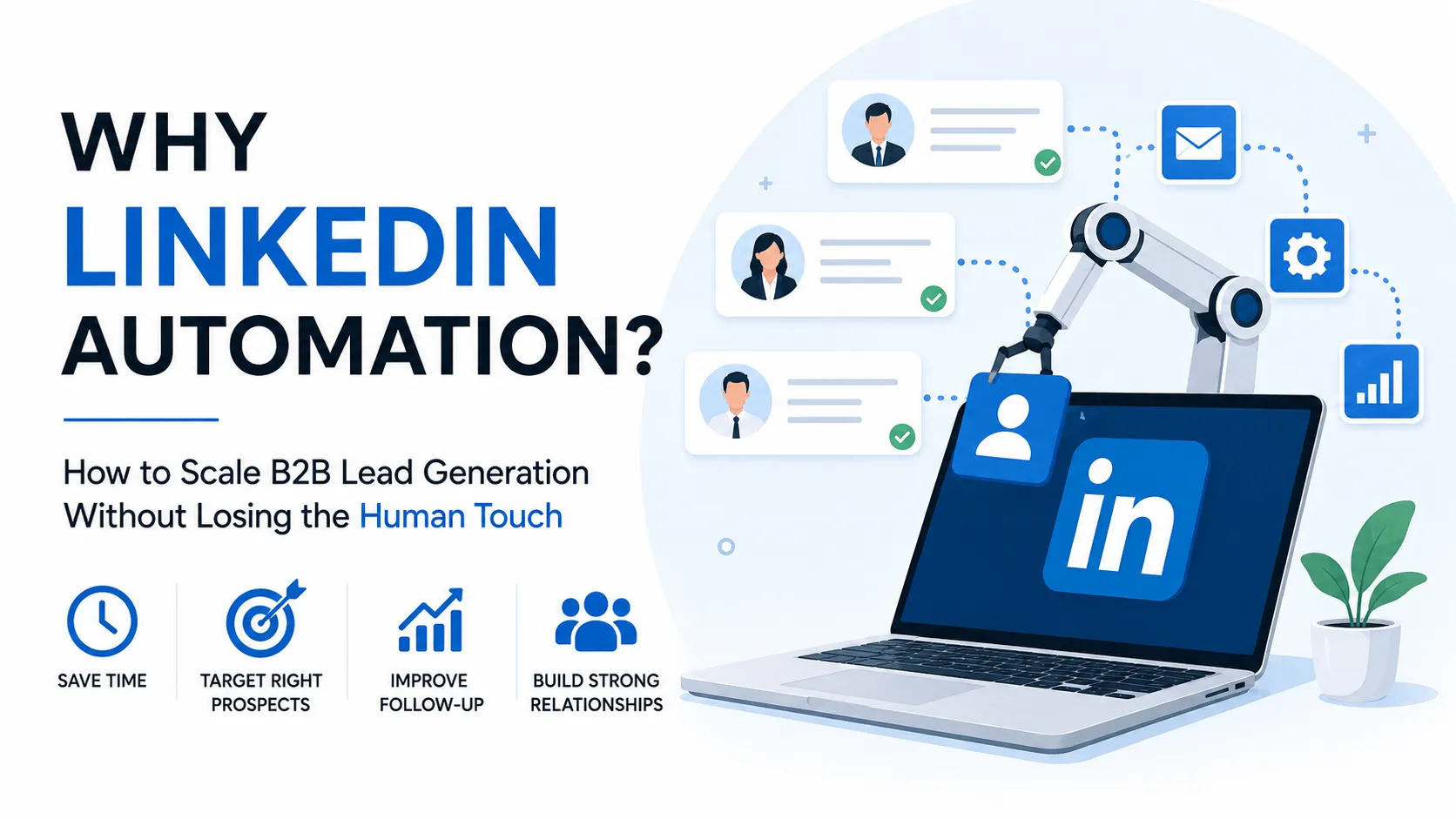
LinkedIn has become one of the most valuable platforms for B2B networking, prospecting, and relationship building. But there is one problem: doing everything manually takes a lot of time.
Finding the right prospects, researching their companies, tracking conversations, following up, publishing content, and keeping your pipeline organized can quickly become a full-time job.
That is where LinkedIn automation enters the conversation.
Used correctly, automation can help sales and marketing teams reduce repetitive work, organize their prospecting process, and spend more time having meaningful conversations with potential customers.
But there is an important distinction.
LinkedIn automation should not mean handing your account over to a bot and letting it send hundreds of generic messages. LinkedIn explicitly prohibits unauthorized tools that automate activity on its platform, including bots, browser extensions, scraping tools, and automated engagement.
The smarter approach is to automate the workflow around LinkedIn prospecting while keeping human judgment and genuine conversations at the center.
What Is LinkedIn Automation?
LinkedIn automation refers broadly to using technology to reduce repetitive tasks involved in LinkedIn prospecting, lead generation, social selling, and relationship management.
For example, a sales professional may use automation to organize prospects, manage follow-up reminders, enrich lead information through permitted tools, synchronize leads with a CRM, or trigger internal workflows when a prospect takes an action.
The goal isn't simply to send more connection requests.
The real goal is to create a more consistent prospecting process.
Think about the difference between these two approaches:
Manual prospecting:
Find prospect → research company → write message → send → remember to follow up → update CRM → repeat.
Organized prospecting workflow:
Identify ICP → build prospect list → research prospects → prioritize leads → personalize outreach → track responses → follow up → update CRM → measure results.
The second process gives salespeople more time to do what humans are actually good at: building relationships.
Why Is LinkedIn So Important for B2B Lead Generation?
LinkedIn is different from most social networks because professional identity is central to the platform.
People typically display their job title, company, industry, professional experience, skills, and other information that can help sales teams understand whether someone is a potential customer.
That makes LinkedIn particularly useful for account-based prospecting and social selling.
LinkedIn's own sales research emphasizes four core activities behind effective social selling:
- Establish a professional brand
- Find the right people
- Engage with insights
- Build strong relationships
This is an important distinction.
Successful LinkedIn prospecting isn't about collecting thousands of connections. It is about finding the right people and developing relationships with them.
LinkedIn's current guidance on social selling also emphasizes relevance, personalization, credibility, and building relationships instead of treating every prospect as a transaction.
7 Reasons Businesses Consider LinkedIn Automation
1. It Saves Time on Repetitive Work
Salespeople spend considerable time on activities that don't directly generate revenue.
Searching for prospects, organizing lead information, updating spreadsheets, checking follow-up dates, and moving information between systems can consume hours every week.
Automation can reduce some of this administrative workload.
Instead of spending the entire day managing a prospecting spreadsheet, a salesperson can spend more time researching high-value accounts and speaking with qualified prospects.
The objective isn't to eliminate human work. It's to eliminate unnecessary repetitive work.
2. It Makes Prospecting More Consistent
One of the biggest problems with manual prospecting is inconsistency.
A salesperson may spend two hours prospecting on Monday, forget about it on Tuesday, become busy with meetings on Wednesday, and finally return to LinkedIn on Friday.
That creates an unpredictable pipeline.
A structured workflow makes prospecting more systematic.
You can define:
- Who qualifies as a prospect
- Which industries you target
- Which job titles matter
- How prospects are prioritized
- When follow-ups should happen
- Which prospects need additional research
- When a lead should be moved into the CRM
Consistency is especially important for small sales teams that don't have dedicated SDR departments.
3. It Helps Salespeople Focus on the Right Prospects
More leads don't automatically mean more sales.
If your team spends time contacting people who have no connection to your product, your response rates will suffer and your salespeople will waste valuable time.
A better approach is to define an ideal customer profile (ICP).
For example, a B2B software company might target:
- Companies with 50–500 employees
- SaaS businesses
- Sales and marketing teams
- VP-level and director-level decision-makers
- Companies expanding their sales teams
Once the criteria are defined, technology can help organize and prioritize prospects.
The human then decides whether the prospect is actually worth contacting.
That combination is much more powerful than blindly automating outreach.
4. It Improves Follow-Up
Here's a simple truth about B2B sales:
One message is rarely enough.
A prospect might see your message while traveling. Another might be busy preparing for a meeting. Someone else may be interested but simply forget to respond.
Without a follow-up system, good opportunities can disappear.
Automation can help teams remember when to follow up and keep prospects from falling through the cracks.
However, follow-ups should not become repetitive spam.
Instead of sending:
“Just following up…”
three times, use the additional time to provide something useful.
For example:
- Share a relevant case study
- Send a useful resource
- Answer a question
- Mention a relevant industry development
- Offer a specific insight
- Ask whether the problem is still a priority
The technology can remind you to follow up.
The message still needs a human reason for being sent.
5. It Makes Lead Management Easier
LinkedIn prospecting becomes difficult to manage when information is scattered across spreadsheets, notes, inboxes, and different tools.
A well-designed workflow can connect prospecting activity with your CRM and sales process where supported.
For example:
LinkedIn research → Lead qualification → CRM → Personalized outreach → Follow-up → Sales conversation → Opportunity
This gives sales teams a clearer view of where each prospect stands.
It also makes it easier to measure which activities actually produce opportunities.
6. It Can Help Scale a Proven Process
Imagine that a salesperson has developed a prospecting process that consistently generates qualified conversations.
The next challenge is scale.
Instead of immediately increasing outreach volume, the smarter strategy is to identify which parts of the process are repetitive and can be systematized.
For example:
Manual: Research every company from scratch.
Better: Establish clear ICP criteria and use permitted research tools to narrow the list.
Manual: Keep follow-up dates in your head.
Better: Use CRM reminders and workflow automation.
Manual: Copy lead information between systems.
Better: Connect systems where supported.
Manual: Send the exact same message to everyone.
Better: Create messaging frameworks while personalizing the important details.
Automation becomes useful when it supports a repeatable sales process that already works.
7. It Gives Sales Teams More Time for Actual Selling
This may be the biggest reason to consider automation.
Salespeople shouldn't spend most of their day performing administrative tasks.
Their highest-value activities are often:
- Understanding customer problems
- Speaking with qualified prospects
- Running demos
- Building relationships
- Handling objections
- Negotiating
- Closing deals
Automation can take some of the repetitive work out of the process so people can concentrate on those activities.
A Simple LinkedIn Lead Generation Workflow
Here is a practical framework businesses can use:
Step 1: Define Your ICP
Start with the basics:
Industry + company size + location + job title + business problem
The more specific your ICP, the easier it becomes to identify relevant prospects.
Step 2: Build a Target Account List
Don't start by collecting thousands of random profiles.
Create a focused list of companies that have a realistic reason to buy your product or service.
Step 3: Identify Decision-Makers
Depending on your offer, this could include:
- Founder
- CEO
- VP of Sales
- Head of Marketing
- Marketing Director
- Sales Director
- Revenue Operations Manager
- HR Director
- IT Director
The right contact depends entirely on the product and buying process.
Step 4: Research Before Outreach
Look for useful context.
Has the company recently expanded?
Are they hiring?
Did they launch a new product?
Did the prospect publish something relevant?
Did the company enter a new market?
These details can turn a generic pitch into a meaningful conversation.
Step 5: Personalize the Outreach
Don't write an essay.
A good first message can be short and relevant.
For example:
“I noticed your team is expanding its outbound sales operation. We've been working on a similar challenge with B2B teams and found a few interesting ways to improve prospecting efficiency.”
The purpose of the first message isn't necessarily to close the deal.
It's to start a conversation.
Step 6: Follow Up With Value
If the prospect doesn't respond, don't automatically send the same pitch again.
Give them a reason to engage.
Share an insight, resource, observation, or useful question.
Step 7: Measure the Process
Track metrics such as:
- Connection acceptance rate
- Response rate
- Positive response rate
- Meetings booked
- Qualified opportunities
- Conversion rate
- Revenue generated
Don't judge your LinkedIn strategy only by the number of connections you acquire.
Is LinkedIn Automation Worth It?
For many B2B companies, the answer can be yes—but only when automation solves a real process problem.
If you don't have a defined target audience, compelling offer, good profile, relevant messaging, and a follow-up strategy, automation won't fix those problems.
It will simply allow you to do the wrong things faster.
But if you already have a proven prospecting process, automation and workflow tools can help you organize it, reduce repetitive administrative work, and create a more consistent sales operation.
The formula is simple:
Good targeting + relevant messaging + human conversations + smart workflows = better LinkedIn prospecting
Not:
Automation + volume = more sales
Final Thoughts
LinkedIn remains a powerful environment for B2B networking and social selling because professionals can research companies, identify decision-makers, establish credibility, and build relationships in one place.
But successful LinkedIn prospecting isn't about sending the maximum number of messages.
It's about reaching the right person with the right reason at the right time.
Automation can help with the repetitive parts of that process. It can organize leads, improve follow-up, reduce administrative work, and make a proven workflow easier to manage.