Why Is a Lubrication System Important for Industrial Machines?
By Technodrop
86 Views
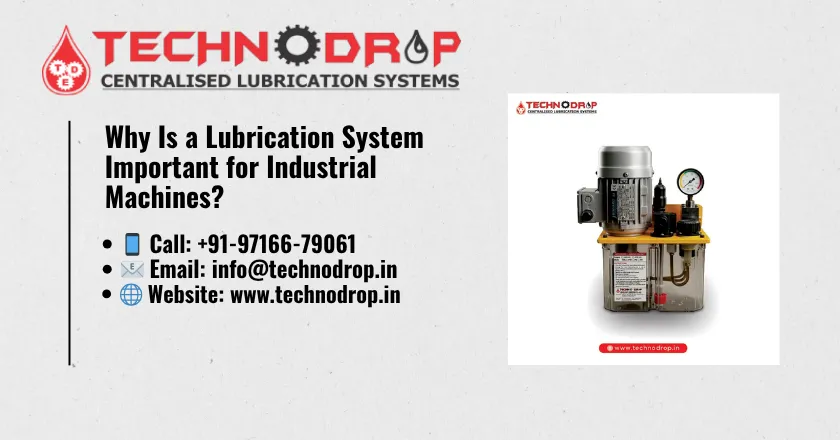
Why Is a Lubrication System Important for Industrial Machines?
I’ve seen perfectly good machines fail early — not because the machine was cheap, not because the operator was careless, but because lubrication was treated like a small maintenance task.
It isn’t small.
A Lubrication System is one of those things business owners don’t think about until bearings start heating, chains begin wearing out, or production stops in the middle of a shift. And honestly? By that time, the damage has usually already started. For industrial machines, proper lubrication isn’t just about oil or grease. It’s about control, timing, pressure, flow, and consistency.
That’s where most businesses get it wrong.
A Lubrication System keeps machines working, not just moving
Look, every machine has friction. Gearboxes, bearings, slides, chains, spindles, bushes — they all deal with metal-to-metal contact in some form. Without the right lubrication, heat builds up, wear increases, and performance drops slowly at first… then suddenly.
And sudden breakdowns are expensive.
A good Lubrication System delivers the right lubricant to the right point at the right interval. That sounds simple, but in actual plant conditions — dust, vibration, high temperature, long running hours — manual greasing doesn’t always hold up. Operators miss points. Too much grease gets applied. Sometimes too little. Sometimes the wrong grade is used.
I’ve seen it happen.
With centralized or automatic lubrication, machines get more consistent protection. That means smoother operation, lower wear, and fewer ugly surprises during production.
The real cost isn’t grease. It’s downtime.
Here’s the thing: business owners often look at lubrication as a maintenance expense. But downtime? That’s the real bill.
One stopped conveyor can delay an entire packaging line. One seized bearing can affect dispatch schedules. One overloaded gearbox can pull your maintenance team away from five other jobs. And if you’re running CNC machines, printing lines, rolling mills, presses, food processing equipment, or packaging machinery, even a few hours of unplanned stoppage can hurt badly.
A Lubrication System helps reduce that risk.
Not eliminate it completely — let’s be honest, no system can promise that. But it reduces avoidable failures caused by poor lubrication habits. And in industrial maintenance, avoidable failure is the first thing you should attack.
Why manual lubrication often becomes a weak link
Manual lubrication works in small setups. No argument there.
But once machines increase, shifts become longer, and production pressure goes up, manual greasing becomes unreliable. Not because people don’t care. Because plants are busy. Maintenance teams are stretched. Operators are focused on output.
So what happens?
Some lubrication points get missed. Some get over-lubricated. Some are greased while the machine is stopped, even though the part actually needs lubrication during motion. That’s not a small detail — it changes how well the lubricant spreads.
This is where experienced Lubrication System Manufacturers usually recommend centralized, progressive, dual-line, or automatic systems based on machine type, load, and operating environment.
Not every machine needs the same setup.
A better system also protects your people
This part gets ignored, but it matters.
In many factories, lubrication points are located near moving parts, hot areas, or awkward machine sections. If workers have to climb, bend, reach, or go close to rotating parts just to grease a point, that’s a safety concern.
An automatic or centralized Lubrication System can reduce manual intervention. The lubricant reaches critical points through pumps, metering valves, distributors, and pipelines. Your team doesn’t need to access every point manually again and again.
Cleaner process. Safer process.
And honestly, that’s how modern industrial maintenance should be.
Choosing the right suppliers matters more than people think
A lubrication setup is not just “pump laga do aur pipe connect kar do.” It needs proper calculation.
Flow rate matters. Grease grade matters. Line length matters. Back pressure matters. Temperature matters. The number of lubrication points matters. Even the machine duty cycle matters.
That’s why choosing experienced Lubrication System Suppliers is important. Good suppliers don’t just sell parts; they study the application. They ask what machine you’re running, how many hours it works, what lubricant is used, and where the failure risk is highest.
For Indian industries, working with reliable Lubrication System Suppliers in India also makes service easier. Faster support, spare availability, installation help, and practical site understanding — these things count when production is on the line.
Price matters, yes.
But wrong selection costs more.
Where Techno Drop fits in
Techno Drop works with industrial lubrication products designed for real plant conditions, not showroom theory. For business owners, the goal is simple: protect machines, reduce maintenance stress, and keep production running with fewer interruptions.
And no, a Lubrication System won’t fix every machine problem. It won’t compensate for poor alignment, overloaded machines, or bad-quality lubricants. But if your equipment is already running hard every day, proper lubrication is one of the smartest protection layers you can add.
Simple as that.
FAQs About Lubrication System
What is the main purpose of a Lubrication System?
The main purpose is to reduce friction, heat, and wear between moving machine parts. It also helps improve machine life, reduce breakdowns, and maintain smoother operation during continuous industrial use.
Is an automatic lubrication system better than manual greasing?
For large or continuously running machines, yes, it’s usually better. Manual greasing depends heavily on timing and human consistency. Automatic systems deliver lubricant in controlled quantities, which makes the process more reliable.
Which industries use lubrication systems?
Industries like steel, cement, packaging, food processing, paper, printing, mining, automotive, plastic processing, and machine tools use lubrication systems. Basically, wherever machines run under load, lubrication becomes important.
How do I choose the right Lubrication System Dealers?
Choose Lubrication System Dealers who understand industrial applications, not just product selling. They should guide you on pump type, lubricant grade, distribution system, installation, and after-sales support. Reliable Lubrication System Dealers in India can also help with faster servicing and spare parts.
Final Word
If your machines are important to your production, then the Lubrication System protecting them shouldn’t be an afterthought. I’ll put it plainly: businesses that take lubrication seriously usually spend less time firefighting breakdowns. The ones that ignore it? They eventually pay — through downtime, repair bills, and lost production.
Related Reading
Top 10 Hidden Secrets About Business & Finance You Need to Know
Welcome to our in-depth exploration of Business & Finance. In an era defined...
Why Business & Finance is Transforming the Global Industry Landscape
Welcome to our in-depth exploration of Business & Finance. In an era defined...