Why Football Predictions Should Measure Process, Not Just Results
By Best Previews
5 Views
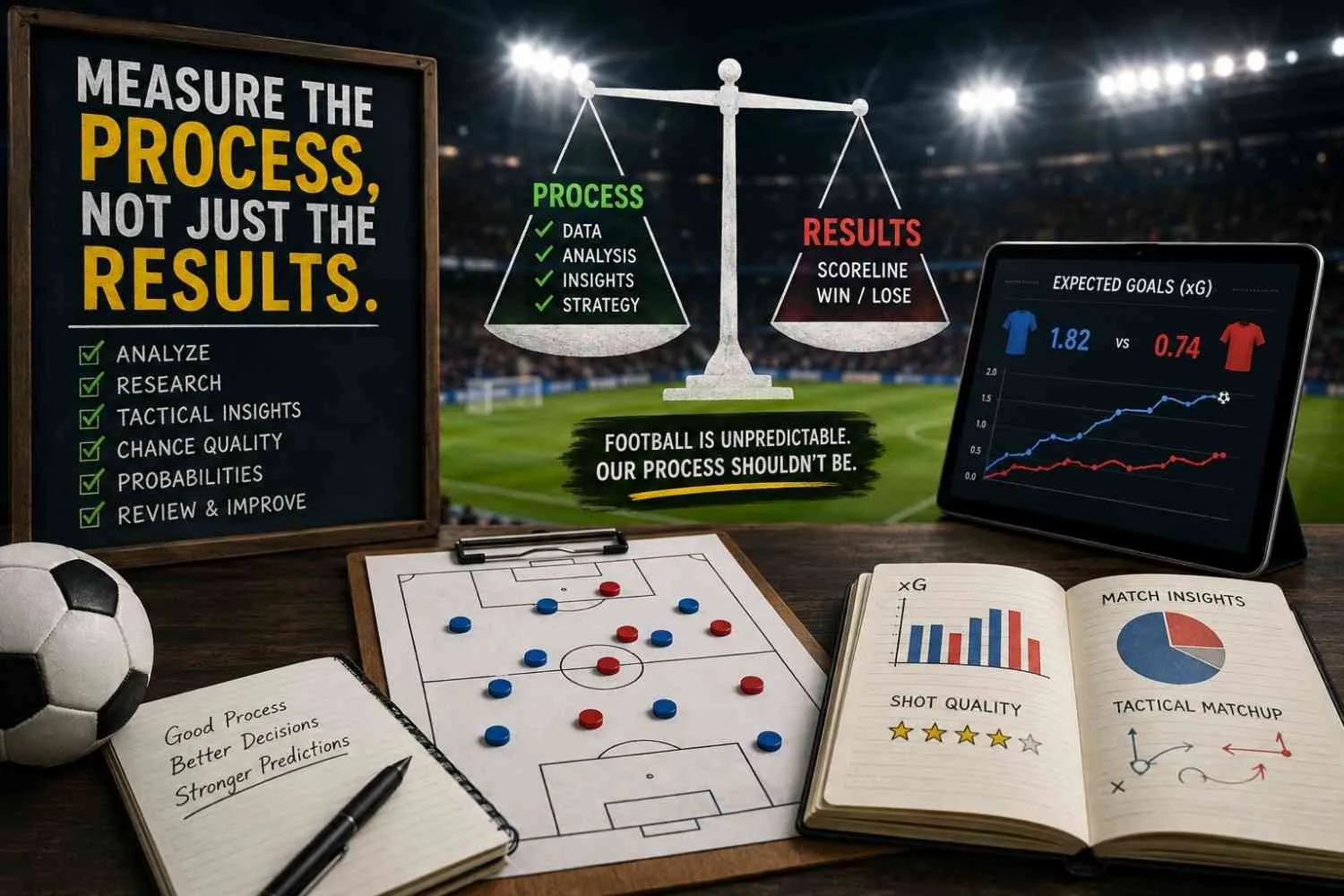
Football has a funny habit of making sensible people look foolish. A team can dominate for 90 minutes, create better chances, hit the post twice, and still lose 1-0 to a deflected shot in the 87th minute. Suddenly, the prediction looks terrible — even though the reasoning behind it was perfectly sound.This is why football predictions should not be judged only by whether the final result was correct. The process behind the prediction matters just as much. Good analysis considers evidence, probabilities, tactics, team news, form, and chance quality before reaching a conclusion.
At Best Previews, the objective is not simply to guess what happens. It is to understand why a particular outcome looks more likely than another.
Results Can Be Misleading
A correct prediction does not automatically mean good analysis.
Imagine predicting a 2-1 home victory because the home team has better attacking numbers, stronger recent performances, and a favourable tactical matchup. The match finishes 2-1 — excellent. But what if the winning goal came from a goalkeeper mistake and the rest of the match suggested a completely different story?
Now consider the opposite. A team dominates the match, creates several high-quality opportunities, but loses because of one counterattack. The prediction was wrong, but the underlying analysis may have been very good.
This is where match Insights become valuable. The final score tells us the outcome. Deeper analysis helps explain the performance behind it.
What Does Measuring the Process Mean?
Process-based evaluation means looking at how a prediction was created rather than judging it entirely through hindsight.
A strong process can include:
- Recent team performance
- Tactical strengths and weaknesses
- Expected goals and chance creation
- Player availability
- Home and away records
- Defensive and attacking trends
- Head-to-head context
- Game-state tendencies
- Probability and uncertainty
None of these guarantees the correct result. Football is not a spreadsheet wearing boots. However, combining relevant evidence creates a more reliable foundation for making predictions.
The key question becomes simple: Was the prediction reasonable based on the information available before kick-off?
Why Chance Quality Matters
Goals are important, obviously — football would become a rather confusing sport without them. But goals alone do not always describe how a match was played.
A team may score from its only shot while conceding ten attempts. Another side may create several clear opportunities but fail to finish. Looking only at the scoreline can hide these differences.
Expected goals (xG), shot locations, big chances, and attacking sequences can provide additional context. They help analysts understand whether a team regularly creates dangerous opportunities or simply benefited from an unusual moment.
This makes chance quality an important part of evaluating prediction accuracy. If the predicted winner consistently creates better chances, even when individual results fluctuate, there may be genuine strength in the underlying process.
Separating Skill From Luck
Football contains plenty of randomness. Deflections, penalties, red cards, injuries, missed chances, and individual errors can all change a match within seconds.
That means one prediction should never become the entire verdict on an analytical method.
A good prediction framework needs to be evaluated across a larger sample. Over time, patterns become easier to identify. We can see whether certain statistics consistently improve predictions, whether tactical assessments are reliable, and whether probability estimates are properly calibrated.
This is also where humility becomes useful. Football analysts occasionally get things wrong — sometimes spectacularly. The trick is learning why rather than simply pretending the prediction never existed.
A Better Way to Review Predictions
A practical review process can include six questions:
1. Was the reasoning logical?
Check whether the prediction followed naturally from the available evidence.
2. Was the evidence reliable?
Look at whether recent performances, statistics, squad information, and other relevant data were considered.
3. Was the tactical matchup understood?
A strong team on paper does not automatically have the advantage if its style creates problems against the opponent.
4. Were probabilities realistic?
Predictions should recognise uncertainty. Saying a team has a 60% chance is very different from claiming it is guaranteed to win.
5. Did the match develop as expected?
Even when the result is different, the tactical and statistical flow of the match can reveal whether the original assumptions were reasonable.
6. What can be improved?
The purpose of reviewing predictions is not to assign blame. It is to identify weaknesses and improve the next analysis.
This approach turns football prediction tips into a continuous learning process rather than a collection of isolated guesses.
Learning From Incorrect Predictions
A missed prediction can be extremely useful.
Suppose a team was expected to control possession but struggled against an aggressive press. That could reveal a tactical weakness that future analysis should consider. Alternatively, an unexpected injury shortly before kick-off may have changed the match completely.
The important thing is avoiding hindsight bias.
Once the final whistle has gone, everything looks obvious. Before kick-off, it rarely is. That distinction matters.
A prediction should therefore be assessed according to the information available when it was made — not according to what became obvious 90 minutes later.
How Best Previews Can Focus on Process
Best Previews takes a broader approach by combining tactical thinking with statistical evidence and match context.
The value of a preview is not simply producing a winner. It is explaining the factors that could influence the game — from team form and player availability to tactical battles and attacking efficiency.
This makes the analysis more useful even when football decides to ignore everyone's carefully prepared expectations.
A strong preview should give readers a clear understanding of the match rather than presenting a conclusion without explanation.
Why Long-Term Evaluation Matters
The real test of any prediction process is consistency.
One correct prediction proves very little. One incorrect prediction proves even less. A larger sample provides a much better opportunity to understand whether an analytical approach is genuinely useful.
Tracking predictions over time can reveal:
- Which statistics provide the strongest signals
- Which types of matches are harder to predict
- Whether probabilities are being estimated accurately
- Which tactical assumptions frequently fail
- Where analysis can be improved
This creates a feedback loop. Predict, review, learn, adjust, and repeat.
That may sound less glamorous than celebrating a perfect score prediction — but it is considerably more useful.
Conclusion
The scoreboard tells us what happened. It does not always tell us whether the prediction process was good.
A sensible evaluation should consider the evidence available before kick-off, the quality of the reasoning, the tactical assumptions, the probability assigned to each outcome, and what the match itself revealed.
Sometimes football will destroy an excellent prediction with a deflection in stoppage time — because apparently 90 minutes of analysis is no match for one unfortunate bounce.
That is precisely why the process matters.
The best analysts are not those who magically predict every result. They are the ones who build a repeatable method, learn from mistakes, recognise uncertainty, and continually improve how they read the game.
FAQs
What does it mean to measure the process of a football prediction?
It means evaluating the reasoning, evidence, statistics, tactical analysis, probabilities, and assumptions used to make the prediction — rather than judging it only by the final result.
Can a wrong prediction still be a good prediction?
Yes. A prediction can be well-reasoned and statistically supported but still lose because football contains uncertainty and random events.
Why is chance quality important in football analysis?
Chance quality helps explain how dangerous a team's attacking opportunities were. It can provide more context than simply looking at the number of goals scored.
How can we improve football prediction accuracy?
Use reliable statistics, analyse tactical matchups, monitor team news, evaluate chance quality, consider probabilities, and review previous predictions over a larger sample.
Should one match determine whether a prediction method works?
No. Individual matches contain too much randomness. Long-term performance provides a much stronger basis for evaluating a prediction process.