Why Choose Professional PU Grouting Services?
By Gubbi Civil
81 Views
Retrofitting services have become an important part of maintaining aging buildings, industrial facilities, basements, tunnels, water retaining structures, and other concrete assets. When cracks, seepage, voids, or deterioration begin affecting a structure, repair decisions should address the underlying pathway rather than only the visible surface. PU grouting and PU injection grouting are useful techniques when water movement through cracks and joints makes conventional surface treatment insufficient.
What Is PU Grouting?
Polyurethane grouting is commonly selected for active water leakage because the injected resin can react with moisture and expand within cracks, joints, and voids. This makes it suitable for locations where water pressure continues to challenge the repair area. The technique can be used as part of broader concrete repair, waterproofing, rehabilitation, or retrofitting work, depending on the structural condition and the source of deterioration.
The main purpose of PU injection grouting is not simply to cover a crack. It is to introduce a suitable polyurethane material into the internal leakage path so that the opening can be sealed from within. This distinction is important for basements, underground structures, retaining walls, lift pits, tanks, and similar areas where water may travel behind concrete surfaces before appearing at a visible leakage point.
Why Is PU Injection Grouting Used?
Before choosing any injection grouting method, engineers should understand whether the crack is active or dormant, whether water is present, and whether the issue is structural, waterproofing-related, or both. Crack width, depth, movement, surrounding concrete quality, hydrostatic pressure, and access conditions can influence the treatment. A site assessment helps determine the most appropriate treatment accurately for the observed defect and site conditions before execution begins.
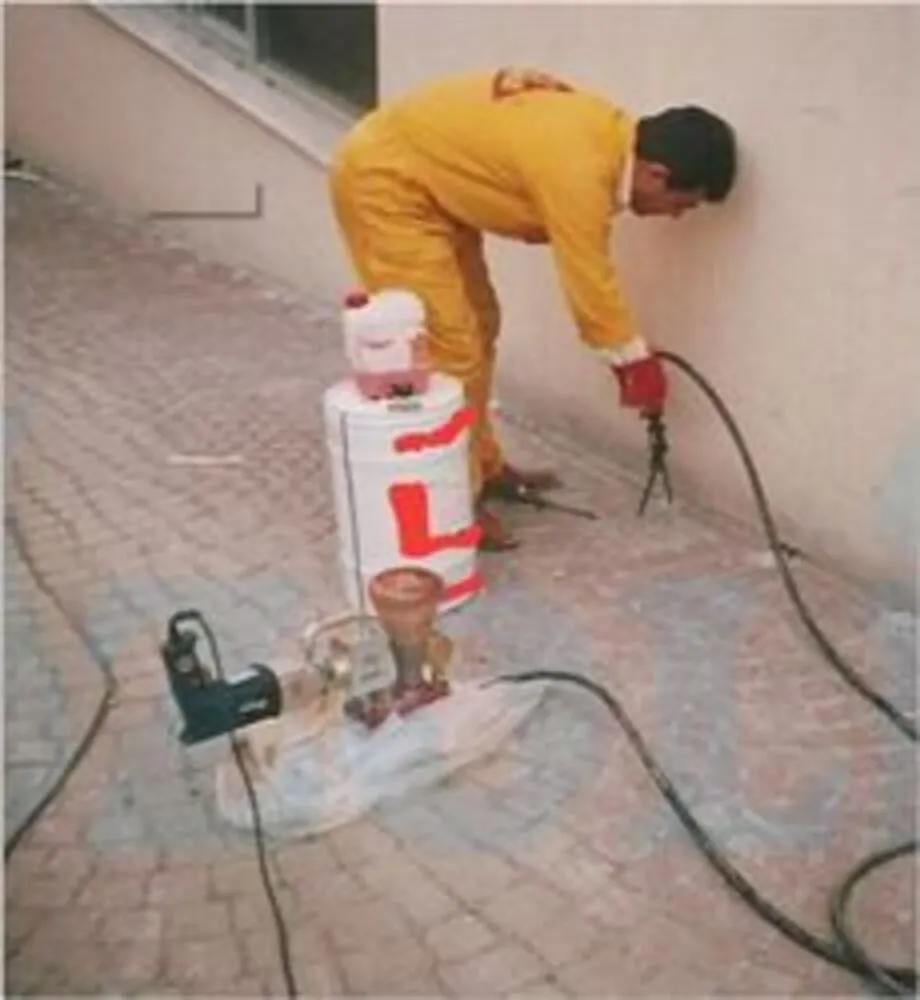
PU grouting can be particularly useful for active leakage control where water is entering through construction joints, cracks, honeycombed concrete, pipe penetrations, or other discontinuities. The resin is injected through mechanical packers positioned along the suspected leakage route. Under controlled pressure, the material travels through connected openings and reacts according to its formulation, helping reduce water flow and seal concealed pathways within the concrete.
One reason polyurethane is used for injection work is its ability to accommodate certain minor movements after curing. Depending on the selected formulation, the material may form a flexible or foam-like mass that remains effective around irregular internal paths. This property can be valuable in locations exposed to moisture and movement, although the material must always be selected according to the actual crack condition, pressure, and project requirements before execution.
PU Injection Grouting Process
A professional PU injection grouting process begins with inspection and diagnosis rather than immediate drilling. The repair team identifies visible cracks, damp areas, leakage intensity, joints, previous repair materials, and possible water sources. The surface is then prepared so injection points can be accurately located. Proper diagnosis matters because sealing one visible point without understanding the complete water pathway may only redirect leakage elsewhere.
During execution, injection packers are installed at calculated intervals along the crack or joint. The spacing and drilling angle depend on concrete thickness, crack geometry, accessibility, and the expected internal path. The selected polyurethane material is then injected using suitable equipment and controlled pressure. Experienced technicians monitor material movement, leakage response, and pressure changes throughout the operation to avoid unnecessary pressure or uncontrolled material consumption.
The injection sequence is also important. Depending on site conditions, technicians may begin from lower points and progress toward higher points, or follow another sequence based on water movement and crack geometry. The objective is to achieve consistent filling of the connected pathway rather than forcing material randomly into the concrete. After injection, packers are removed or treated as specified, and the surface is repaired and finished.
Benefits of PU Grouting for Concrete Repair
For building owners, the biggest advantage of PU grouting is often the ability to treat leakage without extensive demolition. Instead of removing large areas of concrete or finishes, targeted injection can address concealed cracks and voids through relatively small drilled points. This can reduce disruption to occupied buildings and operating facilities. However, injection should be considered a technically planned repair, not a universal substitute for correcting drainage or structural defects.
PU injection grouting is frequently considered for basements where groundwater pressure causes persistent seepage through walls and floor joints. It may also be used around lift pits, underground tanks, retaining walls, podium structures, and other below-ground elements. In each application, the repair strategy should consider water pressure, concrete condition, joint detailing, drainage provisions, and the possibility of movement before finalizing the injection methodology.
Applications in Industrial and Commercial Structures
Industrial facilities can present more demanding conditions because repairs may need to be completed while production continues. Leakage near equipment foundations, pits, tanks, trenches, retaining structures, or concrete walls can create operational and durability concerns. Injection grouting contractors should therefore coordinate access, isolation, safety, curing requirements, and work sequencing with the facility team. A properly planned intervention can help reduce downtime while addressing the identified leakage path.
Retrofitting services often involve more than strengthening an existing member. A building may require simultaneous attention to cracks, corrosion, water ingress, deteriorated concrete, construction joints, and local voids. PU grouting can form one component of a wider rehabilitation strategy when moisture is contributing to deterioration. Other measures, such as concrete repair, protective coatings, jacketing, or fibre reinforcement, may be considered after engineering evaluation.
PU Grouting vs Epoxy Injection Grouting
Choosing between PU injection grouting and epoxy injection grouting depends strongly on the purpose of the repair. Epoxy injection is generally associated with bonding and restoring continuity across suitable cracks, while polyurethane injection is widely used for sealing active water pathways. The decision should therefore be based on crack behavior, moisture conditions, structural requirements, and the desired performance rather than selecting a material simply because it is commonly advertised.
The quality of injection grouting depends heavily on workmanship and equipment. Incorrect packer placement, excessive pressure, inadequate cleaning, poor material proportioning, or incomplete crack identification can compromise the outcome. Reliable injection grouting contractors should have trained personnel who understand the material manufacturer's requirements and can adjust the process to actual site conditions. Documentation of injection points, material usage, pressures, observations, and final treatment can also support quality control.
When PU Injection May Not Be Enough
A common mistake is treating every concrete crack as a waterproofing problem. Some cracks may indicate structural distress, settlement, thermal movement, corrosion, overload, or inadequate detailing. PU injection can control water through an appropriate pathway, but it does not automatically restore the load-carrying capacity of a damaged structural member. When structural concerns are suspected, the repair should be integrated with engineering assessment and suitable structural strengthening measures.
Another important consideration is the source of water. Injection can seal an internal pathway, but persistent groundwater pressure, failed drainage, defective waterproofing, or poorly detailed joints may continue to expose the structure to moisture. A durable repair therefore considers both the immediate leakage path and the surrounding water management system. This broader approach helps reduce repeated repairs and supports the long-term performance of the treated structure.
How to Choose Injection Grouting Contractors
For clients comparing injection grouting contractors, technical capability should be more important than price alone. Ask whether the contractor performs a site inspection, identifies the likely leakage mechanism, recommends the appropriate resin, explains the injection sequence, and provides a defined repair scope. Experience with structural repair and rehabilitation is especially useful when grouting forms only one part of a larger retrofit or concrete restoration project.
Gubbi Civil Engineers Limited can be considered when a project requires coordinated structural repair, rehabilitation, waterproofing, and grouting expertise rather than an isolated treatment. The company states that its grouting capabilities include PU grouting, epoxy injection grouting, micro-fine cement grouting, and cement grouting, supported by engineering assessment and site execution. This integrated approach can help clients match the repair method with actual site conditions and performance requirements.
Project Workflow for PU Injection Grouting
A practical project workflow normally starts with a site inspection, followed by documentation of cracks, leakage points, concrete condition, and relevant structural details. The team then identifies the probable water path and selects the material and injection method. During execution, packers are installed, injection is carried out under controlled conditions, and the treated area is monitored. Final surface restoration and inspection complete the repair process.
Maintenance teams should also monitor repaired areas after completion. Changes in leakage, new cracking, dampness, staining, or movement can provide useful information about the structure's ongoing behavior. A repair should not be considered successful only because visible water stops immediately after injection. Periodic inspection helps determine whether the original source has been controlled and whether additional waterproofing, drainage, crack repair, or structural intervention is required.
Understanding PU Grouting Cost
The cost of PU grouting varies from project to project because material consumption, access, leakage intensity, concrete thickness, injection point density, working conditions, and repair extent can differ significantly. Instead of relying on a generic per-square-foot or per-point estimate, clients should request a site-specific scope and quotation. A technically appropriate repair may also prevent more extensive concrete deterioration and operational disruption later.
For older structures, PU injection grouting can be part of a planned durability improvement strategy rather than an emergency-only repair. Early attention to active leakage can help limit prolonged moisture exposure, which may contribute to concrete deterioration and reinforcement corrosion. When combined with appropriate inspection, concrete rehabilitation, protective measures, and structural strengthening where necessary, targeted grouting can support the continued serviceability of aging assets.
Ultimately, successful grouting depends on matching the right material and method to the actual defect. PU grouting is valuable for many active leakage conditions, but effective results require accurate diagnosis, suitable equipment, controlled injection, competent workmanship, and follow-up inspection. For owners seeking reliable retrofitting services, the best approach is to treat leakage as part of the structure's overall condition and select an experienced technical team accordingly.