Why AI System Design Mock Interviews Are Becoming Popular?
By NostrobeAI
4 Views
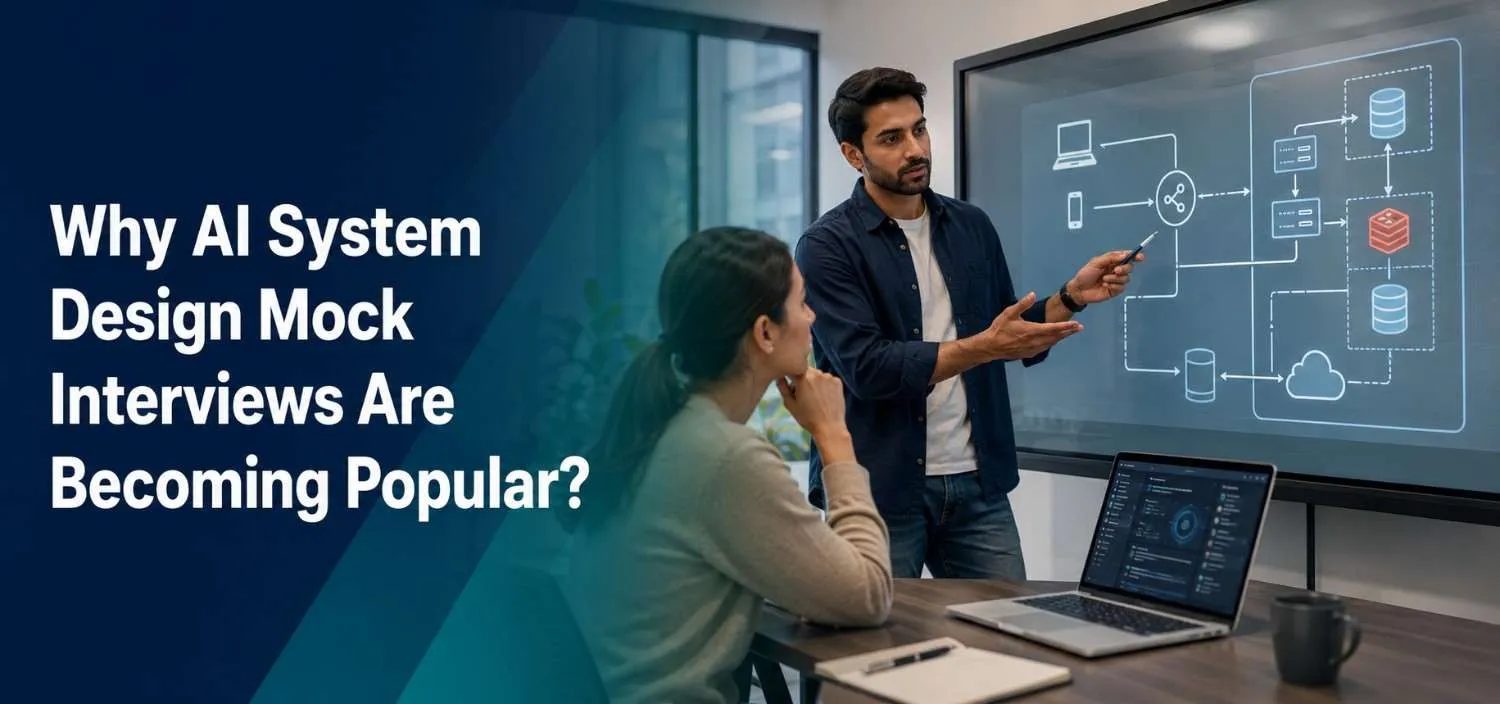
System design interviews demand technical depth, structured reasoning, and clear communication. Candidates must translate broad requirements into scalable architectures while discussing tradeoffs, risks, capacity, data flow, and reliability. Traditional preparation methods often provide concepts without recreating the pressure of an interactive interview. AI system design mock interviews close that gap through responsive questioning, personalized scenarios, and immediate feedback. 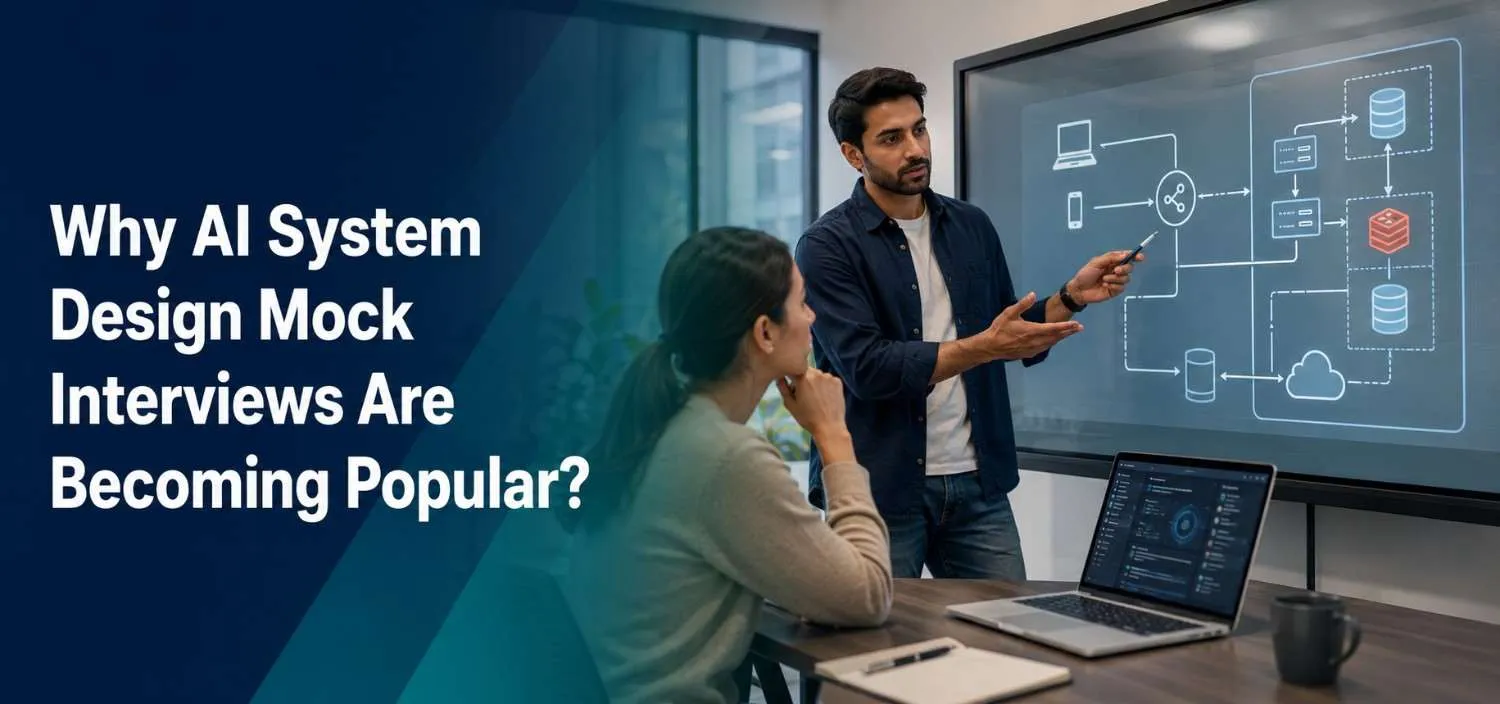
Consequently, engineers can practice complex decisions repeatedly without coordinating with another person. Growing competition for technical roles, greater access to advanced simulation tools, and rising expectations for architectural knowledge have made AI-supported practice increasingly attractive across engineering career levels.
System Design Interviews Present a Unique Challenge
Coding exercises usually ask candidates to solve a defined problem. In contrast, system design questions begin with broad prompts such as designing a payment platform, messaging service, video application, or global file storage system. No single solution fits every case.
Candidates must clarify expectations before proposing an architecture. Moreover, they need to choose suitable technologies, estimate scale, identify bottlenecks, and explain how the system behaves during failures.
Interviewers often evaluate several capabilities at once:
- Requirement clarification
- Architectural reasoning
- Scalability planning
- Data modeling
- API design
- Reliability decisions
- Security awareness
- Cost sensitivity
- Tradeoff analysis
- Communication quality
A candidate may possess strong engineering knowledge yet struggle to organize it within a limited interview. Therefore, realistic practice matters as much as reading technical material. AI simulations create a repeatable setting where engineers can transform passive knowledge into interview-ready performance.
AI Makes Realistic Practice Easier to Access
Traditional mock interviews require another person with enough technical knowledge to evaluate the proposed design. Scheduling can become difficult, especially when candidates need frequent sessions or work across different time zones.
AI removes many logistical barriers. Candidates can start a simulation whenever their schedule permits, select a difficulty level, and repeat weak areas without depending on another engineer’s availability.
Practice No Longer Depends on Scheduling
A human mock interviewer may offer valuable insight, but candidates cannot always arrange several sessions each week. In comparison, an AI interviewer remains available for short drills, full simulations, or last-minute review.
This accessibility supports different preparation routines:
- A thirty-minute architecture drill before work
- A complete interview simulation during the weekend
- Focused database practice after identifying a weakness
- Repeated capacity-estimation exercises
- Verbal tradeoff practice before an upcoming interview
- A review session after receiving recruiter feedback
Moreover, frequent access supports consistency. Candidates can spread preparation across several shorter sessions rather than relying on occasional intensive practice.
Candidates Can Repeat Difficult Scenarios
Human mock sessions usually move forward after discussing one problem. However, candidates often need repetition to correct poor habits.
An AI system can present a similar scenario with different constraints. For example, one session may prioritize low latency, while another emphasizes strong consistency or reduced infrastructure cost. Consequently, candidates must adapt the architecture instead of memorizing one preferred diagram.
Repeated variation strengthens flexible reasoning. It also reveals whether a candidate can apply architectural principles across industries, workloads, and business requirements.
Adaptive Questioning Creates Interview Pressure
A static prompt cannot challenge a candidate’s assumptions. AI mock interviews can respond to the proposed architecture, ask targeted follow-up questions, and introduce new constraints.
This interaction creates productive pressure because candidates must defend decisions rather than describe familiar components.
Follow-Up Questions Test Technical Depth
Suppose a candidate proposes a cache to reduce database load. An AI interviewer might ask how the system handles cache invalidation, stale records, hot keys, regional replication, or failure recovery.
Similarly, a recommendation for asynchronous processing may trigger questions about message ordering, duplicate events, retry policies, and dead-letter handling.
Common follow-up areas include:
- Why a specific database fits the access pattern
- How the design prevents single points of failure
- What happens when traffic grows tenfold
- How services handle partial outages
- Which consistency model the application requires
- How the system protects sensitive data
- Where monitoring and alerting belong
- How teams deploy changes without downtime
Moreover, responsive questioning makes shallow answers difficult to hide. Candidates must connect component choices to requirements and operational consequences.
Changing Constraints Build Adaptability
Interviewers often modify requirements midway through a discussion. A regional application may suddenly require global availability, or a low-volume service may need to support a major traffic spike.
AI simulations can recreate these shifts. Therefore, candidates practice revising designs without abandoning the reasoning that shaped the original solution.
A strong response should:
- Identify which requirement changed.
- Explain which components the change affects.
- Revise the architecture selectively.
- Describe new tradeoffs.
- Address migration or deployment risks.
- Confirm that the new design still meets core goals.
Consequently, candidates develop architectural flexibility rather than dependence on fixed templates.
Immediate Feedback Accelerates Improvement
System design performance includes many interconnected skills, so candidates may struggle to identify why a response felt weak. AI feedback can separate architectural quality, reasoning, communication, and completeness.
Instead of waiting several days for another session, candidates can review mistakes immediately and attempt a revised approach while the problem remains fresh.
Feedback Can Target Specific Design Decisions
Useful feedback should move beyond broad ratings. It should identify unsupported assumptions, missing components, weak tradeoff analysis, and conflicts between the architecture and stated requirements.
For example, the assistant may point out that a candidate selected a relational database without discussing transaction needs or query patterns. Alternatively, it may identify that the proposed queue lacks a strategy for duplicate processing.
Valuable feedback can address:
- Missing functional requirements
- Incomplete capacity estimates
- Weak service boundaries
- Poor storage selection
- Inconsistent data flows
- Unaddressed failure modes
- Security omissions
- Limited observability
- Unclear tradeoffs
- Excessive implementation detail
Furthermore, detailed feedback gives candidates a clear focus for the next session instead of encouraging unfocused repetition.
Progress Tracking Reveals Recurring Patterns
One weak response may reflect unfamiliarity with a particular domain. Repeated omissions often signal a deeper preparation gap.
AI systems can track whether a candidate consistently forgets capacity planning, disaster recovery, authentication, or data retention. Consequently, practice can target those recurring patterns.
Meaningful progress indicators may include:
- Requirement coverage
- Time spent clarifying the problem
- Architectural completeness
- Accuracy of scale estimates
- Tradeoff quality
- Failure analysis
- Communication structure
- Response to follow-up questions
- Independence from prompts
- Improvement across related scenarios
However, candidates should treat automated scores as directional evidence. A number cannot fully represent creativity, judgment, or interpersonal effectiveness.
Personalization Makes Preparation More Relevant
System design expectations differ by role, seniority, industry, and employer. A junior engineer may need to describe common components clearly, while a senior candidate may need to address organizational boundaries, migration strategy, and long-term operating costs.
AI mock interviews can tailor prompts and feedback to these differences.
Role-Specific Scenarios Improve Focus
Backend engineers may need deeper practice with databases, caching, APIs, and distributed processing. Meanwhile, mobile engineers may benefit from offline synchronization, network constraints, and client-side storage scenarios.
Other specializations require different priorities:
- Data engineers need pipelines, batch processing, streaming, and data quality.
- Security engineers need threat modeling, identity controls, and incident response.
- Platform engineers need deployment systems, observability, and infrastructure reliability.
- Machine learning engineers need model serving, feature pipelines, monitoring, and retraining.
- Frontend engineers need performance, state management, accessibility, and content delivery.
- Engineering managers need technical strategy, team ownership, and delivery tradeoffs.
Therefore, personalization prevents candidates from spending excessive time on scenarios that carry little relevance to their target interviews.
Difficulty Can Match Career Level
An adaptive system can begin with a straightforward service and increase complexity after the candidate demonstrates competence. New challenges may involve global distribution, multi-tenancy, strict compliance, or massive traffic.
Conversely, if the candidate struggles, the assistant can reduce complexity and focus on one architectural layer. This adjustment makes practice demanding without making it unproductive.
The best AI system design interview assistant should calibrate depth carefully, challenge unsupported reasoning, and recommend targeted practice based on actual performance. Such personalization provides more value than a fixed library that treats every engineer identically.
AI Supports Structured Architectural Thinking
Candidates often know many technical components but struggle to present them in a logical order. AI mock interviews reinforce a repeatable process for moving from requirements to a defensible architecture.
A Clear Sequence Reduces Confusion
A productive system design discussion commonly follows this sequence:
- Clarify functional requirements.
- Define nonfunctional requirements.
- Estimate users, traffic, storage, and bandwidth.
- Identify core entities and access patterns.
- Design high-level components.
- Describe APIs and data flow.
- Select storage technologies.
- Address scalability and reliability.
- Examine security and privacy.
- Discuss bottlenecks and tradeoffs.
Moreover, candidates should treat this sequence as a flexible framework rather than a rigid script. Some interviews may require deeper database discussion, while others may emphasize service boundaries or operational resilience.
Requirement Clarification Receives More Attention
Many weak designs result from premature architecture decisions. Candidates may assume scale, consistency, latency, or data-retention requirements without asking questions.
An AI interviewer can prevent that habit by challenging vague assumptions. It may ask whether the system needs real-time updates, regional isolation, audit records, or offline support.
Useful clarification areas include:
- Primary users
- Critical use cases
- Expected traffic
- Geographic reach
- Latency targets
- Availability expectations
- Consistency requirements
- Data sensitivity
- Retention policies
- Budget constraints
Consequently, candidates begin designing for stated needs rather than imagined requirements.
Capacity Estimation Becomes Less Intimidating
Many engineers find capacity estimation difficult because it combines assumptions, arithmetic, and communication. AI practice breaks the process into manageable steps and provides immediate correction.
Candidates can estimate:
- Requests per second
- Peak traffic
- Daily active users
- Read-to-write ratios
- Storage growth
- Network bandwidth
- Cache capacity
- Queue throughput
- Replication overhead
- Retention volume
Moreover, the goal does not require perfect arithmetic. Interviewers usually care more about reasonable assumptions, clear calculations, and awareness of scale.
AI mock interviews can vary the numbers and ask candidates to calculate their implications. As a result, estimation becomes a familiar reasoning exercise rather than an intimidating surprise.
Tradeoff Analysis Becomes More Natural
System design rarely involves an objectively perfect choice. Engineers must balance performance, reliability, complexity, cost, security, and delivery speed.
AI interviewers can challenge candidates to compare alternatives instead of naming technologies without justification.
Candidates Must Explain Why
A candidate might select a document database for flexible records. However, the interviewer may ask whether a relational model would provide stronger integrity or easier analytical queries.
Strong tradeoff discussions compare options using relevant criteria:
- Consistency
- Availability
- Latency
- Scalability
- Operational complexity
- Engineering effort
- Cost
- Security
- Maintainability
- Vendor dependence
Additionally, candidates should explain which disadvantages they accept and why those disadvantages remain manageable.
Alternative Designs Strengthen Judgment
AI simulations can ask candidates to redesign the same service under different priorities. A cost-sensitive startup may accept managed infrastructure and modest redundancy. In contrast, a regulated enterprise may prioritize auditability, isolation, and recovery controls.
This comparison develops judgment because candidates must connect architectural choices to business context. Consequently, system design preparation becomes more than memorizing standard components.
Communication Practice Adds Significant Value
A strong design can receive a weak evaluation if the candidate presents it poorly. Interviewers need to follow the reasoning, identify assumptions, and see how decisions support requirements.
AI simulations allow candidates to practice speaking while building the architecture.
Verbal Reasoning Becomes More Organized
Candidates can describe each step, pause for questions, and summarize major decisions. Transcript feedback may reveal unclear transitions, repetitive explanations, unexplained jargon, or excessive detail.
Effective communication usually includes:
- A brief restatement of the problem
- Explicit assumptions
- Clear component responsibilities
- Logical transitions between design layers
- Concise tradeoff explanations
- Regular confirmation with the interviewer
- A closing summary of risks and improvements
Moreover, repeated verbal practice reduces the mental effort required to explain familiar architectural patterns.
Candidates Practice Collaborative Behavior
System design interviews should resemble technical collaboration, not a one-sided lecture. Candidates need to invite feedback, respond constructively, and adjust when the interviewer raises concerns.
An AI interviewer can prompt this behavior by questioning decisions and requesting revisions. Therefore, candidates practice defending sound choices without becoming rigid or defensive.
Broader Hiring Trends Support Adoption
Engineering roles increasingly require knowledge beyond isolated coding tasks. Cloud systems, distributed services, data platforms, and AI-enabled products demand architectural awareness across many career levels.
Consequently, more candidates expect system design rounds even when they do not seek principal or staff positions.
Remote Hiring Encourages Digital Preparation
Remote and hybrid hiring processes have made digital interview environments familiar. Candidates already use online editors, video calls, shared diagrams, and virtual assessments.
AI mock interviews fit naturally into that preparation pattern. Moreover, digital simulations can approximate the same tools and time limits candidates may encounter during remote interviews.
Competitive Roles Raise Preparation Expectations
Applicants for desirable engineering positions often face several technical rounds. As competition increases, candidates seek efficient ways to identify gaps before a real evaluation.
AI practice offers speed and repetition, while human sessions provide nuanced interpersonal feedback. Consequently, many candidates combine both formats rather than viewing them as substitutes.
AI Mock Interviews Offer Privacy for Early Practice
Candidates may feel uncomfortable exposing weak skills to colleagues or professional contacts. AI sessions provide a private environment where users can make mistakes, pause, restart, and repeat basic concepts.
This psychological safety can encourage more frequent practice. Moreover, candidates may attempt harder scenarios because failure carries no social cost.
However, privacy also requires responsible platform selection. Candidates should review:
- Data collection practices
- Recording policies
- Content retention periods
- Account deletion controls
- Model-training permissions
- Third-party data sharing
- Security protections
- Export options
Additionally, users should never submit confidential workplace diagrams, proprietary infrastructure details, credentials, or protected customer information. Fictional examples can deliver strong preparation without exposing sensitive assets.
Limitations Require Human Judgment
AI system design mock interviews provide useful practice, but they cannot replace every form of preparation. Automated feedback may miss organizational context, favor conventional solutions, or make technical errors.
Therefore, candidates should verify questionable recommendations and continue using reliable technical resources.
Potential limitations include:
- Incorrect architectural claims
- Weak awareness of employer-specific expectations
- Limited evaluation of interpersonal presence
- Overemphasis on standard patterns
- Inconsistent scoring across sessions
- Poor handling of highly specialized domains
- Excessive confidence in generated feedback
- Limited assessment of diagram clarity
Moreover, candidates should include occasional human mock interviews. Experienced engineers can evaluate nuance, challenge communication style, and identify whether the discussion feels collaborative.
A Balanced Preparation Strategy Produces Better Results
Candidates gain the greatest benefit when they combine AI simulations with focused study, independent design exercises, and human feedback.
A practical weekly routine could include:
- One full AI mock interview
- Two focused architecture drills
- One capacity-estimation session
- One review of recurring mistakes
- One independent design without prompts
- An occasional human simulation
- A final reflection on measurable progress
Furthermore, candidates should revisit earlier scenarios after several days. Delayed repetition reveals whether the reasoning remains accessible without recent prompts.
Conclusion
AI system design mock interviews have become popular because they make difficult, interactive preparation accessible, repeatable, and personalized. Candidates can practice requirements, estimation, architecture, tradeoffs, and communication without scheduling constant human sessions. Moreover, adaptive questions reveal weaknesses that static study materials often miss. These simulations deliver the strongest value when candidates verify feedback, protect sensitive information, and combine automated sessions with independent work and human evaluation. Used responsibly, AI mock interviews help engineers present clearer decisions, handle changing constraints, and approach demanding architectural discussions with stronger preparation and composure.
FAQs
1. What is an AI system design mock interview?
An AI system design mock interview simulates an architectural discussion through adaptive prompts, follow-up questions, and performance feedback. Candidates clarify requirements, estimate scale, propose components, and defend tradeoffs. Consequently, they practice both technical reasoning and communication without coordinating a live session with another engineer each time.
2. Why are these simulations gaining popularity?
They offer convenient scheduling, unlimited repetition, personalized difficulty, and immediate feedback. Moreover, engineering interviews increasingly assess architecture, scalability, reliability, and communication. Candidates value tools that recreate those demands efficiently, especially when experienced human interviewers remain difficult to schedule for frequent practice sessions across busy workweeks.
3. Can AI evaluate a system design accurately?
AI can identify many missing requirements, weak tradeoffs, scalability concerns, and communication gaps. However, it may produce incorrect or overly conventional recommendations. Therefore, candidates should verify technical claims, compare multiple approaches, and use occasional human review for specialized domains, organizational context, and subtle architectural judgment.
4. Which candidates benefit most from AI mock interviews?
Mid-level, senior, staff, and management candidates often gain substantial value because their interviews emphasize architecture and tradeoffs. Nevertheless, junior engineers can also practice requirement clarification and high-level design. The simulation should match the candidate’s role, technical specialty, career level, and expected interview format for useful results.
5. How often should candidates complete mock sessions?
One or two full simulations each week usually provide enough material for focused improvement. Between sessions, candidates should review feedback, rebuild weak sections, and practice individual skills. Moreover, deliberate reflection matters more than completing numerous interviews without correcting recurring problems or testing whether earlier lessons remain available.
6. Do AI mock interviews replace human practice?
No. AI offers accessibility, repetition, and consistent prompts, while people provide nuanced communication feedback and practical engineering judgment. A balanced strategy combines automated practice with occasional human sessions. Consequently, candidates receive frequent technical rehearsal while still developing the collaborative presence expected during real discussions with experienced interviewers.
7. What topics should a strong simulation cover?
A strong simulation should cover requirements, capacity estimation, APIs, data models, service boundaries, caching, queues, consistency, reliability, security, observability, and cost. Additionally, it should ask follow-up questions based on the proposed design and introduce changing constraints that test adaptability rather than reward memorized architectural templates.
8. Are AI mock interviews useful for specialized roles?
Yes, provided the system supports relevant scenarios. Data, security, platform, mobile, frontend, and machine learning engineers face different architectural concerns. Therefore, candidates should verify that prompts, feedback, and difficulty reflect their specialty instead of relying solely on generic consumer application or social platform design exercises.
9. How should candidates measure progress?
Candidates should track requirement coverage, estimation accuracy, architectural completeness, tradeoff quality, failure analysis, communication structure, and response to follow-ups. Moreover, they should monitor dependence on hints and repeated omissions. Progress appears when candidates produce clearer, more defensible designs within the allotted time and adapt confidently to changing requirements.
10. What risks come with AI interview preparation?
Major risks include inaccurate feedback, dependence on standard templates, overconfidence in automated scores, and exposure of sensitive information. Candidates can reduce these risks by verifying technical advice, practicing independently, adding human review, checking privacy policies, and avoiding confidential workplace designs, customer data, credentials, or proprietary infrastructure details.
Related Reading
Expert Insights: Navigating the Complex World of Education & Learning
Welcome to our in-depth exploration of Education & Learning. In an era defin...
Why Education & Learning is Transforming the Global Industry Landscape
Welcome to our in-depth exploration of Education & Learning. In an era defin...