Whole Home Reverse Osmosis Water System: When It Makes Sense, and When Point-of-Use RO Is Smarter
By Afw Filter
5 Views
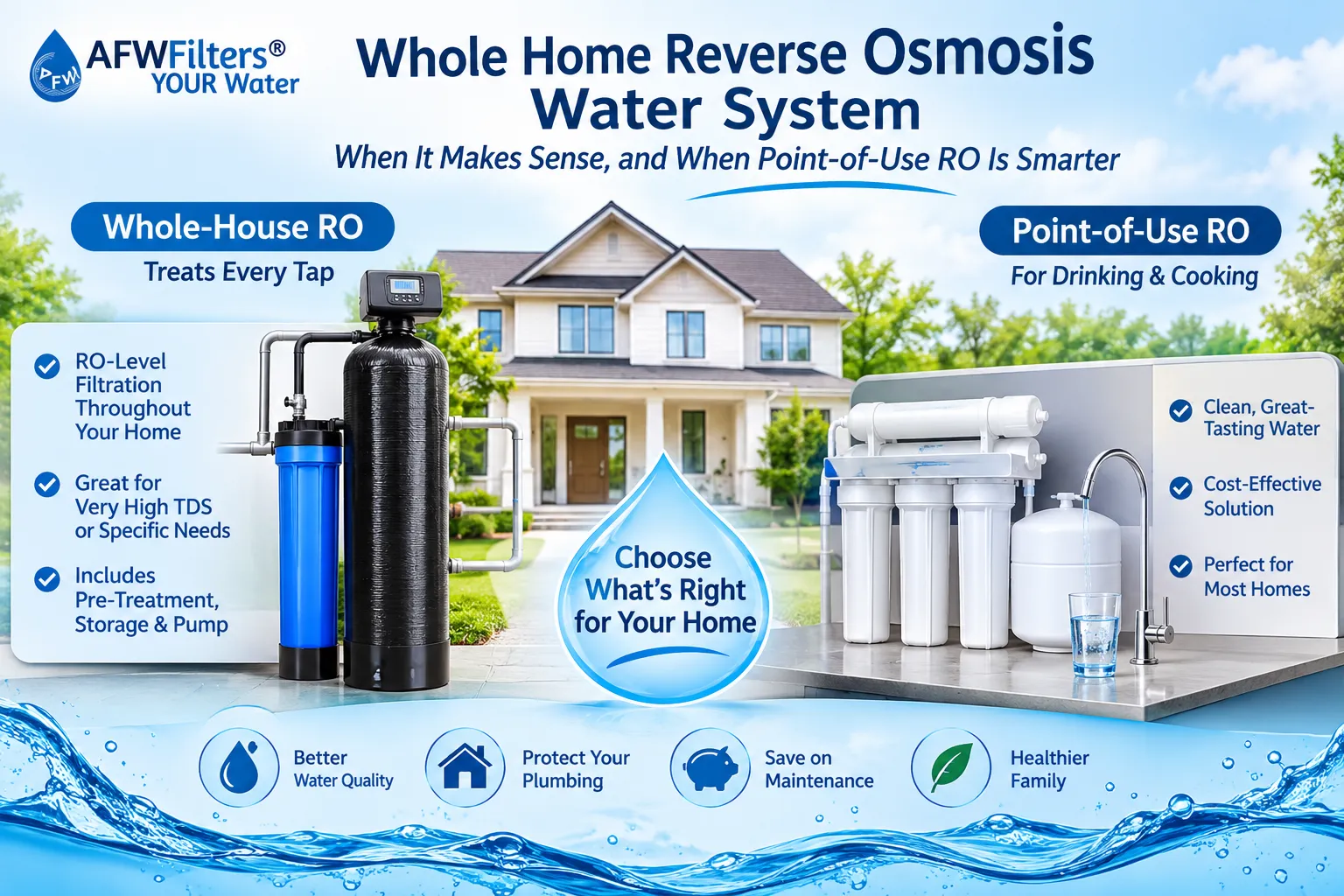
Reverse osmosis has a strong reputation, and for good reason. It removes a wider range of dissolved contaminants than almost any other home treatment. So it's natural to wonder: why not run the whole house on it?
For a few homes, a whole-home reverse osmosis water system is exactly the right call. For most, it's an expensive way to treat water that never needed that level of treatment. Here's how to tell which group you're in.
How whole-home RO works
An under-sink RO system pushes water through a fine membrane at the kitchen tap. A whole-home system does the same for every gallon entering the house, which takes a lot more equipment:
-
Pre-treatment, often sediment filtration, carbon, and a water softener, to protect the membrane from scale, chlorine, and grit
-
The RO unit itself, sized for whole-house demand
-
A large storage tank, because RO produces water slowly and your house needs it fast
-
A repressurization pump to deliver stored water to every fixture
-
Post-treatment, usually pH correction or remineralization, because RO water is very low in minerals
Every RO system also sends part of its incoming water to drain as concentrate. At the scale of a whole house, that adds up quickly.
Why most homes don't need it
The key question is how much of your water actually needs RO-level treatment. According to EPA WaterSense, the average American family uses more than 300 gallons a day at home, about 70% of it indoors. Most of that goes to toilets, showers, laundry, and dishes.
The water you drink and cook with is a small fraction of the total. Treating all of it with RO means paying for equipment, energy, wastewater, and maintenance on hundreds of gallons a day that would have been perfectly fine with simpler treatment.
Very low-mineral water can also be aggressive toward metal plumbing, which is why whole-home systems need careful post-treatment. That adds equipment and upkeep.
When a whole-home RO system does make sense
There are real cases where it's the right choice:
-
Very high total dissolved solids, such as a brackish or salty well that tastes bad at every tap and can damage fixtures
-
A contaminant that RO removes most economically at high levels throughout the house, where no simpler targeted system works
-
Specific household needs, such as a medical or specialty requirement for treated water at multiple points
If one of these applies, plan it with a full water test and a professional design. Size the storage and pump to your peak demand, and budget for the larger pre-treatment and post-treatment equipment.
The setup most homes end up with
For most homes, the better approach splits the job in two:
-
Whole-house treatment for what affects every tap: sediment, chlorine or chloramine, hardness, iron, or bacteria, depending on the water test
-
A reverse osmosis drinking water filter system under the kitchen sink for the water you drink and cook with
That gives you RO-quality drinking water and better water everywhere else, at a fraction of the cost and water waste of whole-home RO. Suppliers that carry both make this easy to plan together. AFW Filters, for example, lists RO drinking water systems alongside its whole-house filters and softeners. If you're building this kind of two-part setup, start with the reverse osmosis drinking water filter system and match the whole-house stage to your water test.
Choosing an RO filtration system for the kitchen
Look for certification. NSF covers reverse osmosis systems under NSF/ANSI 58, which addresses contaminants regulated by the EPA and Health Canada. Check the certified listing for the specific contaminants you care about, such as lead, arsenic, or nitrate, rather than relying on general claims.
Also compare:
-
How many gallons per day it produces, and the size of its storage tank
-
How much water it sends to drain for each gallon it produces
-
How easy the filters are to change, and what they cost
-
Whether it includes a remineralization stage, if you prefer the taste
Keeping up with reverse osmosis water filter replacement filters
An RO system only performs as well as its filters. Most have three kinds:
-
Pre-filters (sediment and carbon) protect the membrane and usually need changing most often.
-
The membrane does the main work and typically lasts longer than the pre-filters.
-
The post-filter polishes taste and is usually changed on a regular schedule.
Follow the maker's schedule, because exact intervals depend on your water and usage. Use replacement filters designed for your model, and flush the system after each change. A drop in water flow or a change in taste is a sign something's due. If you have a TDS meter, a rise in the treated water reading is a good sign the membrane needs replacing.
The bottom line
A whole home reverse osmosis water system solves a specific problem: water that needs RO-level treatment at every tap. If that's your situation, it's worth doing properly. If not, whole-house filtration plus an RO filtration system at the kitchen sink gives you the same drinking water quality for far less money, maintenance, and wasted water.
Related Reading
Expert Insights: Navigating the Complex World of Home Improvement
Welcome to our in-depth exploration of Home Improvement. In an era defined by ra...
Why Home Improvement is Transforming the Global Industry Landscape
Welcome to our in-depth exploration of Home Improvement. In an era defined by ra...