What to Know when Choosing a Manufacturer for Heavy-Duty MS Pallets in India?
By Rajeev Lath
20 Views
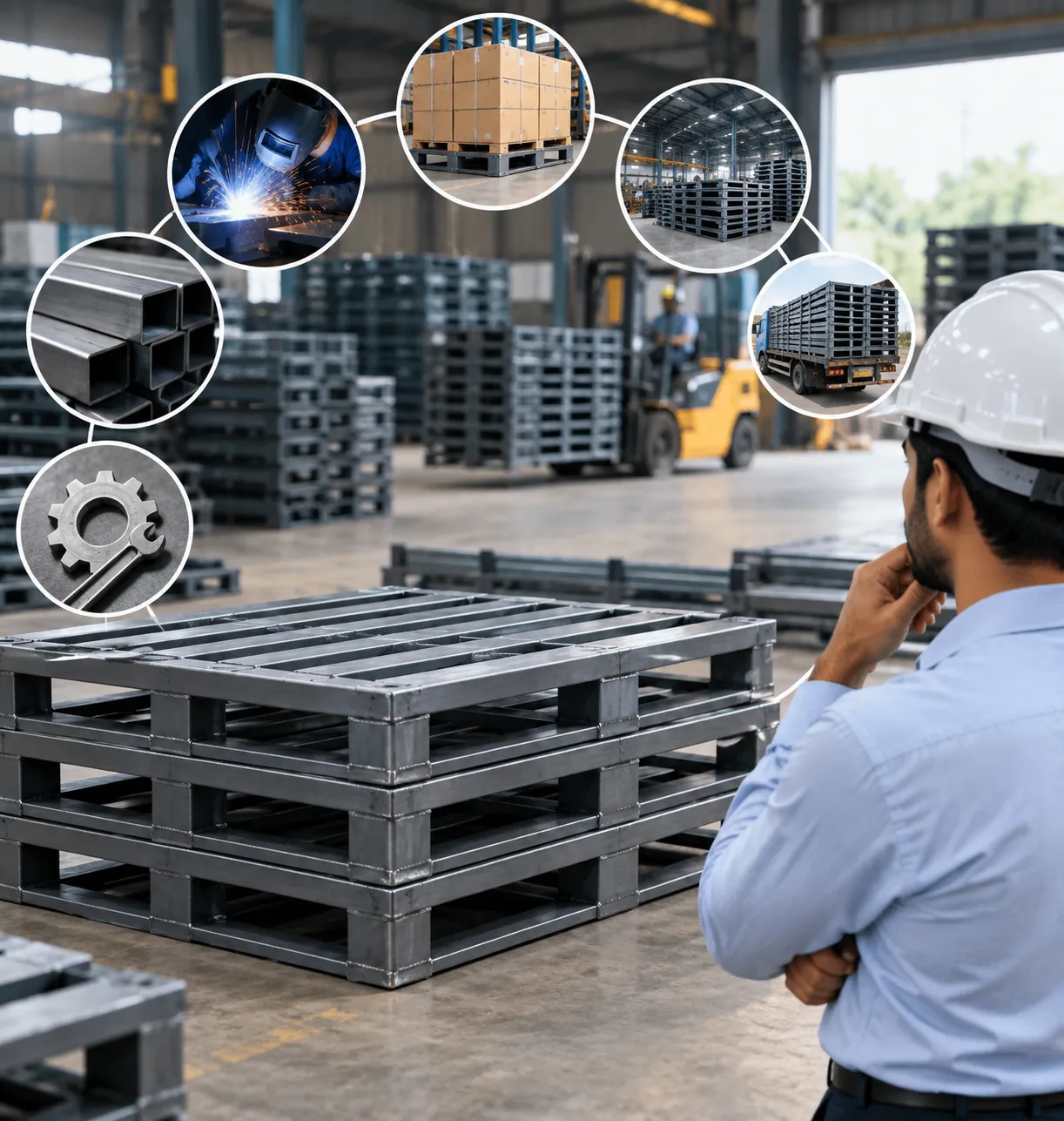
Most buyers shopping for MS pallets India compare exactly one number: load capacity. It's on every spec sheet, every quote, every product listing — and it's also the number most likely to mislead you if you don't know which kind of load capacity you're actually looking at. Two pallets can carry an identical "2,000 kg capacity" label and behave completely differently once they're stacked three-high in a rack for six months. The difference isn't marketing spin; it's a specific engineering distinction that almost never gets explained to the buyer.
This guide covers what that distinction actually means, how steel grade and entry design affect real-world performance, and how to vet an MS pallet manufacturer instead of just comparing capacity numbers on a spec sheet.
Static, Dynamic, and Rackable Capacity Aren't the Same Number
This is the single most important thing to understand before buying, and it's the detail most listings bury or omit entirely:
- Static load capacity is how much weight the pallet can hold while sitting still on the ground, evenly distributed. This is almost always the highest number on the spec sheet.
- Dynamic load capacity is how much weight the pallet can safely carry while being moved — lifted, transported, or handled by a forklift or pallet truck. This number is typically far lower than static capacity because movement introduces shock and uneven weight distribution.
- Rackable capacity is how much weight the pallet can hold when supported only at its edges inside a racking beam, rather than across a full floor surface. This is often the lowest of the three numbers, sometimes only a fraction of the static rating.
A pallet quoted with an eye-catching static capacity might have a rackable capacity that's a small percentage of that figure. If your operation stores pallets in racking (which most warehouses do), rackable capacity is the number that actually matters — not the static figure printed largest on the brochure. Always ask a manufacturer for all three numbers separately, in writing, not just the headline capacity.
Steel Gauge: The Variable Hiding Inside "Heavy Duty"
"Heavy duty" is a marketing term, not a spec. What actually determines durability is steel gauge (thickness) and the grade of mild steel used in the deck versus the frame.
A few things worth knowing:
- Thicker gauge steel increases both load capacity and weight — which matters if your forklifts or conveyor systems have their own weight limits to account for.
- Manufacturers sometimes use a heavier gauge in visible structural members (the frame) while using thinner gauge in the deck surface, since the deck bears distributed weight rather than point-load stress. Ask which gauge is used where, not just an overall figure.
- Welded joints matter as much as the steel itself — a pallet with premium-gauge steel but poor weld quality at stress points (particularly where the deck meets the frame) will fail at the joint long before the steel itself gives out. Ask whether joints are fully welded or spot-welded, since this affects long-term fatigue resistance under repeated loading and unloading.
2-Way vs. 4-Way Entry: A Decision That Affects Your Whole Workflow
MS pallets typically come in two entry configurations, and the choice affects far more than convenience:
- 2-way entry allows forklift access from only two sides. It's typically cheaper and structurally simpler, but it constrains how pallets can be placed and retrieved in racking or transport.
- 4-way entry allows forklift or pallet truck access from all four sides, giving far more flexibility in warehouse layout, loading dock operations, and racking orientation — at a moderate cost premium.
If your facility uses narrow-aisle racking or has forklifts approaching from varied angles, 4-way entry often pays for itself in reduced repositioning time alone. If your workflow is highly linear (one consistent approach direction), 2-way entry can be the more cost-efficient choice without sacrificing real-world usability.
Stacking and Reusability: The Long-Game Cost Factor
MS pallets are typically sold on durability and reusability — but that reusability depends on a few specifics buyers rarely ask about:
- Stacking capacity when empty (how many pallets can nest or stack when not in use) affects storage footprint between uses, which matters more than buyers expect if warehouse floor space is tight.
- Corrosion resistance and finish — powder-coated or galvanized finishes resist rust significantly longer than untreated or basic painted mild steel, which matters heavily if pallets are exposed to humidity, washdown environments, or outdoor storage.
- Repairability — some MS pallet designs allow individual damaged components (a bent corner, a cracked weld point) to be repaired rather than requiring full pallet replacement. This can meaningfully extend the effective lifespan and lower total cost of ownership, but it's rarely mentioned unless you ask directly.
Vetting an MS Pallet Manufacturer
The same pattern holds here as with racking and material handling equipment: the heavy duty MS pallets India manufacturer worth shortlisting ask questions before quoting, and provide documentation without being pushed.
Green flags:
- They ask whether pallets will be used in racking (and specifically request your beam configuration) before quoting rackable capacity
- They provide static, dynamic, and rackable capacity as three separate figures
- They specify steel gauge separately for deck and frame
- They offer a structural warranty and can describe their weld quality process
Red flags:
- Only one "load capacity" figure is offered, with no distinction between static/dynamic/rackable
- No clear answer on steel gauge, or gauge is described only as "heavy duty" without a number
- No option to inspect a sample unit or request a load test before a bulk order
A Practical Checklist Before You Buy
Static, dynamic, and rackable capacity all documented separately in writing
Steel gauge specified for both deck and frame components
Entry configuration (2-way or 4-way) matched to your actual forklift/racking workflow
Finish/coating suited to your facility's humidity and exposure conditions
Repairability of individual components confirmed, not just full-unit warranty
The Bottom Line
The pallet with the biggest number on its spec sheet isn't necessarily the right one for your racking, your forklifts, or your floor space — it depends on which of the three load ratings actually applies to how you'll use it. Ask for static, dynamic, and rackable capacity as separate figures, confirm steel gauge at both the deck and frame, and match entry configuration to your actual workflow rather than defaulting to whichever option is cheaper on paper.
Frequently Asked Questions
1. What's the difference between static, dynamic, and rackable load capacity?
Static capacity is the maximum weight a pallet holds while stationary on the ground; dynamic capacity is the safe weight while being moved or handled; rackable capacity is the weight it can safely hold when supported only at the edges inside racking — and it's usually the lowest of the three.
2. Which load capacity number matters most for warehouse use?
If pallets will sit in racking, rackable capacity is the figure that matters most, since it reflects edge-supported conditions rather than full-floor support.
3. What's the difference between 2-way and 4-way entry pallets?
2-way entry allows forklift access from two sides only, while 4-way entry allows access from all four sides, offering more flexibility in layout and handling at a moderate cost premium.
4. Does steel gauge really affect pallet performance?
Yes — thicker gauge steel generally increases load capacity and durability but also adds weight, and manufacturers often vary gauge between the deck and frame, so it's worth asking about both separately.
5. Are MS pallets better than wooden or plastic pallets?
MS pallets typically offer greater durability, load capacity, and long-term reusability than wood or plastic, but at a higher upfront cost — the right choice depends on load requirements, environment, and expected lifespan.
6. How long do heavy-duty MS pallets typically last?
With proper steel gauge, coating, and maintenance, MS pallets commonly last many years longer than wood alternatives, though lifespan varies significantly with load intensity, environment, and handling practices.
7. What finish should I choose for humid or washdown environments?
Galvanized or powder-coated finishes generally offer better corrosion resistance than untreated or basic painted mild steel, which matters significantly in humid or frequently washed-down facilities.
8. Can damaged MS pallets be repaired instead of replaced? Some designs allow individual component repair (corners, welds) rather than full replacement, which can lower total cost of ownership — but this depends on the specific manufacturer's design, so it's worth confirming upfront.
9. What should I ask a manufacturer before placing a bulk order? Request static, dynamic, and rackable capacity separately, steel gauge for deck and frame, weld quality details, and whether a sample unit or load test is available before committing.
10. Is a higher static load capacity always better? Not necessarily — a high static capacity paired with a low rackable capacity can be misleading if your actual use case involves racked storage, so always evaluate the capacity figure that matches your real handling and storage conditions.
Related Reading
Top 10 Hidden Secrets About Business & Finance You Need to Know
Welcome to our in-depth exploration of Business & Finance. In an era defined...
Why Business & Finance is Transforming the Global Industry Landscape
Welcome to our in-depth exploration of Business & Finance. In an era defined...