What Is the Purpose of a DET Mock Test?
By Aman Singh
87 Views
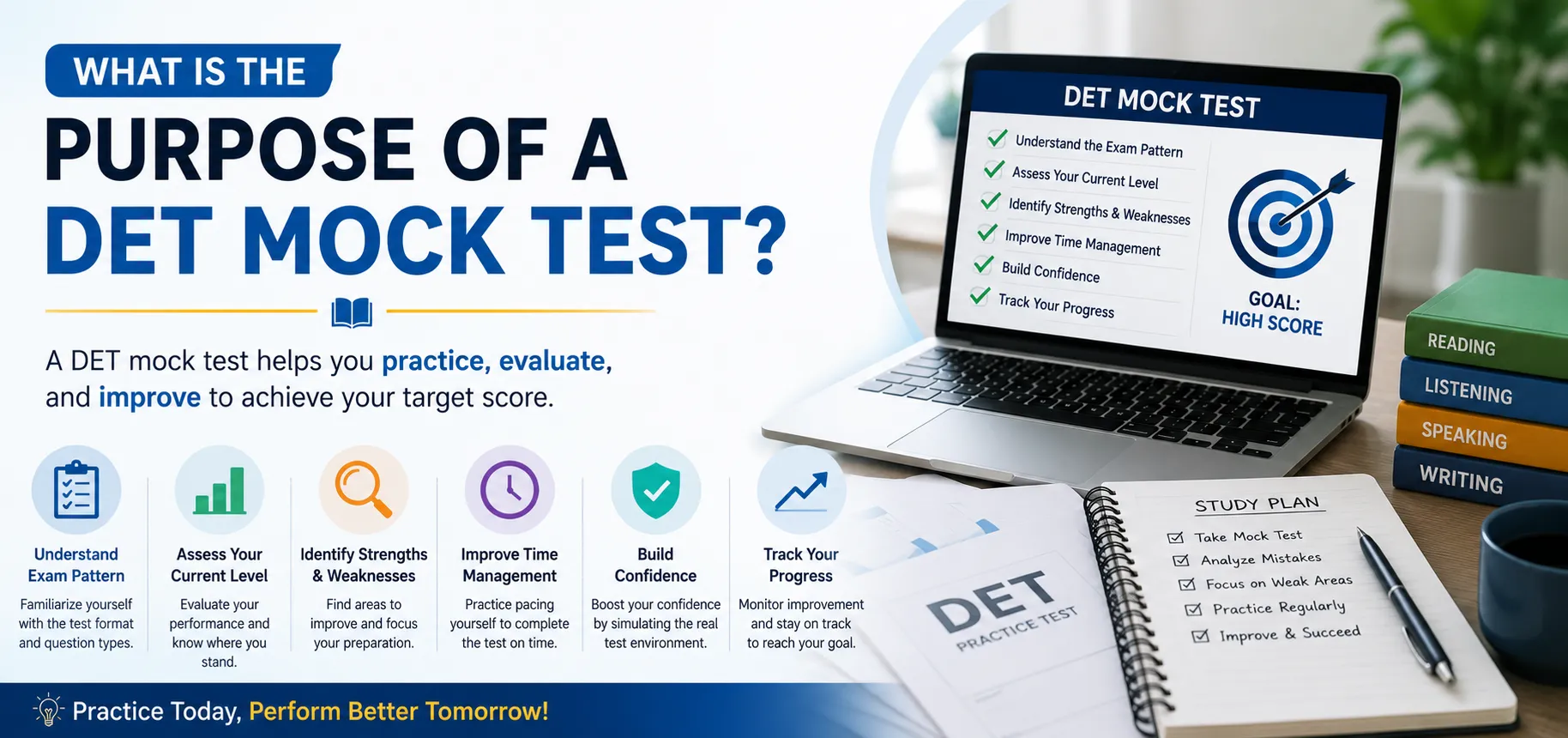
A DET mock test serves as a practical checkpoint before the actual English proficiency assessment. It gives candidates a structured setting to measure reading, writing, listening, and speaking performance while managing realistic time pressure. Moreover, a mock test reveals habits that ordinary practice may not expose, including slow decision-making, inconsistent responses, and difficulty maintaining concentration.
The purpose extends beyond receiving a score. Candidates can use mock results to identify priorities, adjust study schedules, practice strategically, and track progress. When each simulation leads to focused correction, mock testing becomes a useful part of purposeful preparation.
What Is a DET Mock Test?
A DET mock test simulates key features of the actual English proficiency assessment in a practice environment. It typically combines different language tasks and requires candidates to respond within defined time limits.
A Practical Performance Check
The main purpose of a mock test is to show how effectively a candidate can apply English skills under pressure. Regular exercises often isolate one skill, while a simulation combines several demands.
Consequently, candidates receive a broader picture of their current readiness. They can see whether strong performance continues when tasks change quickly, time becomes limited, and concentration must remain steady.
More Than a Practice Score
A mock score provides useful information, but the number alone should not determine preparation decisions. Candidates should examine which tasks caused difficulty and why.
For example, a lower result might reflect vocabulary limitations, weak comprehension, rushed responses, or poor time allocation. Therefore, score analysis should always accompany the score itself.
Why Should You Take a DET Mock Test?
The purpose of mock testing becomes clearer when candidates connect it to specific preparation needs. A well-designed simulation can support several aspects of performance at once.
Measure Current Readiness
An early mock test creates a baseline. Candidates can compare later results against that starting point and identify whether their preparation produces measurable changes.
Moreover, a baseline prevents candidates from spending equal time on every skill. Strong areas can receive maintenance practice, while weaker areas can receive more focused attention.
Become Comfortable With Test Demands
Familiarity can reduce unnecessary uncertainty. A candidate who has never completed a full simulation may spend mental energy figuring out pacing, instructions, and task transitions.
Repeated exposure makes these demands more familiar. As a result, candidates can devote more attention to the language tasks themselves rather than reacting to unfamiliar conditions.
Identify Strengths and Weaknesses
A mock test can reveal performance patterns that ordinary study sessions may hide. However, candidates need to analyze those patterns carefully.
Find Repeated Errors
One incorrect response may represent a simple oversight. Repeated errors, in contrast, often indicate a skill that needs targeted attention.
Candidates can categorize mistakes into areas such as:
- Vocabulary and word choice
- Grammar and sentence structure
- Reading comprehension
- Listening accuracy
- Speaking fluency
- Writing organization
- Spelling and mechanics
- Time management
This classification makes study planning more precise. Consequently, candidates can prioritize problems that occur frequently or affect multiple tasks.
Protect Strong Skills
Preparation should not ignore areas that already perform well. A strong skill can weaken when candidates completely stop practicing it.
Therefore, maintain stronger areas with shorter sessions while assigning additional time to weaker ones. This approach creates a balanced routine and reduces the risk of replacing one weakness with another.
Improve Time Management
Time management plays an important role in computer-based English testing. Candidates must make decisions quickly while maintaining accuracy and clarity.
Find Where Time Goes
A mock test can reveal whether a candidate spends too long on one task or hesitates when choosing an answer. Such patterns may not appear during untimed practice.
Review the timing after each simulation. If one task consistently consumes disproportionate time, identify the cause. Perhaps the candidate rereads unnecessarily, overthinks choices, or struggles to organize a response.
Balance Speed With Accuracy
Faster responses do not automatically produce better results. Candidates need a pace that allows them to process information accurately without leaving tasks unfinished.
Consequently, timed practice should gradually increase efficiency. However, candidates should monitor accuracy while reducing completion time. A faster method only helps when performance remains reliable.
Improve Reading Performance
Reading tasks require more than vocabulary knowledge. Candidates must process information, identify relationships, interpret meaning, and respond efficiently.
Improve Information Processing
Mock tests provide repeated opportunities to work with realistic reading demands. Candidates can identify whether they read too slowly, miss important details, or choose answers without sufficient evidence.
After each test, review the passage and locate the information supporting the correct response. Consequently, answer selection can become more deliberate.
Strengthen Vocabulary in Context
Vocabulary mistakes often involve context rather than isolated definitions. A candidate may recognize a word but misinterpret its meaning within a sentence.
Therefore, review unfamiliar words alongside the surrounding text. Record useful meanings, collocations, and sentence patterns rather than memorizing disconnected lists.
Improve Listening Performance
Listening performance depends on attention, comprehension, memory, and the ability to process spoken information efficiently.
Train Sustained Attention
A full mock test can reveal whether concentration weakens as tasks continue. If mistakes increase later, the issue may involve mental fatigue rather than a lack of vocabulary.
In that situation, include longer listening sessions in preparation. Gradually extending practice can help candidates maintain attention for longer periods.
Improve Note-Taking Decisions
Effective notes capture useful information without distracting the listener. Writing every word can cause candidates to miss the next important point.
Conversely, taking too few notes may make details difficult to recall. Mock testing allows candidates to evaluate their note-taking habits and adjust them according to actual performance.
Improve Speaking Performance
Speaking tasks require candidates to organize ideas quickly and communicate clearly. Mock tests can reproduce that pressure more effectively than casual speaking practice.
Practice Response Organization
Candidates can use timed prompts to practice forming a clear response structure. However, avoid memorizing complete scripts. Flexible structures work better because prompts can vary. Candidates should practice organizing unfamiliar topics while maintaining natural language.
Improve Fluency and Delivery
Review recorded responses when possible. Look for repeated pauses, unnecessary repetition, unclear pronunciation, or incomplete ideas.
Moreover, focus on the most frequent problems first. Trying to change every speaking habit simultaneously can make practice inefficient. Targeted correction creates clearer progress.
Improve Writing Performance
Writing tasks require candidates to express ideas clearly while controlling language and organization. Mock tests add the pressure of completing these demands within limited time.
Strengthen Planning
Track how much time you spend planning, writing, and reviewing. Candidates who skip planning may lose direction, while those who plan excessively may leave too little time for completion.
A short outline can establish the central idea and supporting points. Consequently, writing becomes more organized without consuming unnecessary time.
Correct Recurring Language Errors
Review completed responses for patterns rather than isolated mistakes. Common categories include verb agreement, sentence boundaries, word choice, punctuation, and awkward transitions.
Create a short correction list after each mock. Then use new practice responses to apply those corrections. Repetition can reduce recurring errors over time.
Use Mock Tests to Set Study Priorities
A mock test becomes more valuable when its results directly influence the next study session.
Rank Weaknesses by Impact
Not every mistake deserves equal attention. Prioritize weaknesses that appear frequently, affect several tasks, or significantly reduce performance.
For example, a recurring vocabulary problem may affect reading, listening, speaking, and writing. Therefore, improving that area may provide broader benefits than correcting one isolated mistake.
Create Specific Objectives
Replace broad goals with measurable targets. Instead of writing “improve speaking,” set an objective such as reducing unnecessary pauses during timed responses.
Similarly, replace “practice reading” with a target involving accuracy and completion time. Specific objectives make progress easier to evaluate.
Track Progress Across Multiple Mock Tests
One simulation offers a snapshot. Several simulations create a clearer performance trend.
Record Section-Level Results
Keep a record of performance across major skill areas. A total score can hide meaningful changes within individual skills.
For instance, an overall result may remain stable while speaking improves and reading declines. Section-level tracking helps identify that movement and supports better study allocation.
Monitor Error Patterns
Scores should not provide the only measure of progress. Track recurring mistakes, timing problems, response quality, and consistency.
Moreover, compare tests completed under similar conditions. A single unusually high result may not represent stable improvement, while consistent gains across several simulations provide stronger evidence.
Use Mock Tests at Different Preparation Stages
The purpose of a mock test changes as preparation progresses. Candidates should adjust how they use simulations instead of following one fixed routine.
Early Preparation
At the beginning, use mock testing primarily for diagnosis. Identify major weaknesses, timing concerns, and unfamiliar task demands.
Do not overreact to the initial score. Instead, use it to establish priorities and create a realistic study plan.
Middle Preparation
During the middle stage, use mocks to evaluate whether targeted practice produces measurable improvement. Compare recent results with the baseline and inspect recurring errors.
If one skill improves while another remains unchanged, adjust study time accordingly. Consequently, preparation becomes more responsive to actual performance.
Final Preparation
Near the assessment, full simulations should emphasize consistency. Practice under realistic conditions and avoid making major strategy changes immediately before the test.
Use final reviews to reinforce reliable methods, correct recurring mistakes, and maintain confidence. In contrast, excessive testing can create fatigue without adding useful information.
How to Review a DET Mock Test
Review determines whether a mock test becomes a practice opportunity or simply another score.
Review Incorrect Answers
Start with incorrect responses and determine the exact reason for each mistake. Was the problem caused by comprehension, vocabulary, grammar, timing, or a rushed decision?
Write a short correction beside each mistake. This creates a practical record that can shape the next practice session.
Review Uncertain Correct Answers
Correct answers can still reveal weaknesses when candidates guessed or hesitated. Mark these responses separately and review them.
Moreover, identifying uncertain answers can prevent false confidence. A strong score becomes more meaningful when candidates can explain why their answers were correct.
Review Timing and Behavior
Look beyond answers. Note where concentration dropped, where hesitation increased, and where time became difficult to manage.
These observations can reveal performance habits that ordinary score reports cannot show. Consequently, the next preparation cycle can address both language skills and test behavior.
Conclusion
A DET mock test serves as much more than a practice exercise. It provides measurable evidence about language performance, timing, concentration, strategy, and readiness. Moreover, each simulation can shape the next stage of preparation when candidates review results carefully and target recurring weaknesses. The most effective cycle combines realistic testing, detailed analysis, focused practice, and repeated measurement. Candidates who follow that process can make better use of study time, improve consistency, and approach the actual assessment with greater control. The purpose, therefore, is not simply to obtain another score, but to turn each test into a clear opportunity for measurable improvement.
FAQs
1. What is the main purpose of a DET mock test?
The main purpose is to simulate testing conditions while measuring current performance. A mock test helps candidates identify strengths, weaknesses, timing problems, and recurring errors. More importantly, it provides evidence that can shape subsequent preparation. Candidates should use the results to practice strategically rather than treat the score as an isolated prediction.
2. Can a DET mock test predict my actual score?
A mock test can provide an indication of readiness, but it cannot guarantee an identical official score. Performance may vary because of task difficulty, concentration, technology, or other factors. Therefore, candidates should compare results across several realistic simulations instead of relying on one score as a precise prediction.
3. When should I take my first DET mock test?
Taking an initial mock relatively early can establish a useful baseline. Candidates do not need to master every skill first. The first simulation can reveal which areas deserve attention and how comfortably the candidate manages timing. Consequently, preparation can start with clearer priorities rather than a broad, unfocused schedule.
4. How often should I take a DET mock test?
Frequency should depend on how much corrective practice you need between tests. Many candidates benefit from several days of targeted preparation before another full simulation. However, candidates with limited preparation time may shorten the cycle. The important point is to leave enough time to analyze mistakes and apply meaningful corrections.
5. Should I review a DET mock test after completing it?
Yes. Review provides much of the mock test's practical value. Examine incorrect and uncertain answers, recurring language problems, timing issues, and concentration patterns. Then identify a small set of priorities for the next study period. Without review, candidates may repeat the same mistakes in subsequent simulations.
6. Can mock tests improve time management?
Yes. Timed simulations reveal where candidates hesitate, overthink, or spend excessive time. After identifying those patterns, candidates can practice with controlled limits and gradually improve efficiency. Nevertheless, speed should not replace accuracy. The objective is to develop a reliable pace that supports correct, clear, and timely responses.
7. Should I take a mock test every day?
Usually, no. Daily full simulations can reduce the time available for targeted correction and may increase fatigue. Candidates generally benefit from alternating assessment with focused practice. Section-based exercises can maintain momentum between full tests, while periodic simulations can measure whether those targeted efforts produce measurable improvement.
8. How can mock tests improve speaking performance?
Speaking simulations create pressure to organize ideas and respond within strict limits. Candidates can review fluency, pronunciation, pauses, organization, and response relevance. Recording practice can make repeated habits easier to identify. Moreover, repeated timed responses help candidates become more comfortable organizing unfamiliar topics without relying on memorized scripts.
9. How can I use a low mock score effectively?
Treat a low score as diagnostic information. Break the result into specific skill areas and identify the causes behind lost points. Then prioritize the weaknesses that appear most often or affect several tasks. After focused practice, complete another simulation and compare both the score and the underlying error patterns.
10. How do I know when mock testing is working?
Look for several indicators rather than one score increase. Useful signs include fewer recurring errors, better timing, stronger section-level results, improved consistency, and greater control during difficult tasks. When multiple indicators improve across several simulations, you have stronger evidence that your preparation methods are producing meaningful progress.
Related Reading
Expert Insights: Navigating the Complex World of Education & Learning
Welcome to our in-depth exploration of Education & Learning. In an era defin...
Why Education & Learning is Transforming the Global Industry Landscape
Welcome to our in-depth exploration of Education & Learning. In an era defin...