What Is ISI Mark? Meaning, Benefits & How to Get It in India
11 Views
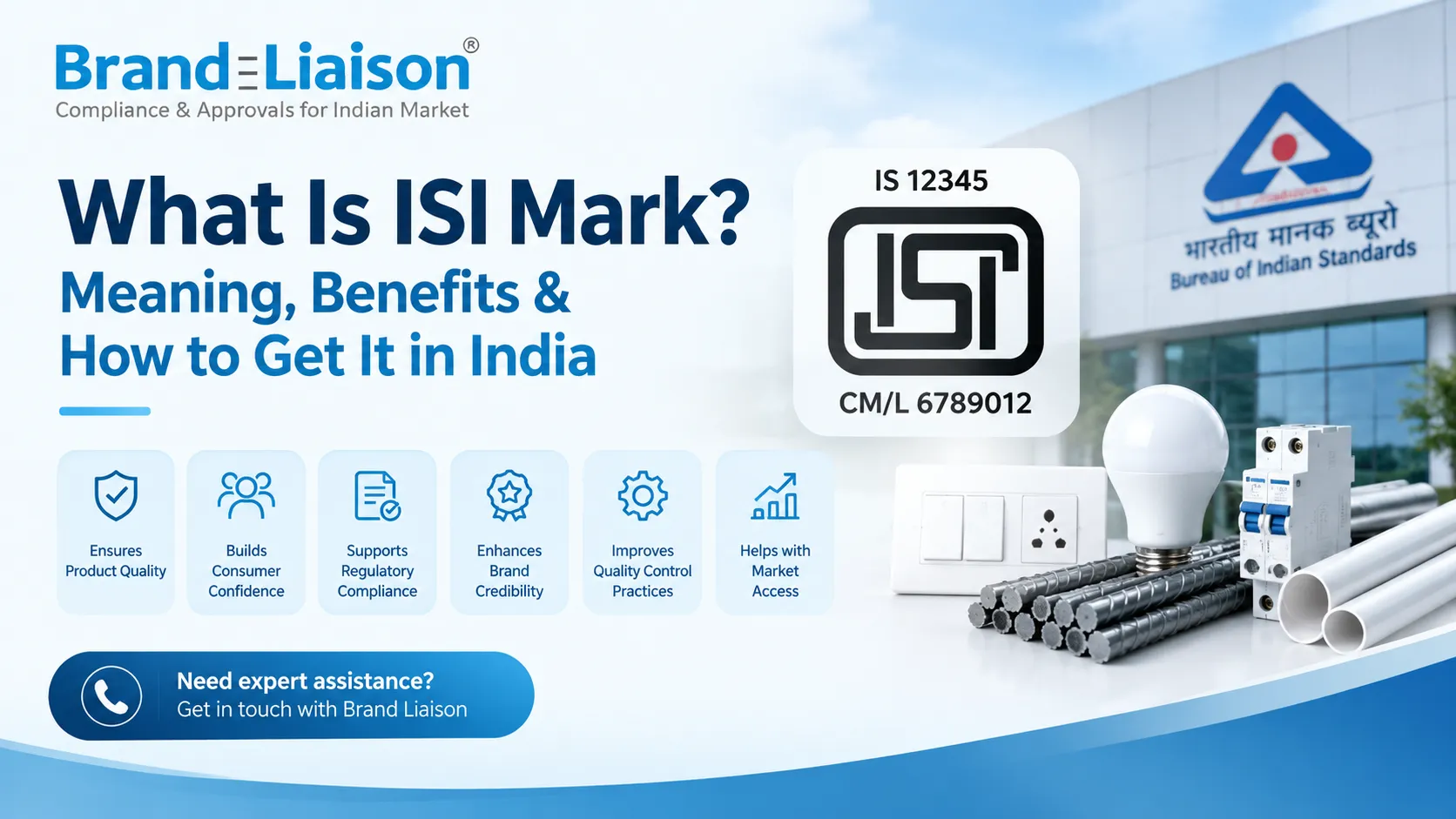
When buying products in India, consumers often look for the ISI Mark as an indication that a product conforms to the applicable Indian Standard. For manufacturers, however, the ISI Mark is more than a quality symbol—it is connected with the Bureau of Indian Standards (BIS) product certification system and, for certain products, is a mandatory compliance requirement.
The BIS ISI Mark is used for products certified under BIS Scheme-I. BIS assesses the manufacturer's manufacturing infrastructure, process controls, quality-control and testing capabilities and verifies that the product conforms to the relevant Indian Standard.
In this guide, we explain what the ISI Mark means, why it is important, its benefits, who needs it, and how manufacturers can obtain BIS ISI Certification in India.
What Is the ISI Mark?
The ISI Mark is the commonly used name for the BIS Standard Mark associated with BIS product certification under Scheme-I.
It indicates that a product has been assessed for conformity with the applicable Indian Standard and that the manufacturer has obtained the appropriate BIS licence to use the Standard Mark. BIS explains that the presence of its Standard Mark provides assurance that the product conforms to the requirements of the relevant Indian Standard.
The ISI Mark can be found on various categories of products, including products used in construction, electrical applications, engineering and other regulated sectors.
However, it is important to understand that not every product in India automatically requires an ISI Mark. BIS certification is generally voluntary, but the Government of India makes certification mandatory for specified products through Quality Control Orders (QCOs) and other regulatory requirements.
What Does the ISI Mark Mean?
The ISI Mark essentially communicates that the certified product conforms to the applicable Indian Standard under the relevant BIS certification scheme.
For a manufacturer, obtaining the mark involves more than simply printing the ISI logo on a product. The manufacturer must obtain a valid BIS licence and comply with the applicable requirements.
A BIS licence is granted after assessment of the manufacturer's capabilities and verification of product conformity through testing and other applicable assessment procedures.
Therefore:
ISI Mark = BIS Standard Mark + conformity with the applicable Indian Standard + valid BIS licence
Manufacturers must not use the ISI Mark without the required BIS authorization. BIS also undertakes enforcement activities against misuse or imitation of the Standard Mark.
What Is BIS ISI Certification?
BIS ISI Certification is the process through which a manufacturer obtains a BIS licence to use the Standard Mark on products that conform to the applicable Indian Standard.
Under Scheme-I, BIS evaluates factors such as:
-
Applicable Indian Standard
-
Manufacturing infrastructure
-
Production process
-
Quality-control arrangements
-
Testing facilities and capabilities
-
Product conformity
-
Required documentation
-
Factory assessment
-
Testing of product samples
BIS states that the manufacturer must have the necessary manufacturing infrastructure, process controls, quality-control and testing capabilities corresponding to the relevant Indian Standard.
Is ISI Mark Mandatory in India?
The answer depends on the product.
BIS certification is generally voluntary. However, the Government of India can make compliance compulsory for specific products through Quality Control Orders (QCOs).
If a product is covered under a mandatory QCO requiring BIS certification, the manufacturer must obtain the applicable BIS licence before manufacturing or selling the product in accordance with the regulatory requirements.
Therefore, manufacturers should first determine:
-
What is the product?
-
Which Indian Standard applies?
-
Is the product covered by a QCO?
-
Which BIS conformity assessment scheme applies?
-
What testing and factory requirements are applicable?
BIS maintains information on products covered under compulsory certification, including products under Scheme-I.
Benefits of the BIS ISI Mark
Obtaining BIS ISI Certification can provide several benefits to manufacturers and consumers.
1. Demonstrates Product Conformity
The ISI Mark indicates that the certified product conforms to the requirements of the applicable Indian Standard.
This gives manufacturers a structured framework for maintaining product quality and consistency.
2. Builds Consumer Confidence
Consumers are generally more confident purchasing products carrying a genuine BIS Standard Mark because the mark represents conformity with the applicable Indian Standard.
BIS identifies quality, safety and reliability as important outcomes of its conformity assessment system.
3. Supports Regulatory Compliance
For products covered by mandatory certification requirements, obtaining the required BIS licence is essential for regulatory compliance.
Manufacturers should therefore check the latest QCO and BIS requirements applicable to their specific product before placing it on the Indian market.
4. Improves Brand Credibility
A valid BIS certification can strengthen a manufacturer's credibility among customers, distributors, retailers and business partners.
For businesses competing in regulated product categories, demonstrating compliance can also help differentiate the brand from uncertified products.
5. Helps Improve Quality-Control Practices
The BIS certification process requires manufacturers to maintain appropriate production controls and testing capabilities.
This can encourage manufacturers to establish more systematic quality-control procedures within their manufacturing operations.
6. Supports Market Access
For products under mandatory BIS certification, obtaining the required certification is an important step toward lawful market access in India.
The exact requirements depend on the applicable Indian Standard and regulatory notification.
How to Get BIS ISI Certification in India?
The process for obtaining an ISI licence generally involves identifying the applicable standard, preparing the manufacturing and quality-control system, applying to BIS, testing and factory assessment.
Step 1: Identify the Applicable Indian Standard
The first step is to identify the Indian Standard (IS) applicable to the product.
Different products are governed by different Indian Standards. BIS provides mechanisms for manufacturers to identify the relevant standard for their products.
This step is extremely important because the applicable standard determines the technical, testing and certification requirements.
Step 2: Check Whether BIS Certification Is Mandatory
After identifying the applicable IS number, manufacturers should check whether the product falls under compulsory BIS certification.
This can be determined by reviewing the applicable QCO and BIS's list of products under compulsory certification.
Step 3: Review Product Requirements
Manufacturers should review the relevant Indian Standard and applicable BIS product-specific requirements.
This includes understanding:
-
Product specifications
-
Testing requirements
-
Raw-material requirements
-
Manufacturing process controls
-
Quality-control requirements
-
Marking requirements
-
Testing facilities
-
Inspection requirements
Step 4: Prepare the Required Documents
The manufacturer needs to prepare documentation required for the BIS application.
Depending on the product and certification requirements, this may include information relating to:
-
Manufacturing unit
-
Factory layout
-
Manufacturing process
-
Machinery
-
Testing equipment
-
Quality-control personnel
-
Raw materials
-
Product specifications
-
Test reports
-
Quality-control procedures
-
Legal/company documents
The exact documentation varies according to the product and applicable Indian Standard.
Step 5: Product Testing
The product must be tested according to the applicable Indian Standard.
BIS explains that conformity can be established through third-party laboratory testing, testing at the manufacturing premises where applicable, or a combination of methods depending on the certification process.
Testing is important because it establishes whether the product meets the technical requirements specified in the relevant Indian Standard.
Step 6: Submit the BIS Application
BIS product certification applications are submitted online through the BIS system.
The manufacturer submits the relevant information, documentation and applicable fees as part of the application process. BIS confirms that applications for product certification are accepted through online mode.
Step 7: Factory Inspection by BIS
Where applicable under the certification procedure, BIS assesses the manufacturing premises.
The assessment can cover areas such as:
-
Manufacturing facilities
-
Production process
-
Quality-control system
-
Testing facilities
-
Availability of trained personnel
-
Raw-material controls
-
Product testing arrangements
BIS states that licensing decisions involve assessment of the manufacturer's manufacturing infrastructure, process controls, quality-control and testing capabilities.
Step 8: Grant of BIS Licence
After successful completion of the applicable assessment and conformity requirements, BIS may grant the licence to use the Standard Mark.
Only after obtaining the appropriate authorization should the manufacturer use the BIS ISI Mark on the certified product.
Related Guide: How to Check BIS Registration Online?
How to Download BIS Certificate Online?
What Information Is Shown With the ISI Mark?
A genuine BIS Standard Mark is associated with information that helps identify the certified product and manufacturer.
The BIS enforcement information explains that the Standard Mark is accompanied by a licence number, historically represented in the form of a CM/L number, which helps identify the manufacturing unit associated with the licence.
Manufacturers should follow the specific marking requirements applicable to their product and Indian Standard rather than using the ISI logo independently.
ISI Mark vs BIS Certification: Are They the Same?
The terms ISI Mark and BIS Certification are often used interchangeably, but there is a distinction.
BIS is India's national standards body and operates different conformity assessment schemes.
The ISI Mark is the Standard Mark associated with BIS product certification under Scheme-I.
Therefore, BIS certification is the broader concept, while the ISI Mark refers specifically to the Standard Mark used under the applicable BIS certification framework.
It is also important not to confuse BIS ISI Certification with BIS CRS Registration.
BIS CRS is a separate registration scheme applicable to specified Electronics and IT products, while the ISI Mark Scheme-I is a different BIS conformity assessment route.
Who Can Apply for BIS ISI Certification?
Manufacturers seeking BIS product certification can apply when their products fall within the applicable BIS certification framework.
A manufacturer should have the required:
-
Manufacturing infrastructure
-
Production facilities
-
Process controls
-
Quality-control arrangements
-
Testing capabilities
-
Product conformity
BIS specifically states that these capabilities are essential requirements for obtaining a BIS product certification licence.
Foreign manufacturers may also need to follow the applicable Foreign Manufacturers Certification Scheme (FMCS) requirements where relevant. BIS states that FMCS allows foreign manufacturers to obtain a licence to use the Standard Mark on products conforming to an Indian Standard, subject to the scheme's requirements.
Common Mistakes Manufacturers Should Avoid
Manufacturers planning to obtain BIS ISI Certification should avoid the following mistakes:
Using the ISI Mark Without a BIS Licence
The ISI Mark should not be used simply because a product meets an Indian Standard. The appropriate BIS licence is required for authorized use of the Standard Mark.
Choosing the Wrong Indian Standard
A product must be assessed against the correct applicable standard. Selecting an incorrect IS number can lead to testing and application problems.
Ignoring the Latest QCO
Regulatory requirements can change. Manufacturers should check the latest applicable QCO and BIS notifications before starting the certification process.
Inadequate Testing Facilities
Some certification requirements may require specific testing arrangements. Manufacturers should review the applicable requirements before applying.
Incomplete Documentation
Missing or inconsistent documents can delay the certification process. Documentation should accurately reflect the actual manufacturing facility and processes.
How Can Brand Liaison Help With BIS ISI Certification?
Obtaining BIS ISI Certification can involve multiple technical, documentation, testing and regulatory requirements. Manufacturers may therefore choose to work with an experienced compliance consultant for guidance throughout the process.
Brand Liaison is a BIS ISI Consultant in Delhi, India providing support to manufacturers for BIS compliance and product certification.
With 10+ years of experience and 5,000+ certificates delivered, Brand Liaison helps businesses understand applicable certification requirements and supports them through documentation, testing coordination, application and certification-related processes.
Our BIS certification support can include:
-
Identification of applicable BIS requirements
-
Indian Standard assessment
-
Documentation assistance
-
Product testing coordination
-
BIS application support
-
Factory inspection preparation
-
Compliance guidance
-
Certification follow-up
-
Post-certification support
If you are a manufacturer planning to obtain BIS ISI Certification or need assistance understanding whether your product requires the ISI Mark, professional BIS Consultant in India can help simplify the certification journey.
Frequently Asked Questions About ISI Mark
What is the full form of ISI Mark?
ISI stands for Indian Standards Institution. The term ISI Mark is commonly used for the BIS Standard Mark associated with product certification under Scheme-I.
Is the ISI Mark issued by BIS?
Yes. The current BIS product certification system provides the licence for use of the BIS Standard Mark under the applicable certification scheme.
Is ISI Mark mandatory for every product?
No. BIS certification is generally voluntary, but the Government of India makes certification mandatory for specified products through QCOs and other regulatory requirements.
Can a manufacturer use the ISI logo without certification?
No. A manufacturer should not use the BIS Standard Mark without the appropriate BIS authorization. BIS takes enforcement action against misuse and imitation of the Standard Mark.
How long does BIS ISI Certification take?
The timeline varies depending on the product, applicable Indian Standard, testing requirements, documentation, factory assessment and BIS processing. Manufacturers should therefore avoid assuming a fixed certification timeline.
Is BIS ISI Certification the same as BIS CRS Registration?
No. BIS ISI Certification under Scheme-I and BIS CRS Registration under Scheme-II are separate BIS conformity assessment routes applicable to different product categories.
Conclusion
The BIS ISI Mark is an important indicator of conformity with applicable Indian Standards. For consumers, it can provide confidence that a certified product has undergone the relevant conformity assessment process. For manufacturers, BIS ISI Certification can be a critical regulatory requirement when a product is covered by a mandatory QCO.
The certification journey generally begins with identifying the correct Indian Standard and checking the applicable regulatory requirement, followed by documentation, testing, application, factory assessment and grant of the BIS licence.
If you are unsure whether your product requires an ISI Mark or need professional assistance with BIS ISI Certification, Brand Liaison can help you understand the applicable requirements and guide you through the certification process.
Need expert assistance with BIS ISI Certification? Get in touch with Brand Liaison.
Also Read: Top BIS Consultant in Delhi, India
Related Reading
Top 10 Hidden Secrets About Business & Finance You Need to Know
Welcome to our in-depth exploration of Business & Finance. In an era defined...
Why Business & Finance is Transforming the Global Industry Landscape
Welcome to our in-depth exploration of Business & Finance. In an era defined...