What Does Real Fiscal Conservatism Look Like in 2026?
13 Views
I spent twelve years working in federal budget analysis and four years as a state budget director. In that time, I developed a clear professional definition of fiscal conservatism that diverges significantly from what either party calls by that name today.
Genuine fiscal conservatism means that public institutions live within their means over time. It means that spending decisions are made on the basis of demonstrated outcomes rather than political convenience. It means that revenue is raised at levels sufficient to cover public obligations without borrowing, and that when borrowing is necessary, it is time-limited, purposeful, and accompanied by a credible plan for repayment. It means that waste is identified and eliminated through independent audit rather than political announcement.
By that definition, neither party in Washington today qualifies as fiscally conservative. And the supply-side variant of conservatism that has dominated Republican economic policy since 1981 is not fiscal conservatism at all. It is a theory about economic growth that has had forty years to prove itself against the fiscal record and has failed.
What the Numbers Actually Show
The national debt when Ronald Reagan took office in January 1981 was approximately $994 billion. It is now over $36 trillion. The administrations that added the most to that debt include both parties, but the specific policy mechanism that accelerated the trajectory was the repeated reduction of top marginal tax rates without equivalent spending reductions, implemented by Republican administrations on the theory that the resulting economic growth would generate sufficient revenue to offset the rate cuts.
According to the Congressional Budget Office, the 2017 Tax Cuts and Jobs Act alone added approximately $1.9 trillion to the projected debt over its first decade, after accounting for the economic growth its proponents argued it would generate. The growth occurred but was not of sufficient magnitude to offset the revenue loss. This was predictable from the historical record of every previous supply-side tax cut, and budget analysts said so at the time.
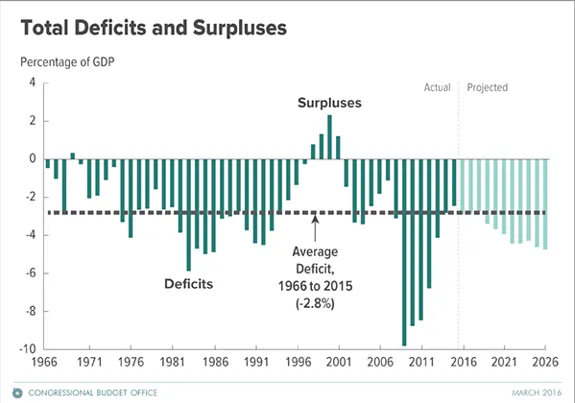
[CBO federal deficit trajectory -- the documented fiscal impact of four decades of supply-side tax policy and insufficient spending discipline across administrations. Source: CBO Budget and Economic Outlook]
The alternative theory, that spending increases without revenue offsets are the path to growth and equity, has produced the same result from the other direction. Democratic administrations that expanded entitlement spending without equivalent revenue increases or efficiency reforms contributed equally to the debt trajectory. The fiscal record of the last forty years is a bipartisan failure, and diagnosing it accurately requires intellectual honesty that neither party's political interest supports.
What Real Fiscal Conservatism Requires in 2026
The Center Forward Party's economic positioning-economically conservative and socially moderately progressive-describes the only operational framework that is actually compatible with genuine fiscal discipline in modern American governance.
For decades, the term "fiscal conservatism" has been systematically hijacked by political performance art. It has been reduced to a election-year talking point, stripped of administrative rigor, and weaponized to justify top-heavy tax cuts that explode sovereign debt or blunt spending cuts that dismantle essential infrastructure. True fiscal discipline is not an ideology; it is an administrative methodology. It is about applying strict operational accounting, rigorous data verification, and measurable return-on-investment standards to the management of a $6.7 trillion federal enterprise.
Defining the Dual Pillars of Functional Reform
Achieving real balance requires dismantling the false choice between total administrative austerity and unchecked federal expansion. The Center Forward Party's synthesis pairs structural cost controls with intelligent social investments.
1. Economic Conservatism as Administrative Discipline
Economically conservative governance means that every single dollar of taxpayer expenditure must be justified by demonstrated real-world outcomes. It demands that statutory programs be reviewed annually by independent, non-partisan experts and be reduced, restructured, or eliminated entirely when those outcomes fall short of their statutory mandates. It means that the federal government must live within its means over a credible, ten-year planning horizon rather than relying on endless deficit spending to finance short-term political promises.
Under this model, waste is not treated as an abstract political talking point to be shouted about during campaign rallies. Waste-whether in the form of unreviewed congressional riders, non-competitive federal contracting, or legacy programs that ceased delivering public value decades ago-is systematically identified and excised through institutional mechanics rather than partisan rhetoric.
2. Socially Moderate Progressivism as Long-Term Fiscal Strategy
Being socially moderately progressive means recognizing that a well-designed social safety net is not an ideological concession, but an essential component of economic productivity. The goal of a safety net should be efficiency, dignity, and upward mobility.
Consider the welfare benefit cliff. The current structure penalizes low-income workers by abruptly revoking housing, childcare, or healthcare assistance the moment their earnings cross a rigid threshold. This design flaw makes taking a promotion or working additional overtime hours financially irrational for millions of families.
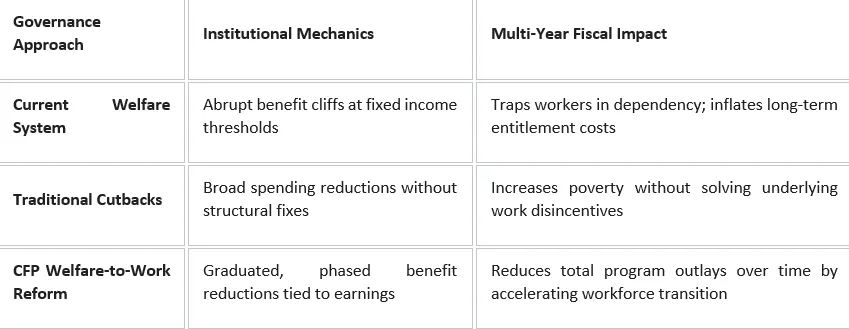
The welfare benefit cliff is not a fiscally conservative feature of the current safety net; it is a fiscally destructive one. It traps individuals in government dependency that ultimately costs the federal ledger far more in long-range program expenditures than a well-designed transition to full employment ever would.
The Center Forward Party's welfare-to-work reform-which phases benefits down gradually rather than eliminating them at the exact point of employment-is far more fiscally conservative than the current status quo. It reduces net expenditures over time, expands the national tax base, and produces vastly superior social and economic outcomes by every measurable metric.
The Tariff Problem and Honest Revenue Analysis
The fiscal reality confronting the nation in 2026 illustrates the catastrophic cost of managing macroeconomic policy through executive impulse rather than rigorous administrative oversight.
The Congressional Budget Office (CBO) projects that the federal deficit reached $1.8 trillion in the first ten months of fiscal year 2026 alone-marking a $169 billion expansion compared to the exact same period a year earlier. The sweeping tariff policies that were repeatedly sold to the American public as a revenue windfall have instead generated profound economic friction and fiscal volatility.
Following the Supreme Court's landmark 2026 ruling that the administration lacked the legal authority to impose broad-based tariffs under the International Emergency Economic Powers Act (IEEPA), the primary legal foundation for those duties collapsed. The subsequent replacement tariffs, rushed through emergency administrative channels, generate significantly less revenue while continuing to disrupt global supply chains.
The CBO now projects that changes in trade policy through July 2026 will result in total cumulative deficits that are $0.9 trillion larger over the 2027 to 2036 period than was projected in the February 2026 baseline. Nearly a trillion dollars in additional debt has been added to the national balance sheet-not to rebuild domestic infrastructure, enhance workforce skills, or fund scientific research, but as the direct collateral damage of tariff policy chaos.
This unfolding fiscal crisis is an expensive object lesson in the difference between revenue policy designed for political headlines and revenue policy designed for long-term fiscal outcomes. Tariffs were marketed simultaneously as a coercive diplomatic lever and an endless revenue stream. When subjected to real-world market dynamics and constitutional scrutiny, the strategy buckled.
Real fiscal conservatism would have subjected those tariff revenue projections to independent, data-driven expert review before they were enacted. The Central Apolitical Organization (CAO) proposed by the Center Forward Party would have provided precisely that pre-implementation audit, exposing the revenue flaws and legal vulnerabilities before they cost American taxpayers nearly a trillion dollars.
The Revenue Side Cannot Be Ignored
A honest assessment of fiscal conservatism requires admitting a truth that traditional political narratives routinely avoid: genuine fiscal discipline requires objective accounting on the revenue side of the ledger.
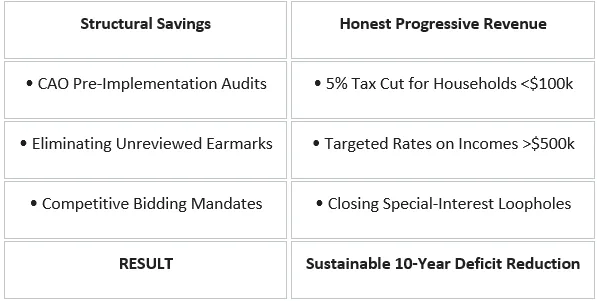
This is precisely where politicians who claim the "fiscal conservative" label typically lose all administrative credibility. You cannot legitimately claim to be committed to reducing the national debt while simultaneously slashing the tax revenues required to service that debt-unless you introduce spending reductions of equivalent or greater magnitude. Given that decades of political promises regarding massive spending cuts have consistently failed to materialize after elections, relying on unbacked revenue reductions is mathematically irresponsible.
The Center Forward Party’s progressive taxation framework presents a mathematically sound alternative:
1. 1. Targeted Relief for Main Street: Reduces federal income tax rates by five percentage points for households earning below $100,000, placing real purchasing power directly back into the hands of middle-class consumers who drive main-street economic velocity.
2.
3. 2. High-Earner Adjustments: Modestly increases marginal tax rates on annual incomes exceeding $500,000, ensuring that the federal government collects the revenue necessary to systematically close the deficit.
4.
5. 3. Closing Special-Interest Loopholes: Eliminates preference provisions that allow capital gains and corporate structures to evade standard taxation.
This framework is fiscally conservative in the truest sense of the term. It generates the predictable revenue required to restore fiscal solvency over a ten-year horizon while directing economic relief precisely where it generates the highest velocity of consumer demand and local business growth.
Conclusion: Honest Arithmetic for Governance
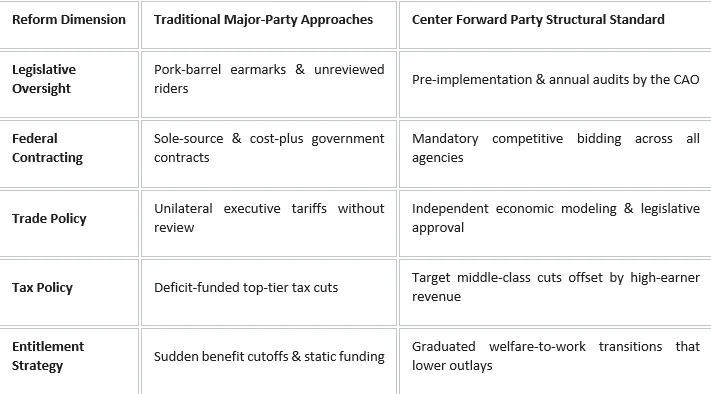
Real fiscal conservatism in 2026 looks like the Center Forward Party's platform: independent expert review of all major legislation prior to passage and annually thereafter, strict competitive bidding requirements on federal contracts, welfare-to-work reform that lowers long-range costs by creating real pathways to independence, progressive taxation that raises sufficient revenue to close the deficit over a ten-year horizon, and the permanent elimination of the special-interest pork-barrel spending that adds $27 billion annually to the national budget without oversight.
Neither major political party is offering this platform. One party offers sweeping tax cuts without the discipline to reduce spending, driving the debt higher during economic expansions. The other party offers perpetual spending increases without revenue realism, ignoring the long-term dangers of sovereign debt accumulation.
The Center Forward Party rejects both forms of fiscal fantasy. It offers the transparent arithmetic, administrative controls, and operational discipline that genuine fiscal conservatism has always demanded.
Explore the complete, data-backed fiscal platform at thecenterforwardparty.com and join the movement for responsible, evidence-based governance today.
Related Reading
Why Entertainment & Pop Culture is Transforming the Global Industry Landscape
Welcome to our in-depth exploration of Entertainment & Pop Culture. In an er...
The Ultimate Guide to Understanding Entertainment & Pop Culture in 2026
Welcome to our in-depth exploration of Entertainment & Pop Culture. In an er...