What Does IMA Mean in Text? Clear Explanation for Beginners (2026 Guide)
151 Views
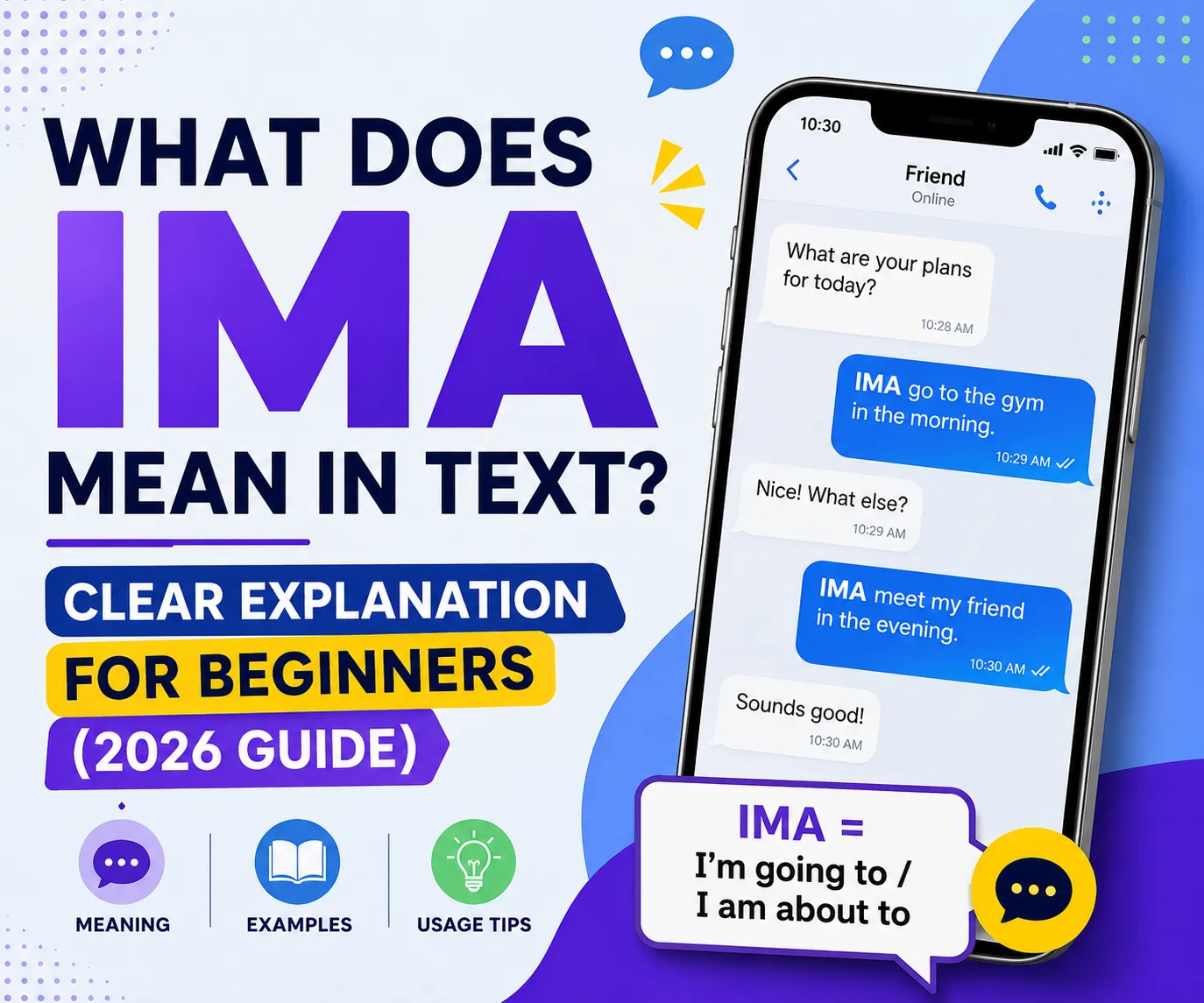
If you've recently received a text message that says "IMA", you might be wondering what it means. Texting slang and internet abbreviations continue to evolve every year, making online communication faster and more convenient. Whether you're chatting with friends, using social media, or sending messages through apps, understanding common abbreviations can help you communicate more effectively.
In this guide, you'll learn the meaning of IMA, how people use it in text conversations, examples of its usage, and other related slang terms. By the end, you'll have a clear understanding of this popular texting abbreviation.
What Does IMA Mean in Text?
IMA is a shortened form of the phrase "I'm going to" or "I am about to."
People use it in casual texting, online chats, and social media conversations to save time and type fewer characters. Instead of writing the full phrase, they simply write "IMA."
Examples:
- IMA call you later.
- IMA head home now.
- IMA finish my homework before dinner.
- IMA watch a movie tonight.
In each example, "IMA" replaces "I'm going to."
Full Sentences:
- IMA call you later → I'm going to call you later.
- IMA leave now → I'm going to leave now.
- IMA eat lunch → I'm about to eat lunch.
The abbreviation is extremely common among younger internet users and mobile phone users.
Origin of IMA
The abbreviation "IMA" comes from the way many English speakers pronounce the phrase "I'm gonna" or "I'm going to" during casual speech.
For example:
- I'm going to leave.
- I'm gonna leave.
- Ima leave.
Over time, people started typing the spoken version as "IMA" in text messages and online chats.
The term became popular through:
- SMS texting
- Online forums
- Social media platforms
- Gaming communities
- Messaging apps
Today, it remains widely used across digital communication.
How Is IMA Used in Texting?
IMA is generally used when someone is talking about an action they plan to do very soon.
It often expresses:
1. Future Intentions
The most common use is to show what someone plans to do next.
Examples:
- IMA study for my exam.
- IMA take a nap.
- IMA clean my room.
2. Immediate Actions
Sometimes it means the action is about to happen right away.
Examples:
- IMA log off now.
- IMA send the file.
- IMA head out.
3. Casual Conversations
IMA helps make messages shorter and more conversational.
Example:
Friend: Want to play later?
You: Sure, but IMA finish dinner first.
Examples of IMA in Real Conversations
Example 1
Friend: Are you coming to the party?
You: Yeah, IMA get ready now.
Example 2
Friend: Did you finish the project?
You: Not yet. IMA work on it tonight.
Example 3
Friend: Call me when you're free.
You: Okay, IMA call you after work.
Example 4
Friend: What are you doing?
You: IMA watch a new series on Netflix.
These examples show how naturally the abbreviation fits into everyday conversations.
Is IMA Formal or Informal?
IMA is highly informal.
It should only be used in:
- Text messages
- Social media comments
- Online chats
- Casual conversations
- Messaging apps
Avoid using IMA in:
- Business emails
- Academic writing
- Professional documents
- Job applications
- Formal communication
Formal Alternative
Instead of:
- IMA send the report tomorrow.
Write:
- I am going to send the report tomorrow.
Professional communication should always use complete words and proper grammar.
IMA vs I'ma
You may also see the abbreviation written as:
- I'ma
- Ima
- IMA
All three versions generally mean the same thing.
Examples
- I'ma leave now.
- Ima leave now.
- IMA leave now.
The meaning remains:
"I'm going to leave now."
The choice depends on personal preference and typing style.
Why Do People Use IMA?
There are several reasons why texting abbreviations remain popular.
1. Faster Typing
Writing "IMA" takes less time than typing "I'm going to."
2. Casual Tone
It sounds relaxed and friendly.
3. Mobile Convenience
Shortened words are easier to type on smartphones.
4. Internet Culture
Online communities frequently create abbreviations to make communication quicker.
Because of these benefits, IMA continues to be widely used in 2026.
Other Meanings of IMA
Although "I'm going to" is the most common texting meaning, IMA can occasionally stand for different phrases depending on the context.
Examples include:
- Institute of Management Accountants
- International Medical Association
- Information Management Application
However, these meanings are typically found in professional or organizational settings.
When used in texting or social media, IMA almost always means:
"I'm going to" or "I am about to."
Similar Texting Slang to IMA
If you're learning internet abbreviations, you may also encounter these common terms.
BRB
BRB = Be Right Back
Example:
- BRB, I need to answer the door.
IMO
IMO = In My Opinion
Example:
- IMO, that movie was amazing.
IDK
IDK = I Don't Know
Example:
- IDK what time the event starts.
TBH
TBH = To Be Honest
Example:
- TBH, I liked the first season more.
BTW
BTW = By The Way
Example:
- BTW, thanks for helping me.
NTY
NTY = No Thank You
Example:
- NTY, I'm not interested.
Learning these abbreviations can make online conversations easier to understand.
Should You Use IMA?
Yes, if you're communicating in casual environments.
IMA works well when:
- Texting friends
- Messaging family
- Chatting online
- Posting on social media
- Talking in gaming communities
However, avoid it when professionalism is important.
A good rule is:
If you would normally use slang while speaking, IMA is probably acceptable.
Common Mistakes When Using IMA
Using It in Professional Emails
Incorrect:
- IMA send the proposal tomorrow.
Correct:
- I am going to send the proposal tomorrow.
Confusing It with Organizations
In professional discussions, IMA may refer to organizations rather than texting slang.
Always check the context.
Using It in Academic Writing
Essays and reports should use proper grammar instead of internet abbreviations.
Frequently Asked Questions
What does IMA stand for in texting?
IMA stands for "I'm going to" or "I am about to."
Is IMA a real word?
No. It is an informal internet abbreviation used in digital communication.
Is IMA rude?
No. It is generally considered friendly and casual.
Can adults use IMA?
Yes. Anyone can use it in informal conversations.
Is IMA still popular in 2026?
Yes. It remains a common abbreviation across texting apps, social media platforms, and online communities.
Final Thoughts
The abbreviation IMA is a simple and popular texting shortcut that means "I'm going to" or "I am about to." It helps people communicate quickly and naturally in text messages, social media posts, and online chats.
For example:
- IMA call you later.
- IMA leave now.
- IMA finish this project tonight.
While it works perfectly in casual conversations, it should be avoided in professional or academic settings where complete sentences are expected.
As texting language continues to evolve in 2026, understanding abbreviations like IMA can help you stay up to date with modern online communication and avoid confusion when chatting with others.
Related Reading
Expert Insights: Navigating the Complex World of Education & Learning
Welcome to our in-depth exploration of Education & Learning. In an era defin...
Why Education & Learning is Transforming the Global Industry Landscape
Welcome to our in-depth exploration of Education & Learning. In an era defin...