What Are the Latest Trends in Big Data That Will Shape 2026?
By Isha Verma
115 Views
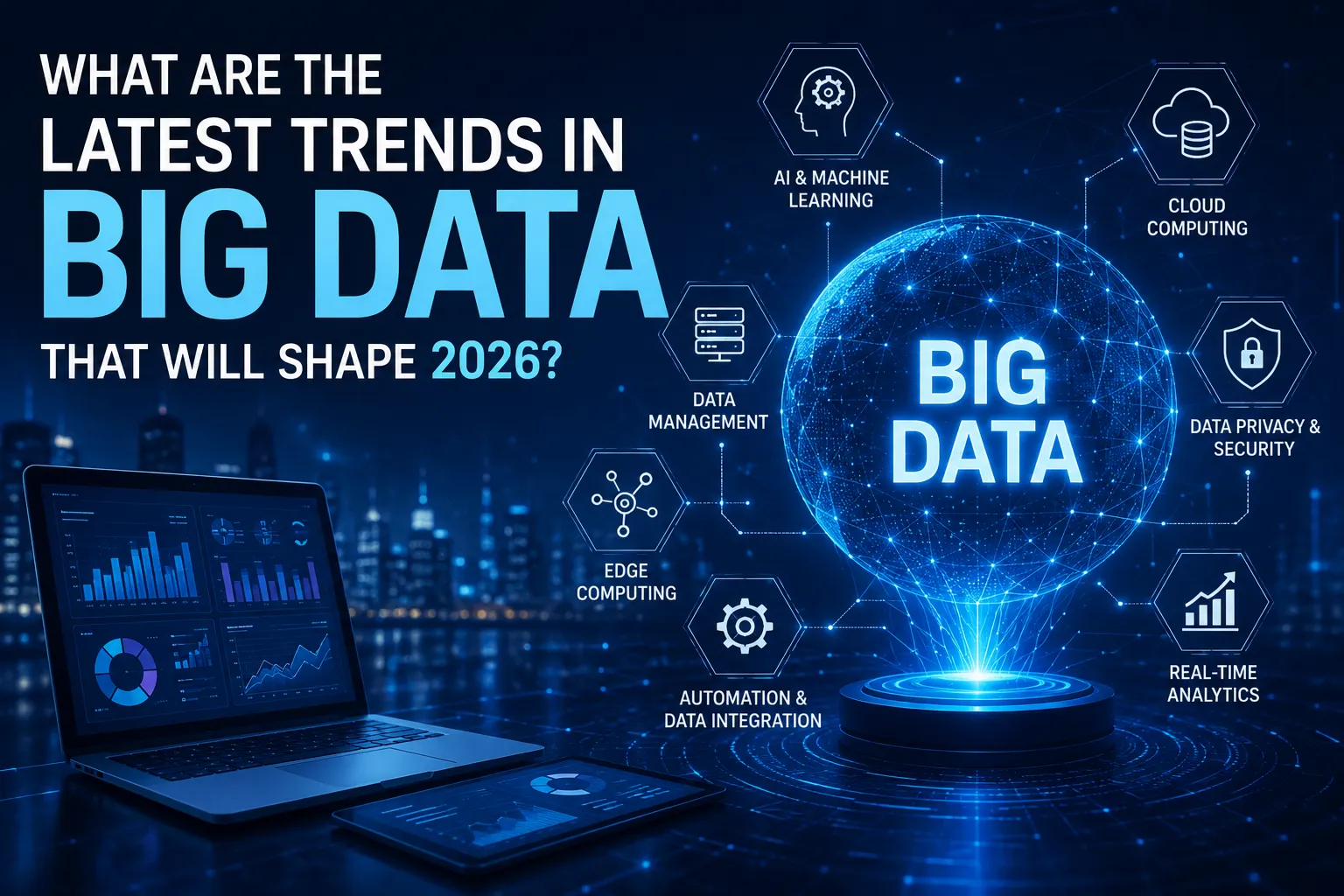
Businesses are generating more information than ever before, making data one of the most valuable assets for growth and innovation. Understanding the latest Big Data trends 2026 helps organizations make smarter decisions, improve customer experiences, and stay ahead of the competition. From artificial intelligence and cloud computing to automation and real-time analytics, data-driven technologies are transforming how companies operate across every industry.
AI Is Making Business Intelligence Smarter
Artificial intelligence (AI) is changing the way organizations analyze information. Modern AI systems can identify patterns, predict customer behavior, and automate repetitive tasks with remarkable accuracy. Businesses are using AI-powered analytics to improve forecasting, optimize supply chains, detect fraud, and personalize customer experiences. When combined with Big Data, AI enables organizations to process massive datasets more efficiently and generate insights that support faster, more informed business decisions. This combination is becoming an essential part of digital transformation strategies in 2026.
Real-Time Analytics Is the New Business Standard
Traditional reporting methods often deliver information hours or even days after events occur. Today's businesses require immediate insights to respond quickly to changing customer demands and market conditions. Real-time analytics allows organizations to monitor transactions, track operations, and detect issues as they happen. Industries such as banking, healthcare, manufacturing, retail, and logistics are increasingly relying on live data to improve efficiency and reduce operational risks.
Cloud Platforms Continue to Drive Growth
Cloud technology has transformed the way businesses store and manage information. Instead of maintaining expensive physical infrastructure, organizations are adopting cloud-based platforms that provide scalability, flexibility, and cost savings. Cloud solutions also make collaboration easier by allowing employees to securely access business data from anywhere. As organizations expand globally, hybrid and multi-cloud environments continue to support business continuity and operational efficiency.
Data Privacy and Cybersecurity Are More Important Than Ever
As businesses collect increasing amounts of customer information, protecting sensitive data has become a top priority. Governments around the world are introducing stricter privacy regulations, encouraging companies to strengthen their cybersecurity strategies. Encryption, multi-factor authentication, continuous monitoring, and zero-trust security frameworks are becoming standard practices. Strong data governance not only helps organizations remain compliant but also builds customer trust and protects valuable business assets.
Edge Computing Improves Speed and Performance
Edge computing processes information closer to where it is generated rather than sending everything to centralized data centers. This significantly reduces latency and improves the performance of applications that require instant responses. Industries using Internet of Things (IoT) devices, autonomous vehicles, smart factories, and healthcare monitoring systems are adopting edge computing to deliver faster services while reducing network congestion.
Automation Is Simplifying Data Management
Automation continues to reduce the complexity of managing large datasets. AI-powered tools can clean information, identify inconsistencies, generate reports, and monitor system performance with minimal human intervention. By automating repetitive processes, organizations improve data quality, reduce operational costs, and allow employees to focus on innovation and strategic business initiatives instead of routine administrative work.
Why Big Data Conferences Matter in 2026?
Technology is evolving rapidly, making continuous learning essential for business professionals. Big Data Conferences provide opportunities to discover emerging technologies, learn from industry experts, and explore practical business applications. These events cover topics such as artificial intelligence, cloud computing, cybersecurity, predictive analytics, data governance, and enterprise analytics. Attending Big Data Conferences also helps professionals build valuable networks and stay informed about industry best practices.
What's Next for Big Data?
The future of Big Data trends 2026 extends beyond simply collecting information. Businesses are investing in intelligent analytics, automation, predictive technologies, and responsible AI to transform raw information into meaningful business value. Organizations that embrace innovation, strengthen data governance, and invest in modern analytics platforms will be better prepared to improve customer experiences, increase operational efficiency, and remain competitive in an increasingly digital marketplace.
The technologies shaping Big Data in 2026 are creating new opportunities for organizations to innovate and grow. AI-powered analytics, real-time processing, cloud platforms, stronger cybersecurity, edge computing, and automation are helping businesses make faster and smarter decisions. By staying informed about emerging technologies and adopting modern data strategies, organizations can confidently prepare for the future and maintain a competitive advantage in the years ahead.
Related Blogs You May Find Helpful:
Related Reading
Expert Insights: Navigating the Complex World of Education & Learning
Welcome to our in-depth exploration of Education & Learning. In an era defin...
Why Education & Learning is Transforming the Global Industry Landscape
Welcome to our in-depth exploration of Education & Learning. In an era defin...