What Are Behavior Based Interview Questions? A Plain-English Guide (With Examples)
By Career Zeno
19 Views
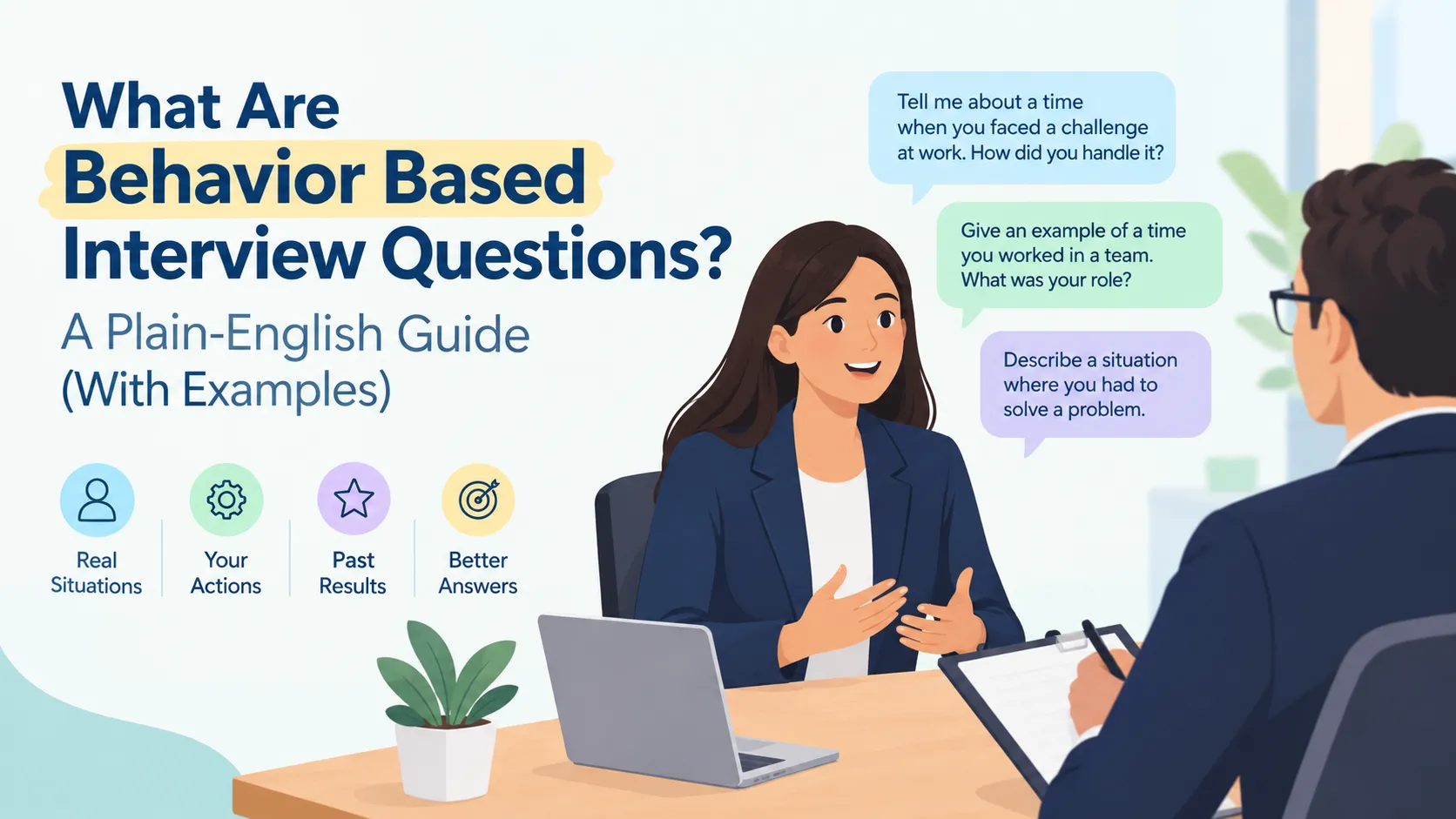
You're sitting in an interview, things are going fine, and then the interviewer leans back and says, "Tell me about a time you disagreed with a coworker." Your mind goes blank. Sound familiar? If you've ever wondered what are behavior based interview questions and why they feel so much harder than "What are your strengths?", you're in good company. Almost everyone freezes the first time.
The good news is that these questions follow a pattern, and once you see the pattern, they get much easier to handle. In this guide, I'll explain what behavior based interview questions are, why employers love them, and how to prepare answers that sound natural instead of rehearsed. No jargon, I promise.
So, What Are They, Exactly?
Behavior based interview questions ask you to describe something you've actually done in the past. Instead of asking what you would do, the interviewer asks what you did.
The thinking behind it is simple: how you handled situations before is a decent clue to how you'll handle similar situations in the future. Rather than taking your word that you're "a great team player," they'd like to hear a real story that shows it.
You'll often hear them called behavioral interview questions. Same thing, different spelling.
Why Employers Ask Them
If you've ever found these questions a bit annoying, it helps to see it from the other side. Interviewers have a tricky job. They have maybe 30 to 60 minutes to figure out whether a stranger will do well in a role. Everyone says they're hard-working and good with people, so those claims don't help much.
A real example is harder to fake. It shows:
-
How you think through problems
-
How you act under pressure
-
How you work with other people
-
What you consider important
-
Whether you learn from mistakes
It also makes it easier for employers to compare candidates fairly, since everyone gets asked about the same kinds of situations.
How to Spot One
Behavior based questions almost always start with a phrase like:
-
"Tell me about a time when..."
-
"Give me an example of..."
-
"Describe a situation where..."
-
"Can you walk me through a time you..."
-
"Have you ever had to..."
If you hear one of those openers, take a breath. They want a story with a beginning, middle, and end.
Common Examples by Theme
Here are some questions you're likely to run into, grouped by what the interviewer is really trying to learn.
Teamwork
-
Tell me about a time you worked with a difficult teammate.
-
Describe a project where you had to rely on others to get it done.
Problem-solving
-
Give me an example of a problem you solved with limited information.
-
Tell me about a time something went wrong and how you handled it.
Communication
-
Describe a time you had to explain something complicated to someone unfamiliar with it.
-
Tell me about a time you had to deliver bad news.
Leadership and initiative
-
Tell me about a time you took the lead without being asked.
-
Describe a goal you set and how you achieved it.
Time management
-
Tell me about a time you juggled multiple deadlines.
-
Describe a situation where you had to prioritize quickly.
Handling mistakes and feedback
-
Tell me about a mistake you made and what you did next.
-
Describe a time you received criticism and how you responded.
You won't get all of these, but most interviews include a handful.
The STAR Method (Your New Best Friend)
STAR is a simple way to organize your story so you don't ramble or forget the important bits.
-
S: Situation. Set the scene in a sentence or two.
-
T: Task. Explain what you needed to achieve or what your role was.
-
A: Action. Describe what you did, step by step.
-
R: Result. Share how it turned out and what you learned.
The biggest tip I can give you: spend most of your time on the Action and Result. Many people spend too long on background and then rush through the part the interviewer actually cares about.
A Sample Answer, Start to Finish
Question: "Tell me about a time you handled a tight deadline."
Situation: In my final semester, I was leading a group project on market research, and two days before the deadline, one teammate fell ill and couldn't finish the data analysis.
Task: I needed to make sure we still submitted a complete, accurate report on time.
Action: I reorganized the remaining work, took over the analysis myself, and asked another teammate to handle formatting and proofreading. I also set a quick check-in each evening so nobody was surprised by changes.
Result: We submitted on time and earned one of the highest marks in the class. It also taught me to speak up early about problems and to share the workload fairly instead of trying to handle everything alone.
That answer takes about a minute and a half to say out loud, which is just right.
Behavior Based vs. Situational Questions
People often mix these up, so here's the quick difference.
-
Behavior based: "Tell me about a time you handled conflict." (Past experience)
-
Situational: "What would you do if two team members disagreed about a plan?" (Hypothetical)
For situational questions, you describe how you'd approach something. For behavior based ones, you tell a real story. If you get a situational question and you have a relevant real example, it's perfectly fine to say, "I actually faced something similar once..."
Build a Story Bank
Here's a trick that saves a lot of stress. Instead of preparing a separate answer for every possible question, prepare five to seven good stories that you can adapt.
-
Jot down moments from work, school, volunteering, or projects where something interesting happened.
-
Pick a mix: one success, one challenge, one mistake, one teamwork story, one leadership moment, one time you handled pressure.
-
Write each in STAR format using a few bullet points, not a full script.
-
Practice saying them out loud.
One strong story can often answer several different questions. A story about a tough group project might work for teamwork, conflict, communication, and deadlines, depending on which part you emphasize.
What If You Don't Have Much Experience?
This worry comes up a lot, especially for students and first-time job seekers. You don't need formal work history. Good stories can come from:
-
Class projects and group assignments
-
Clubs, sports, and societies
-
Volunteering
-
Part-time or casual jobs
-
Helping family with a business or event
-
Personal projects or hobbies
What matters is that you describe what you did, why you did it, and what happened.
Mistakes People Make
Giving a hypothetical answer-. If the question starts with "Tell me about a time," don't say "I would usually..." Tell a real story.
Saying "we" the whole time- Teamwork is great, but the interviewer wants to know your part.
Skipping the result- An answer without an ending feels unfinished.
Picking a story that makes you look bad and not explaining the lesson- Mistakes are fine, as long as you show what you learned.
Rambling- Aim for one to two minutes per answer.
Memorizing a script- It sounds stiff. Know your key points instead.
Blaming others- Even when someone else caused the problem, focus on how you handled it.
A Few Tips for the Day Itself
-
It's okay to pause for a few seconds before answering. It looks thoughtful, not unprepared.
-
If you're stuck, ask, "Could I take a moment to think of a good example?"
-
Keep your tone natural, as if you're telling a story to a colleague.
-
End by connecting your story back to the role, if it fits.
-
Be honest. Interviewers can often tell when a story has been stretched.
One Last Thing
Behavior based interview questions can feel intimidating, but they're really just an invitation to tell your story. Pick a few moments that show your strengths, shape them with the STAR method, and practice until they come out naturally. You don't need to be perfect. You just need to be clear, honest, and a little bit prepared.
If you'd like more practical support with interview preparation, resumes, and cover letters, you can explore the resources at CareerZeno, where we aim to help you walk into your next interview feeling more confident and less stressed.
Related Reading
Expert Insights: Navigating the Complex World of Education & Learning
Welcome to our in-depth exploration of Education & Learning. In an era defin...
Why Education & Learning is Transforming the Global Industry Landscape
Welcome to our in-depth exploration of Education & Learning. In an era defin...