Veterinary Orthopedic Instruments — Understanding the Essential Categories
5 Views
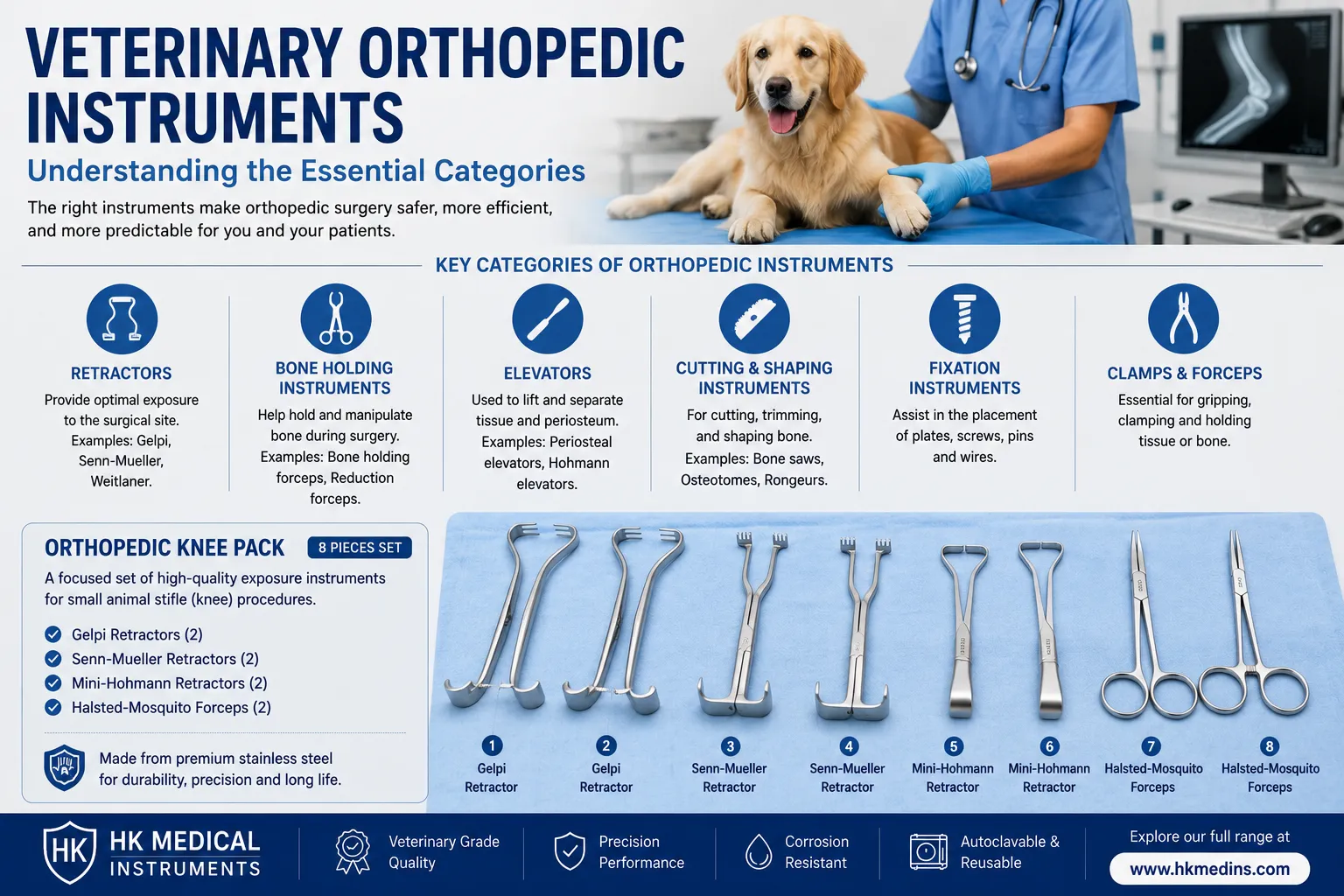
orthopedic procedures require a carefully selected range of instruments to support exposure, handling, fixation, and other stages of surgery. For veterinary clinics, purchasing orthopedic equipment is not simply a matter of choosing a large instrument set. The appropriate selection depends on the procedure, the patient's size, the surgeon's technique, and the equipment already available in the operating theatre.
Understanding the main instrument categories helps veterinary practices plan their inventory, compare products, and avoid purchasing items that do not fit their clinical requirements.
What are veterinary orthopedic instruments?
Veterinary orthopedic instruments are tools used by trained veterinary professionals during procedures involving bones, joints, and associated structures. Depending on the operation, the instrument inventory may include retractors, elevators, clamps, bone-holding tools, cutting instruments, and specialised equipment for fixation.
The exact requirements differ between procedures. A small-animal stifle operation, for example, may require a different exposure setup from a fracture repair or a procedure involving a larger patient.
Clinics should therefore build their instrument lists around specific surgical workflows rather than treating every orthopedic procedure as identical.
Understand the main instrument categories
Retractors help maintain access to the operative field. Different patterns are designed for different depths, incision sizes, and tissue requirements. The selected retractor should provide appropriate exposure without placing unnecessary pressure on surrounding structures.
Bone-holding instruments help control bone during specific stages of an operation. Their design and capacity must match the intended use and the surgeon's preferred technique.
Elevators and related instruments may be used to separate or mobilise tissue and other structures where indicated. The name of an instrument alone does not establish that it is suitable for a particular orthopedic task.
Cutting and shaping instruments vary according to their intended application. Their compatibility with the procedure and any associated equipment must be confirmed before purchase.
Fixation equipment may include specialised instruments associated with plates, screws, wires, or other systems. These requirements are procedure-dependent and should be checked against the manufacturer's specifications.
Why instrument exposure matters
A stable, appropriately exposed surgical field can make instrument handling more manageable. Retractors are therefore an important part of orthopedic planning, but size and tip configuration deserve attention.
For example, HK Medical Instruments lists an Orthopedic Knee Pack, 8 Pieces. The listed set includes Gelpi retractors, Senn-Mueller retractors, Mini-Hohmann retractors, and a Halsted-Mosquito forcep.
This is a focused exposure-oriented pack rather than a complete solution for every orthopedic procedure. Implants, measuring tools, cutting guides, and other specialised equipment may need to be selected separately.
Choose sizes according to the patient and procedure
The patient's size is one factor when selecting orthopedic instruments, but it should not be the only one. The required depth of access, incision length, tissue characteristics, and surgeon preference also influence selection.
A retractor that is too large may obstruct the working area or place unnecessary pressure on tissues. One that is too small may not provide the required exposure. Clinics should compare actual dimensions and working-end configurations instead of relying solely on descriptions such as “small animal” or “general purpose.”
Where several surgeons work in the same practice, documenting preferred sizes can improve consistency. It also makes future purchasing and replacement easier because the clinic can compare new instruments with an established specification list.
Inspect quality and construction before purchasing
Orthopedic instruments must tolerate the demands of their intended use. Buyers should review material specifications, joint construction, locking mechanisms, surface finish, and manufacturer care instructions.
Inspect movable parts for smooth operation and check that the instrument opens, closes, locks, and releases as intended. Look for visible defects, misalignment, corrosion, or rough edges. A product description can support purchasing decisions, but physical inspection and appropriate quality checks remain important.
Clinics should also confirm whether an instrument is reusable and whether its reprocessing requirements fit the practice's validated cleaning and sterilisation workflow.
Plan the complete orthopedic workflow
A purchasing checklist should extend beyond the instruments used during the operation itself. Consider preparation, sterile storage, instrument transport, reprocessing, inspection, and replacement.
Separate the core orthopedic inventory from procedure-specific equipment. Label sets clearly and record the individual instruments included in each pack. Before a scheduled procedure, staff can use the checklist to identify missing or damaged items and confirm that all required equipment is available.
This approach is particularly useful when several teams share instruments or when the practice performs different orthopedic procedures on the same day.
Frequently asked questions
Is an orthopedic knee pack suitable for every orthopedic operation?
No. A knee pack may provide selected exposure instruments, but different operations require different combinations. Confirm the pack contents against the surgeon's procedure-specific checklist.
What should clinics check before purchasing orthopedic retractors?
Review the length, blade or prong design, opening range, intended tissue application, and manufacturer's specifications. The choice should match the procedure and the surgeon's technique.
Should a clinic buy all orthopedic instruments at once?
Not necessarily. Practices can prioritise equipment for their established procedures and expand the inventory as services develop. Essential requirements must still be met before undertaking each procedure.
Final thoughts
Choosing veterinary orthopedic instruments requires attention to procedure requirements, patient size, instrument dimensions, quality, and workflow. A focused inventory plan helps clinics select appropriate equipment without assuming that one pack can cover every operation. Reviewing product specifications and maintaining a consistent inspection process supports better organisation over the working life of the instruments.