VAWA Requirements for Abuse Victims: What to Know
By Naqash jay
22 Views
For someone experiencing abuse in a relationship, immigration status can become another source of fear and uncertainty. The Violence Against Women Act (VAWA) provides certain immigrants with a way to seek immigration protection without relying on the abusive family member to file an immigration petition for them.
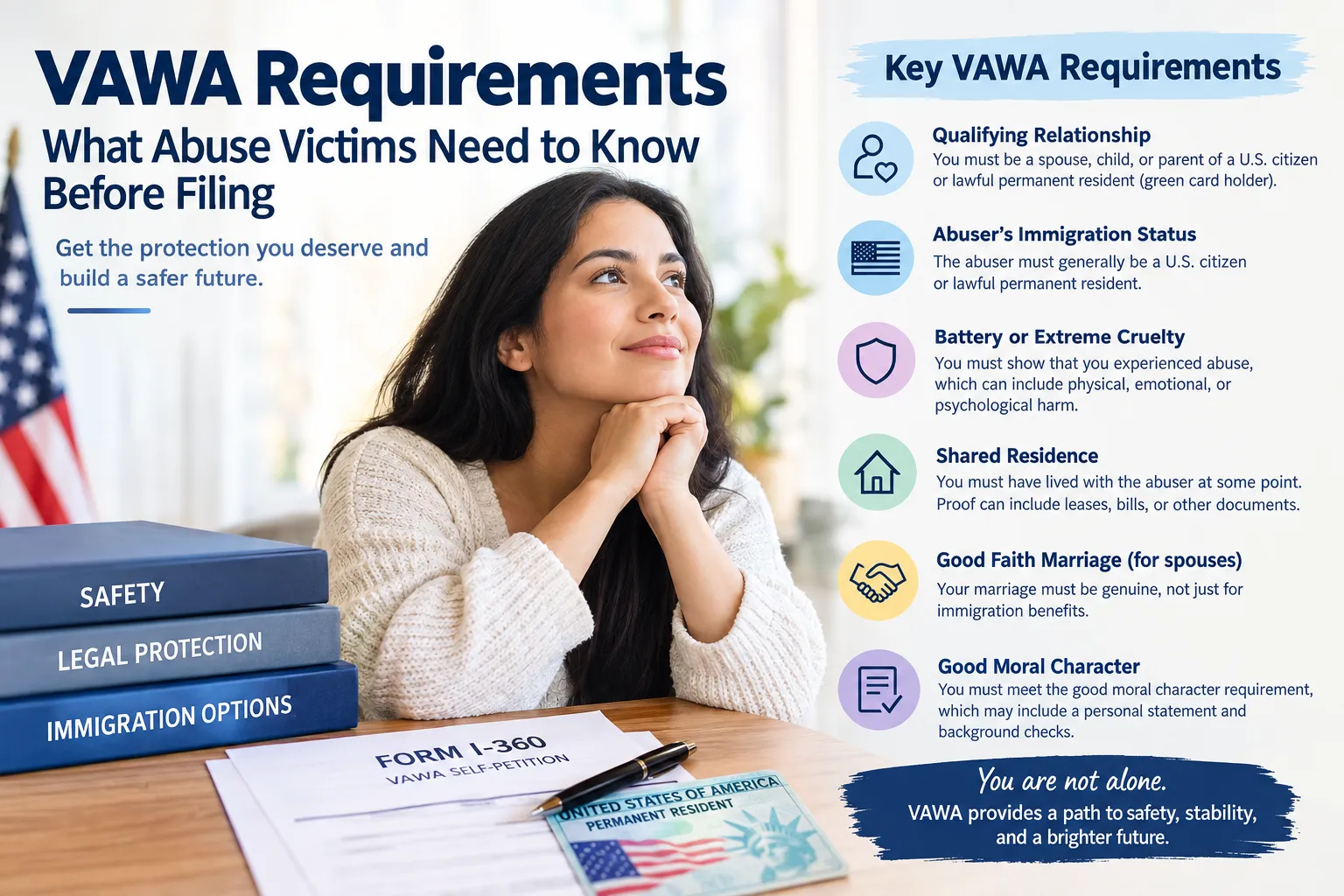
Understanding the VAWA requirements is an important first step. Eligibility depends on several factors, including the relationship with the abuser, the abuser’s immigration status, the abuse involved, shared residence, good moral character, and other immigration requirements.
VAWA protections are available to qualifying spouses, children, and parents, and the law applies regardless of the applicant's gender. USCIS allows eligible individuals to file a VAWA self-petition without the participation or knowledge of the abusive relative.
Who May Qualify for VAWA?
VAWA self-petitioning is generally available to certain individuals who experienced battery or extreme cruelty from a qualifying U.S. citizen or lawful permanent resident.
Potential applicants include:
- A spouse of an abusive U.S. citizen or lawful permanent resident
- A child of an abusive U.S. citizen or lawful permanent resident
- A parent abused by a U.S. citizen son or daughter who is at least 21 years old
In some circumstances, a person may still qualify even though the qualifying relationship has ended. For example, USCIS rules provide certain protections involving divorce, the death of the abusive spouse, or loss of the abuser's immigration status when specific conditions and filing deadlines are met.
What Are the Main VAWA Requirements?
The exact requirements depend on whether the person is filing as a spouse, child, or parent. However, several eligibility factors commonly apply.
1. You Must Have a Qualifying Family Relationship
The relationship between the applicant and abuser must generally fall within the categories recognized under VAWA.
For example, a qualifying spouse may have been married to a U.S. citizen or lawful permanent resident. A qualifying child may have been abused by a U.S. citizen or permanent resident parent. A parent may qualify when the abusive son or daughter is a U.S. citizen who is at least 21 years old.
Documentation such as marriage certificates, birth certificates, divorce records, or other relationship evidence may help establish the qualifying relationship.
2. The Abuser Must Have the Required Immigration Status
For many VAWA self-petitions, the abuser must be a U.S. citizen or lawful permanent resident.
This requirement is especially important for people researching permanent residents because lawful permanent resident status can establish the required relationship for certain VAWA spouse or child cases.
VAWA eligibility can become more complicated if the abuser's immigration status changed. Certain special filing rules may apply when the abuser loses citizenship or permanent resident status because of an incident involving domestic violence.
3. Battery or Extreme Cruelty Must Be Established
VAWA is not limited to situations involving physical injuries. The law also recognizes extreme cruelty, which can involve serious forms of controlling, threatening, or abusive behavior.
Evidence may include documentation of threats, intimidation, psychological abuse, financial control, isolation, or other conduct that may support an extreme-cruelty claim.
However, not every difficult or unhealthy relationship automatically satisfies the legal standard. USCIS reviews the evidence and determines whether the facts meet the applicable requirements. USCIS decisions also emphasize that credible evidence is considered, but the agency determines what evidence is credible and how much weight it receives.
4. You Generally Must Have Lived With the Abuser
Another important requirement involves residence.
A VAWA self-petitioner generally must have resided with the U.S. citizen or lawful permanent resident abuser at some point. Evidence showing a shared residence can include leases, utility records, correspondence, insurance documents, financial records, photographs, or other documents connecting both individuals to the same home.
The evidence does not necessarily have to come from only one type of document. USCIS states that relevant, credible evidence may be submitted to establish eligibility.
Good Faith Marriage Can Be Important
For a VAWA spouse self-petition, the marriage generally must have been entered into in good faith.
This means the marriage was entered into because the couple intended to establish a genuine marital relationship, rather than primarily for an immigration benefit.
Evidence can include joint financial records, photographs, correspondence, insurance documents, lease agreements, children's records, or statements from people familiar with the relationship.
The purpose is to help establish the history and nature of the marriage rather than simply proving that a marriage certificate exists.
Good Moral Character Is Another Requirement
A VAWA applicant generally must establish good moral character.
USCIS guidance explains that an applicant's personal affidavit can be important evidence, and police clearances or state criminal background checks may also be relevant. USCIS evaluates good moral character under the applicable immigration law and regulations.
A criminal history does not always mean that a VAWA case is automatically impossible. Immigration law contains specific rules and exceptions, so an applicant with an arrest, conviction, or other criminal issue should have the situation reviewed carefully before filing.
What Evidence Can Support a VAWA Case?
One common concern is the lack of traditional documentation. Abuse often happens privately, and victims may not have police reports or medical records.
USCIS permits the submission of any credible relevant evidence when evaluating VAWA self-petitions.
Potential evidence can include:
- Personal declaration describing the relationship and abuse
- Police or court records
- Medical or counseling records
- Shelter or domestic violence organization records
- Statements from relatives, friends, neighbors, or other witnesses
- Lease or housing documents
- Joint bank or financial records
- Insurance documents
- Photographs and correspondence
- Birth, marriage, or divorce records
- Evidence concerning the abuser's immigration status
The most useful evidence depends on the individual circumstances. A person should not assume that one missing document automatically prevents a VAWA filing.
Can You File Without the Abuser's Help?
Yes. One of the central features of a VAWA self-petition is that the qualifying family member does not have to file the petition for the applicant.
The applicant may submit Form I-360 as a VAWA self-petitioner. USCIS also provides special procedures for certain VAWA cases involving confidential addresses and communications.
This can be especially important when contacting the abusive family member could create additional safety concerns.
What Happens After a VAWA Self-Petition?
A VAWA self-petition is an immigration petition, not automatically a green card.
Depending on the circumstances, an eligible person may have additional immigration options after or alongside the VAWA process. These can include adjustment of status or immigrant visa processing when the applicable requirements are satisfied.
Employment authorization may also be available in certain circumstances. USCIS notes that adjudication of certain employment authorization categories connected with Form I-360 can depend on the VAWA petition decision.
Because each immigration case can involve different issues, the next step after filing depends on the applicant's immigration history and eligibility.
Avoid Common VAWA Filing Problems
Applicants can reduce avoidable problems by carefully reviewing the evidence before submitting the petition.
Common issues include incomplete forms, inconsistent dates, insufficient relationship evidence, unclear descriptions of abuse, missing documentation, or failure to address immigration or criminal-history concerns.
A detailed personal statement can help explain the circumstances in a clear chronological order. Supporting documents should then reinforce the facts described in the statement.
It is also important to use the current USCIS form instructions and filing requirements because immigration procedures can change.
When Should You Get Immigration Legal Help?
VAWA cases can involve sensitive family circumstances, immigration history, criminal records, previous applications, divorce, removal proceedings, or other complications.
An experienced Immigration Attorney can review the facts, identify potential eligibility issues, organize supporting evidence, and explain possible immigration options. Legal advice can be particularly useful when the case involves previous immigration violations, arrests, removal proceedings, or a complicated relationship history.
Most importantly, someone experiencing domestic violence should not feel that they must remain in an abusive relationship simply to maintain an immigration benefit. VAWA exists in part to provide qualifying victims with an immigration pathway that does not depend on the cooperation of the abusive family member.
Final Thoughts on VAWA Requirements
Understanding the requirements before preparing a VAWA self-petition can make the process easier to navigate. The key issues often include a qualifying relationship, the abuser's qualifying immigration status, battery or extreme cruelty, shared residence, good moral character, and, for qualifying spouses, a good-faith marriage.
The evidence in every case is different. USCIS considers relevant credible evidence, so applicants should look at the complete history of the relationship rather than focusing on one particular document.
If you believe you may qualify, reviewing your circumstances with an experienced immigration professional can help you understand which evidence and immigration options may apply to your situation.