Using AI Ethically in SEO: A Practical Guide for Marketers and Brands
112 Views
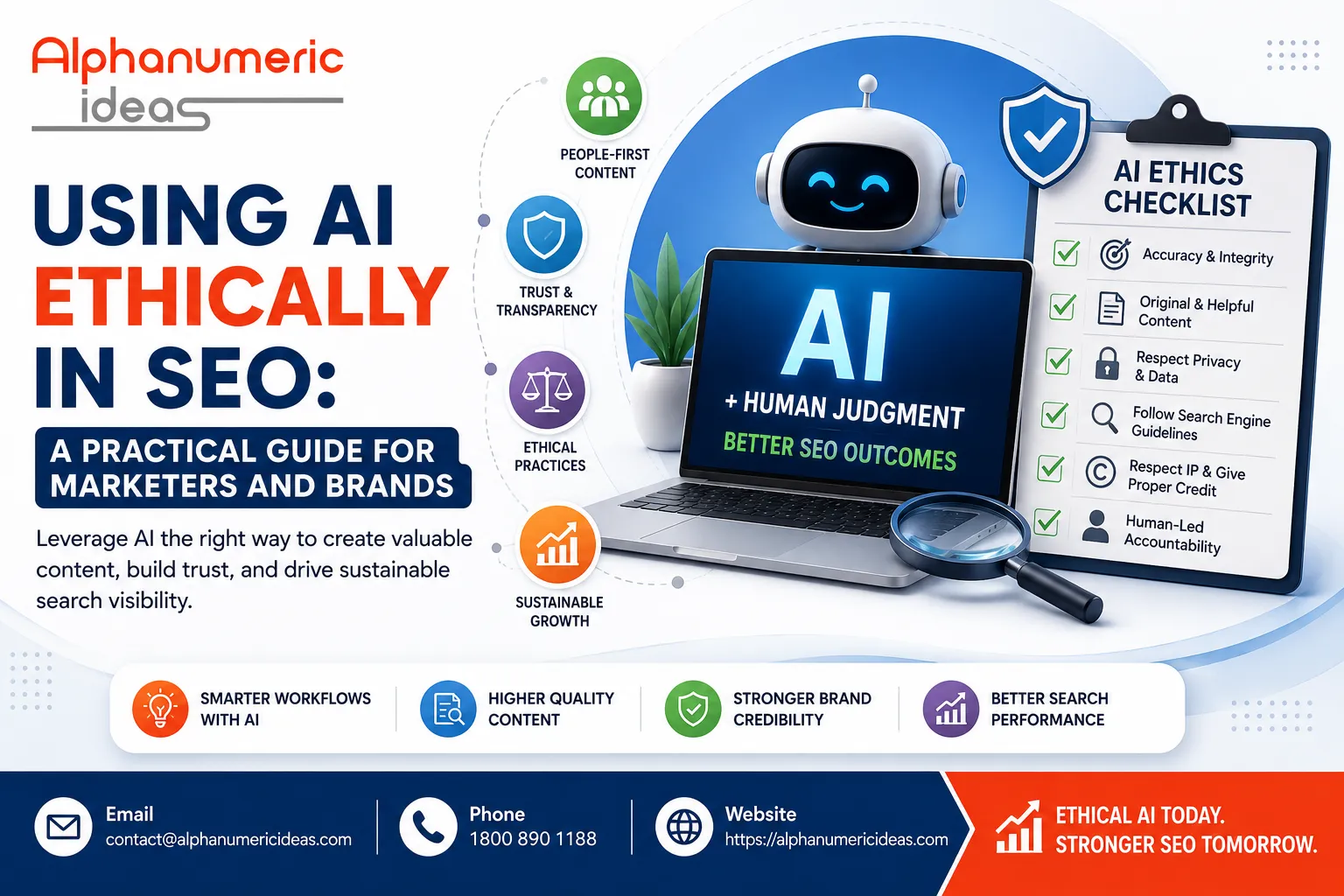
Artificial intelligence has quickly become part of modern SEO. From keyword research and content planning to data analysis and workflow automation, AI can help marketers complete repetitive tasks faster and work more efficiently.
But faster does not always mean better.
AI tools can produce inaccurate information, repetitive language, biased recommendations, or content that lacks originality and real-world experience. When businesses depend on AI without proper human oversight, they can risk damaging their search visibility, brand reputation, and customer trust.
That is why ethical AI use in SEO is becoming increasingly important.
Ethical AI in SEO means using artificial intelligence responsibly, transparently, and fairly while protecting user privacy, respecting intellectual property, and ensuring that published information is accurate and genuinely useful.
What Does Ethical AI Use Mean in SEO?
Using AI ethically does not mean avoiding AI completely. Instead, it means understanding where AI can add value and where human judgment is essential.
AI can be useful for brainstorming topics, organizing research, analyzing large datasets, identifying patterns, creating content outlines, summarizing information, or improving workflows.
However, marketers should not treat AI-generated output as automatically accurate or ready for publication.
A strong approach is AI-assisted, human-led SEO.
Humans should remain responsible for strategy, fact-checking, originality, expertise, and the final editorial decision.
Be Transparent About AI Usage
Transparency should be a core part of an ethical AI strategy.
If an agency uses AI tools during research, analysis, content planning, or other SEO activities, clients should understand how those tools are being used. Clear internal policies can also help teams determine which tasks are appropriate for AI and which require human involvement.
Transparency is particularly important when AI is used to handle customer information, proprietary business data, or content intended for public consumption.
The goal should be to use AI as an assistant rather than allowing it to operate without accountability.
Put Accuracy and Integrity First
One of the biggest challenges with generative AI is that it can produce information that sounds convincing but is incorrect.
This is particularly risky for SEO content involving statistics, financial information, healthcare, legal topics, technical subjects, product specifications, or other areas where inaccurate information can have serious consequences.
Every AI-assisted output should therefore go through human review.
SEO professionals should verify important facts against reliable sources, remove unsupported claims, check dates and statistics, and ensure that the final content reflects the intended audience and search intent.
Create Original and Helpful Content
AI can help accelerate content production, but quantity should never replace quality.
Publishing hundreds of generic AI-generated articles may create more pages, but it does not necessarily create more value for users.
Instead, businesses should focus on original insights, first-hand experience, expert opinions, examples, case studies, unique research, and genuinely useful information.
AI can help organize information, but the final content should provide something meaningful that readers cannot get from a generic collection of existing information.
This is where human expertise becomes especially valuable.
Follow Search Engine Guidelines
AI should never be used to manipulate search rankings.
Practices such as keyword stuffing, cloaking, automatically generated doorway pages, deceptive redirects, or large-scale production of low-value content can create SEO risks.
The better approach is to use AI to support legitimate SEO activities while maintaining a people-first content strategy.
Before publishing AI-assisted content, ask:
· Does this page genuinely help the reader?
· Is the information accurate?
· Does it demonstrate relevant expertise?
· Is the content original?
· Does it satisfy the user's search intent?
· Would we publish it if search engines did not exist?
If the answer to these questions is no, more AI-generated content is unlikely to solve the problem.
Protect Customer Data and Privacy
Privacy is another major consideration when using AI tools.
SEO teams often have access to customer information, analytics data, business strategies, unpublished content, credentials, and other confidential material. This information should not automatically be pasted into public AI systems.
Organizations should understand how an AI platform handles submitted information before using it for business purposes.
Companies should also establish clear rules covering:
· Confidential business information
· Customer and employee data
· Proprietary research
· Passwords and credentials
· Unpublished campaigns
· Client documents
· Personally identifiable information
For sensitive workflows, businesses should involve their legal, security, and compliance teams where appropriate.
Respect Copyright and Intellectual Property
AI-generated content can also raise intellectual property questions.
An AI system may produce wording, ideas, or information that resembles existing material. Asking an AI tool to provide sources does not automatically guarantee that the resulting content is original or correctly attributed.
For this reason, human research and editorial review remain important.
Marketers should verify sources, attribute information appropriately, avoid copying competitors, and use originality or plagiarism-checking tools where appropriate.
Most importantly, AI output should not be treated as automatically unique simply because a machine generated it.
Build a Human-Led AI Workflow
The safest way to use AI in SEO is to give humans responsibility at every important stage.
A practical workflow could look like this:
Research → AI-assisted analysis → Human verification → Expert input → Content creation → Editorial review → SEO optimization → Publication → Performance monitoring
This approach allows marketers to benefit from AI's speed while retaining human creativity, judgment, and accountability.
Strengthen E-E-A-T Through Real Expertise
As search continues to evolve, demonstrating experience and expertise is increasingly important.
Businesses should showcase knowledgeable authors, subject-matter experts, first-hand experiences, original research, credible references, and transparent information about who created the content.
AI cannot replace genuine experience.
For example, an AI tool can help organize a restaurant guide, but a travel expert who has personally visited the restaurants can provide details, observations, comparisons, and recommendations that make the content more useful.
That human perspective can make a significant difference.
Don't Forget the User Experience
Ethical SEO is not only about content.
A website should also provide a positive experience. Pages should load efficiently, navigation should be intuitive, information should be easy to find, and visitors should be able to accomplish their goals without unnecessary friction.
AI can help identify technical problems and analyze user behavior, but marketers still need to consider the experience from a human perspective.
The ultimate objective should be simple: help people find trustworthy information and make better decisions.
Why Ethical AI Will Matter More in SEO
AI is likely to become even more deeply integrated into SEO workflows. The businesses that benefit most will not necessarily be those producing the most AI-generated content.
They will be the businesses that know how to combine technology with expertise.
AI can accelerate research, automate repetitive tasks, analyze data, and support creative workflows. Humans provide context, originality, experience, ethics, and accountability.
That combination creates a more sustainable approach to modern SEO.
Instead of asking, “How much content can AI create?”, marketers should ask, “How can AI help us create something more useful for our audience?”
That change in mindset can help businesses build stronger brands, earn user trust, and compete more effectively as search continues to evolve.
Frequently Asked Questions
1. Is using AI for SEO unethical?
No. Using AI is not inherently unethical. The ethical concerns arise from how it is used. AI should support responsible SEO practices rather than producing misleading, copied, inaccurate, or low-value content at scale.
2. Can AI write SEO content?
AI can assist with outlines, brainstorming, research organization, and editing. However, important SEO content should receive substantial human review to ensure accuracy, originality, expertise, and usefulness.
3. Does Google penalize AI-generated content?
The key issue is not simply whether AI was used. Content created primarily to manipulate search rankings or that provides little value can violate search spam policies, regardless of whether it was produced by AI or humans.
4. How can businesses use AI safely in SEO?
Businesses should create an AI usage policy, protect confidential information, verify AI-generated facts, review content manually, check originality, respect copyrights, and maintain human accountability throughout the workflow.
5. Should AI-generated content be disclosed?
Disclosure requirements can depend on the context, platform, industry, and applicable laws or policies. Businesses should establish transparent internal practices and clearly communicate relevant AI usage to clients and stakeholders.
6. Can AI replace SEO professionals?
AI can automate many repetitive SEO tasks, but it does not eliminate the need for strategic thinking, creativity, subject-matter expertise, relationship building, editorial judgment, and business understanding.
7. What is the best approach to AI and SEO?
The strongest approach is generally human-led and AI-assisted. Use AI where it improves efficiency, but keep humans responsible for strategy, fact-checking, originality, quality, privacy, and the final publishing decision.
About Alphanumeric Ideas
Alphanumeric Ideas is a digital marketing agency based in Mohali, Punjab, India, providing digital empowerment and online promotion solutions. The agency is recognized among APAC's top digital marketing agencies and is a Google Premier Partner Agency, listed among the top 3% of companies in the APAC region.
With more than nine years of experience, our team of SEO specialists, content writers, graphic designers, and web developers helps businesses build stronger digital brands and achieve sustainable online growth.
Our services include SEO Services, PPC Services, Social Media Management, content marketing, website development, and digital branding.
Contact: contact@alphanumericideas.com
Phone: 1800 890 1188
Website: https://alphanumericideas.com/
Build Your Modern Business With Alphanumeric Ideas
At Alphanumeric Ideas, we combine culture, creativity, design, technology, and digital marketing expertise to help brands solve real business challenges. Our focus is on creating simple, meaningful, and effective digital experiences that connect businesses with their audiences.