Turkey Real Estate Market Size, Share, Trends and Growth Report 2026-2034
By Sonpal Singh
2 Views
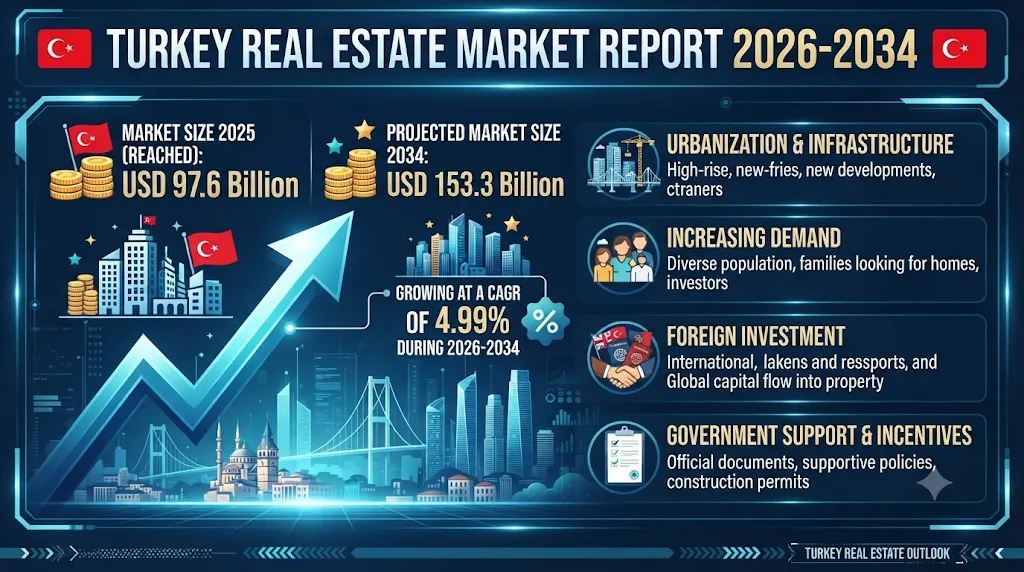
IMARC Group, a leading global market research and management consulting firm, has published its latest market intelligence report on the Turkey real estate market size reached USD 97.6 Billion in 2025 and is projected to reach USD 153.3 Billion by 2034, growing at a CAGR of 4.99% during 2026-2034, driven by rapid urbanization, a young and growing population, large-scale government housing and urban renewal programs, rising foreign investor interest supported by the citizenship-by-investment scheme, and the steady digitalization of property discovery and transactions across the country’s major metropolitan regions.
The market is supported by the structural need for new, earthquake-resilient housing and by Turkey’s expanding urban population, which reached 86.09 million people nationally. Istanbul alone is home to about 16 million residents and contributes roughly 30% of national GDP, making it the center of property demand and valuations. Government-backed developers such as the Housing Development Administration (TOKİ) and Emlak Konut GYO are delivering housing at scale, while private developers focus on premium residential, retail, office, and mixed-use projects. TOKİ had built 1,758,426 homes across all 81 provinces by March 2026, which shows the scale of public-sector participation. At the same time, high borrowing costs are pushing buyers toward developer instalment plans, and mortgage-financed purchases are growing from a low base.
How AI is Reshaping the Future of the Turkey Real Estate Market?
- AI-Powered Valuation and Pricing Intelligence: Property portals and developers are using machine learning to analyze listing data, neighborhood trends, transaction records, and construction costs. This produces faster, more transparent valuations in a market where Istanbul prices have reached about TRY 74,101 per square meter and buyers need reliable price benchmarks.
- Intelligent Search and Virtual Tours on Digital Platforms: Sahibinden.com attracts 58.1 million monthly users, and Hepsiemlak and Zingat are adding AI-driven recommendations, 3D virtual tours, and neighborhood analytics. These tools reduce unnecessary site visits and shorten the path from discovery to shortlisting, even where final deals are still signed in person.
- Risk Scoring for Earthquake Resilience and Urban Renewal: AI models that combine building age, soil conditions, and structural data help authorities and developers prioritize high-risk buildings for transformation. This is highly relevant as the government works to renew risky housing stock in Istanbul and other seismic zones.
- Smart Construction Management Using BIM and Analytics: Developers are combining Building Information Modelling with AI-based scheduling and cost forecasting to cut waste and improve accuracy to within about 5%, easing margin pressure from volatile input costs.
- Automated Title Deed and Compliance Workflows: Digital and blockchain-based title deed pilots by the Land Registry and Cadastre General Directorate, supported by automated document checks, are expected to reduce fraud and manual errors, which helps foreign buyers who face translation and verification requirements.
Grab a sample PDF of this report: https://www.imarcgroup.com/turkey-real-estate-market/requestsample
Turkey Real Estate Market Trends and Drivers:
The Turkey real estate market is expanding on the back of structural housing demand, active state participation, and a growing base of international buyers. Urban residents make up about 77.5% of the population, and roughly 500,000 new urban households are formed annually, which sustains demand for both purchase and rental housing. Homeownership remains a strong cultural aspiration, and property is widely treated as a hedge against inflation, which keeps the sales segment dominant at 61.9% of the market. The rental segment holds 38.1% and is gaining relevance as high prices in Istanbul and Ankara push younger working households toward renting. Monthly activity shows the market’s depth: in June 2026, total house sales rose almost 16% year over year to 129,979 units, and in September 2026 they stood at 142,390 units, including 51,519 new and 90,871 existing homes.
Government programs are a central pillar of supply and affordability. TOKİ and Emlak Konut deliver social and mid-market housing, and the Environment, Urbanization and Climate Change Ministry runs the “Half Is on Us” campaign for urban transformation in Istanbul, where beneficiaries in large site-based projects receive a TL 875,000 grant and TL 125,000 in relocation assistance. Authorities report that 1 million homes in Istanbul have been transformed. The post-earthquake reconstruction effort has completed 455,357 units, made up of 367,995 conventional homes, 65,672 village homes, and 21,690 commercial units. TOKİ delivered 124,034 homes in a single year, including 58,561 social housing units and 65,473 homes in earthquake-hit areas, and planned tenders for a further 150,000 homes. In February 2025, Emlak Konut launched a zero-down-payment, decreasing-instalment campaign across 25 projects in Istanbul, Izmir, Antalya, and Balıkesir, directly targeting middle-income buyers who are shut out of expensive mortgages.
Foreign demand, digitalization, and quality expectations are reshaping buyer behavior. The citizenship-by-investment program requires a minimum property purchase of USD 400,000 and continues to draw buyers from Russia, Iran, Iraq, Ukraine, and Central Asia. Foreign buyers purchased 15,308 homes in the first nine months of 2026, about 1.4% of all sales, and the Antalya region, the main foreign-buyer market, recorded strong price growth. Earthquake-resistant and green-certified buildings now command premiums of 15% to 25% over standard units. Online platforms hold 27.4% of the market and are growing quickly as PropTech portals add digital transaction features. Meanwhile, tight financing is a defining restraint: mortgage rates stood at about 40% in mid-2026, yet mortgage-financed sales rose 25.8% in the first five months of the year to 116,801 units, showing pent-up demand that responds quickly to any easing in credit conditions.
Turkey Real Estate Industry Segmentation:
The report has segmented the market into the following categories:
Breakup By Property:
- Residential
- Commercial
- Industrial
- Land
Residential property anchors the market through urban household formation, social housing delivery, and foreign purchases in Istanbul, Antalya, and the Aegean coast. Commercial real estate is supported by Grade A offices, shopping malls, and mixed-use developments such as Mall of Istanbul. Industrial property benefits from growing demand for modern warehouses and logistics space tied to e-commerce, while land remains central to developers’ pipelines in a city where developable parcels are scarce.
Breakup By Business:
- Sales
- Rental
The sales segment accounts for the largest share at 61.9%, driven by first-time buyers, investor acquisitions, citizenship-linked purchases, and developer instalment schemes. Rental holds 38.1% and is expanding as affordability pressures delay homeownership for younger urban households.
Breakup By Mode:
- Online
- Offline
Offline transactions lead with a 72.6% share, reflecting a strong culture of visiting show homes, dealing directly with developer sales teams, and signing at notary offices. Online channels hold 27.4% and are the faster-growing mode as digital discovery, virtual tours, and online offers become standard.
Breakup By Region:
- Marmara
- Central Anatolia
- Mediterranean
- Aegean
- Southeastern Anatolia
- Black Sea
- Eastern Anatolia
Marmara dominates the market with a 34.2% share, anchored by Istanbul, which accounts for roughly 15% to 20% of all national transactions. Central Anatolia follows with 16.8%, supported by Ankara’s commercial market and industrial expansion, and the Aegean holds 13.9% on the strength of Izmir’s technology economy and coastal holiday homes in Bodrum and Çeşme. The Mediterranean contributes 12.7%, followed by the Black Sea at 8.4%, Southeastern Anatolia at 7.6% on post-earthquake renewal, and Eastern Anatolia at 6.4%.
Competitive Landscape:
The report provides a comprehensive analysis of the competitive landscape in the Turkey real estate market with detailed profiles of all major companies, including:
- Emlak Konut GYO
- Torunlar GYO
- Sinpaş Holding
- Sur Yapı
Emlak Konut GYO leads the affordable-to-mid-market residential segment through urban transformation projects and mass-market housing campaigns, while Torunlar GYO is a leader in premium retail, office, and mixed-use assets. Sinpaş Holding is known for branded lifestyle communities with integrated amenities in Istanbul, and Sur Yapı focuses on premium residential compounds in Istanbul and coastal markets with strong appeal to foreign buyers. Below this top tier the market is fragmented, with more than 1,000 licensed developers and real estate investment companies operating across 81 provinces.
Recent News and Developments in Turkey Real Estate Market
- October 2026: Authorities reported that the post-earthquake reconstruction program had completed 455,357 housing and commercial units, including 367,995 conventional homes, 65,672 village homes, and 21,690 commercial units, coordinated by TOKİ, Emlak Konut, and the Urban Transformation Presidency.
- September 2026: Total house sales reached 142,390 units, with new home sales at 51,519 units and sales to foreign buyers rising 9.9% to 2,167 units, led by buyers from Russia, Iraq, and Germany.
- August 2026: Istanbul authorities announced that 1 million homes have been transformed in the city, and Emlak Konut completed two redevelopment phases in Tokatköy, delivering 823 units made up of 776 homes and 47 commercial spaces.
- June 2026: Total house sales rose almost 16% year over year to 129,979 units, the highest level of the year to date, while sales to foreign buyers increased 20.1% to 2,015 units, supported by a surge in mortgage-financed purchases.
- January 2026: Homeowners in Istanbul’s Maltepe district moved into new earthquake-resistant apartments under the “Half Is on Us” urban transformation campaign, with a TL 875,000 grant applied toward building costs in large site-based projects.
- August 2025: Emlak Konut REIT raised TRY 21.41 billion (USD 525.8 million) through a real estate certificate offering for its Damla Kent project, which will finance 2,214 residential units, with demand reaching 1.87 times the available certificates.
- May 2025: Emlak Konut opened a USD 2.8 billion tender for residential parcels in Dursunköy near the Istanbul Canal corridor.
- February 2025: Emlak Konut launched a zero-down-payment, decreasing-instalment housing campaign across 25 projects in Istanbul, Izmir, Antalya, and Balıkesir to support middle-income homeownership.
Note: If you require specific details, data, or insights that are not currently included in the scope of this report, we are happy to accommodate your request. As part of our customization service, we will gather and provide the additional information you need, tailored to your specific requirements. Please let us know your exact needs, and we will ensure the report is updated accordingly to meet your expectations.
About Us:
IMARC Group is a global management consulting firm that helps the world’s most ambitious changemakers to create a lasting impact. The company provides a comprehensive suite of market entry and expansion services. IMARC offerings include thorough market assessment, feasibility studies, company incorporation assistance, factory setup support, regulatory approvals and licensing navigation, branding, marketing and sales strategies, competitive landscape and benchmarking analyses, pricing and cost research, and procurement research.
Media and Sales Contact
IMARC Group
Email: sales@imarcgroup.com
United States: +1-201-971-6302
India: +91-120-433-0800
United Kingdom: +44-753-714-6104