Traditional Office vs Flexible Office Space in Bangalore: What Actually Makes Sense for Your Business?
By Rita Sharma
68 Views
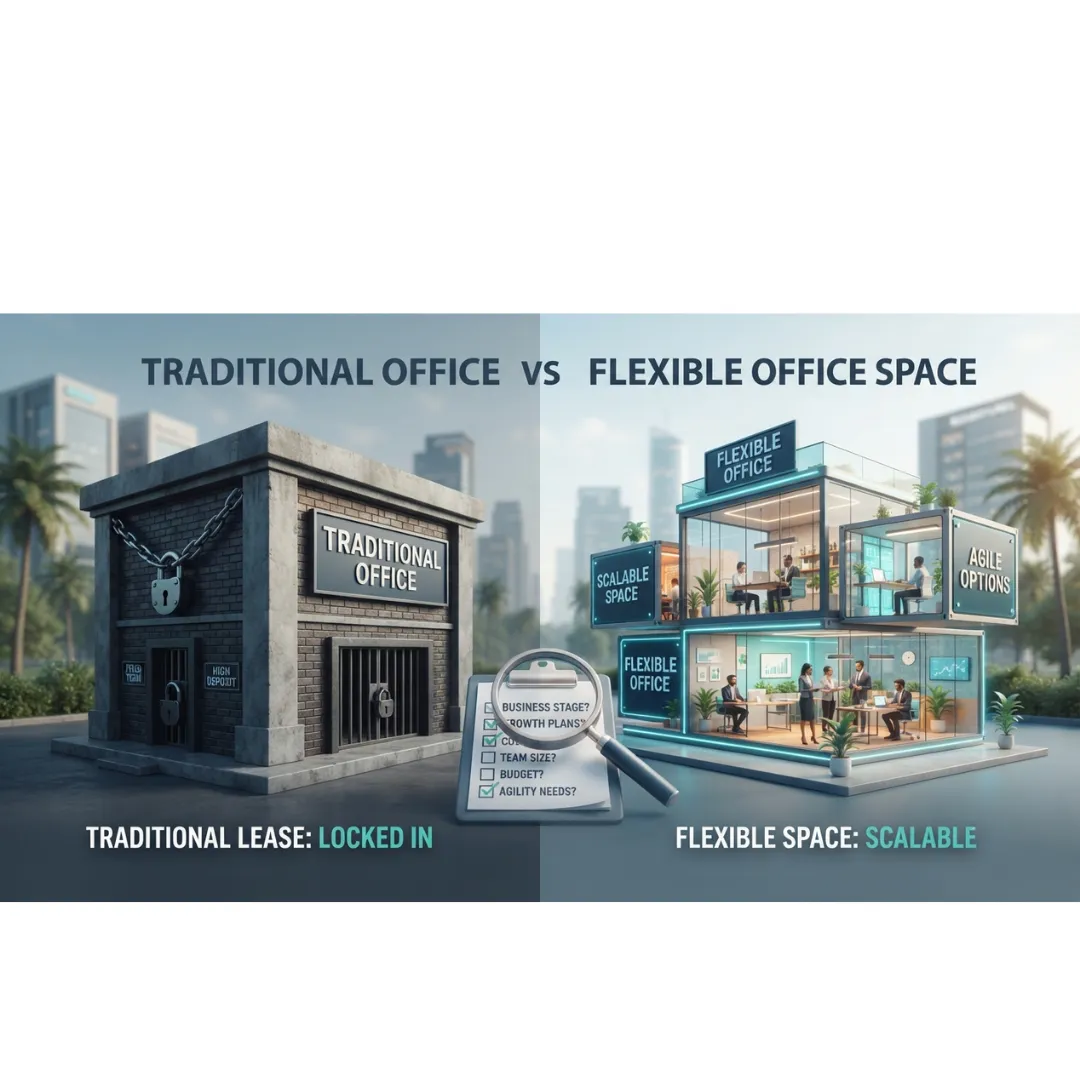
If you are a business owner or team lead in Bangalore trying to decide between signing a long-term office lease or going with a more adaptable setup, the answer depends heavily on your business stage, team size, and financial priorities. This blog breaks down both options practically so you can make an informed decision.
The Real Cost of a Traditional Office in Bangalore
When most people think of a traditional office, they think of stability. And there is some truth to that. But the full cost picture is rarely discussed upfront.
Renting a traditional office in Bangalore, especially in areas like Whitefield, Indiranagar, or Koramangala, involves:
- Security deposits that can go up to 10 to 12 months of rent
- Interior fit-out costs that easily run into lakhs
- Long-term lease commitments, usually 3 to 5 years
- Monthly overhead for electricity, housekeeping, internet, and maintenance
- Dedicated HR or admin bandwidth to manage the facility
For a company with 50 or more people, a stable revenue base, and a clear 5-year roadmap, this model makes complete business sense. You control the space, you build the culture physically, and the cost per seat can become reasonable at scale.
But for startups, growing teams, or companies entering Bangalore as a new market, this model often ties up capital that could go directly into product, hiring, or sales.
Where Flexible Office Spaces Change the Equation
A flexible office space in Bangalore gives businesses access to fully operational workspaces without the long-term commitments or upfront infrastructure costs. You pay for what you use, and you scale up or down depending on your actual team size.
This is not just about hot desks and bean bags. Modern managed offices in Bangalore now offer:
- Private cabins and dedicated desks for teams of any size
- High-speed internet, power backup, and meeting rooms included
- Month-to-month or short-term agreements
- Prime business addresses across key Bangalore locations
- Support services built in, so you are not managing vendors separately
For companies testing a Bangalore expansion, running a distributed team, or operating in a phase where headcount fluctuates, this model removes a lot of operational friction.
Head-to-Head: What Each Model Handles Better
When a Traditional Office Works Better
- Your team is 100 plus people and growing steadily
- You need complete control over office design and branding
- Your lease cost per seat is significantly lower than managed space pricing
- You have an established operations team to manage the facility
- Your business requires specialized infrastructure like labs or server rooms
When a Flexible Setup Works Better
- You are a startup or SME with under 50 people
- Your team is partially remote or hybrid
- You are expanding to Bangalore from another city and want to test the market first
- You need a professional address without committing to a full lease
- You want to avoid capital getting stuck in deposits and interiors
The Hybrid Reality Most Businesses Are Moving Toward
A growing number of companies in Bangalore are not choosing between the two extremes. They are running a lean headquarters on a flexible plan and holding off on a traditional lease until their Bangalore operations prove out.
This approach works particularly well for:
- IT services companies with project-based hiring
- D2C brands setting up regional sales or ops teams
- Funded startups post-Series A who need credibility but not a full lease
- Consulting firms that need client-facing meeting rooms but not permanent desks
The economics here are straightforward. You are not locking capital, and you are still maintaining a professional setup for your team and clients.
Location Matters More Than the Office Type
In Bangalore, location often determines hiring quality and client perception. Areas like MG Road, HSR Layout, Electronic City, and Sarjapur Road each serve different business profiles.
A flexible office space in Bangalore lets you pick up addresses in business-relevant locations without the premium lease costs those areas typically carry. That has real value for early-stage companies trying to attract talent or close enterprise deals.
Platforms like Flexo Spaces offer managed and coworking options across key Bangalore business corridors, which means you can match your address to your business identity without overcommitting on real estate.
Cost Comparison: What the Numbers Generally Look Like
Without going into figures that change by locality or market conditions, here is what the cost structure typically looks like in comparison:
Traditional Office:
Higher upfront capital, lower monthly cost per seat at scale, fixed overheads regardless of occupancy
Flexible Office:
Zero or minimal upfront, higher per-seat cost in absolute terms, but costs are variable and match actual usage
For a 10-person team, flexible often wins financially. For a 200-person team in a stable business, traditional can be more cost-effective over a 5-year horizon.
What You Should Actually Decide Based On
Before making a call, answer these three questions honestly:
- Do you have clarity on your Bangalore headcount for the next 24 months?
- Can you afford to lock 6 to 10 months of rent as a security deposit right now?
- Is your team fully in-office, hybrid, or remote-first?
Your answers will point clearly toward one model or the other.
Conclusion
The debate between traditional and flexible office space in Bangalore is not about which is better in general. It is about which fits your current business reality. Traditional offices make sense at scale and with stability. Flexible spaces make sense when you need speed, lower commitment, and operational simplicity.
If you are at an early or growth stage, exploring options through managed workspace providers like Flexo Spaces is a practical starting point. You get real infrastructure without the real estate headache.
FAQs
Q.1 What is the main difference between a traditional office and a flexible office space?
Ans. A traditional office involves long-term leases, high deposits, and full operational responsibility. A flexible office space provides a ready-to-use workspace on shorter commitments, usually with services included.
Q.2 Is flexible office space in Bangalore suitable for a growing startup?
Ans. Yes. It removes upfront capital requirements and lets you scale your team size without renegotiating a lease each time.
Q.3 Which Bangalore areas have good flexible office options?
Ans. Areas like Koramangala, HSR Layout, MG Road, Indiranagar, and Whitefield have a strong supply of managed and coworking spaces with professional setups.
Q.4 How much does a flexible office space typically cost in Bangalore?
Ans. Pricing varies by location, seat type, and amenities. Dedicated desks generally start from a few thousand rupees per month per seat, while private cabins for teams cost more depending on size and location.
Q.5 Can a company use a flexible office as its registered business address?
Ans. Many managed workspace providers offer a business address as part of their plan, which can be used for GST registration and official correspondence. Confirm this with your provider before signing up.
Related Reading
Top 10 Hidden Secrets About Business & Finance You Need to Know
Welcome to our in-depth exploration of Business & Finance. In an era defined...
Why Business & Finance is Transforming the Global Industry Landscape
Welcome to our in-depth exploration of Business & Finance. In an era defined...