5 Things to Check Before Applying for a Payday Loan
By Insta Loans
28 Views
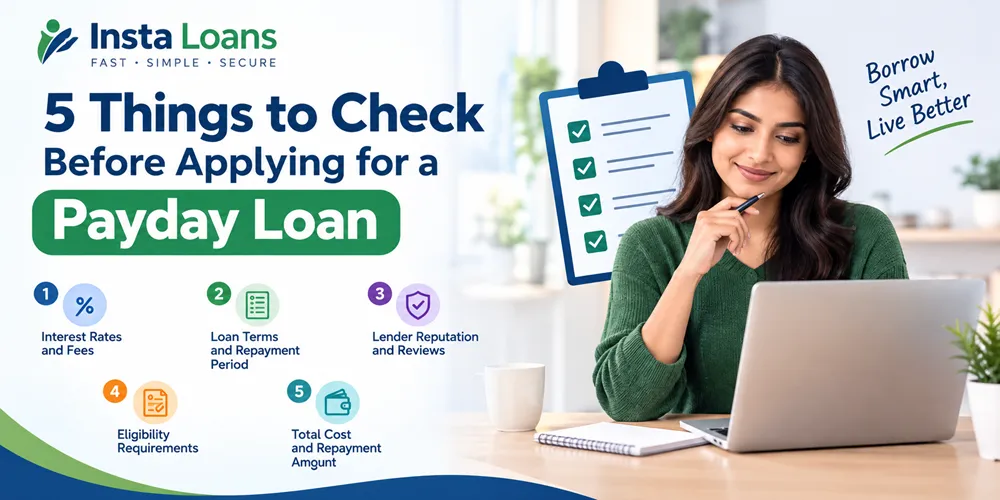
A payday loan can feel like the fastest way out of a tight financial spot. Rent is due, a medical bill has landed unexpectedly, or your salary is still a week away — and a payday loan promises quick cash with almost no paperwork. But speed and convenience come with trade-offs, and payday loans are one of the most misunderstood borrowing products in personal finance.
Before you sign up for one, it pays to slow down for just a few minutes. A payday loan is a short-term, high-cost loan usually meant to be repaid by your next salary date, and the terms can vary dramatically from one lender to another. Some are transparent and reasonably priced; others bury borrowers in fees and rollover charges that turn a small loan into a long-term burden.
This guide walks you through the five most important things to check before you apply for a payday loan — so you can borrow responsibly, avoid nasty surprises, and choose a lender that actually works in your favor. If you're looking for a transparent, digital-first borrowing experience, Insta Loans is built to make short-term borrowing simple and clear from the very first step.
1. The Interest Rate and Annual Percentage Rate (APR)
The single biggest thing that separates a manageable payday loan from a financial trap is the interest rate. Payday loans are notorious for carrying interest rates that look small on paper but translate into extremely high annual percentage rates (APR) once annualized.
A lender might quote a fee of ₹15 for every ₹100 borrowed over a two-week period. That sounds modest, but calculated as an APR, it can easily cross triple digits. Because payday loans are short-term by design, lenders often express cost as a flat fee rather than a percentage rate — which makes it harder for borrowers to compare offers at a glance.
Before applying, always ask (or look for) these numbers:
• The total interest or fee charged in rupees, not just a percentage
• The APR, so you can compare it fairly against other loan products
• Whether the rate is fixed for the loan term or can change
• Any difference in rate for first-time borrowers versus repeat borrowers
A transparent lender will show you the exact repayment amount before you accept the loan — not after. If a platform is vague about the total cost or hides it behind confusing terms, treat that as a red flag. On Insta Loans, the applicable interest and total repayable amount are displayed clearly during the application process, so there's no guesswork involved.
2. The Repayment Terms and Due Date
Payday loans are structured around a single lump-sum repayment, typically due on or shortly after your next payday. This is very different from a personal loan, which is repaid gradually through monthly EMIs over months or years.
Before applying, get complete clarity on:
• The exact due date of repayment
• Whether the amount is deducted automatically from your bank account or needs manual repayment
• What happens if your payday shifts or your income is delayed
• Whether partial repayment is allowed, or if it must be paid in full
This matters because a mismatch between your income timing and the loan's due date is one of the most common reasons borrowers end up rolling over a payday loan — extending it and paying additional fees. A rollover might solve today's problem, but it usually multiplies the total cost and can trap borrowers in a repeating cycle of debt.
Before you apply, map the repayment date against your actual salary credit date, factoring in weekends, bank holidays, or any known delays your employer has had in the past. If there's any doubt, it's often safer to borrow a smaller amount you're certain you can repay on time, rather than the maximum amount offered.
3. The Lender's Legitimacy and Licensing
Short-term lending has attracted its share of unregulated and even fraudulent operators, particularly online. Before sharing your bank details, ID proof, or salary information with any platform, verify that the lender is legitimate and operates within the applicable regulatory framework.
A few checks worth doing:
• Look for the lender's registration or partnership details with a regulated financial institution or NBFC on their website
• Check if the website uses secure, encrypted connections (https, a valid privacy policy, and clear contact details)
• Search for independent reviews, ratings, and complaint records rather than relying only on testimonials shown on the lender's own site
• Avoid lenders who ask for upfront 'processing fees' paid via untraceable methods before disbursing any loan
• Confirm there is a real customer support channel — phone, email, or chat — that you can reach if something goes wrong
Genuine digital lending platforms are transparent about who they are, how they're regulated, and how your data will be used. If a website avoids answering basic questions about its legal identity or pressures you to complete the process quickly without reading the terms, it's worth stepping back and doing more research before proceeding.
4. Hidden Fees and Additional Charges
The advertised interest rate is often not the full story. Payday loans can come bundled with a range of additional charges that aren't always obvious at first glance, including:
• Processing or origination fees deducted from the loan amount before disbursal
• Late payment penalties, which can be a flat charge or a daily/weekly compounding fee
• Rollover or extension fees if you're unable to repay on the due date
• Prepayment charges, in the rare case you want to repay early
• Mandatory insurance or 'membership' add-ons bundled into the loan
Ask for — or read carefully in the loan agreement — a full breakdown of every charge, and calculate the actual amount you'll receive in hand versus the total amount you'll eventually repay. A loan advertised as ₹10,000 might disburse only ₹9,200 after fees, while still requiring you to repay the full ₹10,000 plus interest. That gap matters, especially when you're borrowing because money is already tight.
A trustworthy lender will list every fee upfront in the loan summary, not in fine print you only discover after signing. Insta Loans displays the complete fee structure before you confirm your application, so you know exactly what you're receiving and what you owe.
5. Your Own Eligibility and Repayment Capacity
The final — and arguably most important — check is an honest look at your own finances. Payday loans are designed for short-term cash gaps, not as a substitute for a stable income shortfall or a way to cover recurring expenses month after month.
Before applying, check these eligibility and affordability factors:
• Minimum age, income, and employment criteria set by the lender
• Documents required — usually ID proof, address proof, income proof, and bank statements
• Your existing monthly obligations, so the new repayment doesn't push you into a shortfall next month
• Whether you have any ongoing loans or missed payments that could affect approval or terms
• An honest assessment of whether the amount you need can realistically be repaid by the due date
It also helps to ask yourself why you need the loan. If it's a one-time, short-term gap — a delayed salary, an emergency bill, an unavoidable expense — a payday loan can be a reasonable tool. If you find yourself needing payday loans repeatedly to cover regular monthly expenses, it may be worth looking at other options, such as a longer-tenure personal loan with lower overall interest, or speaking to a financial advisor about restructuring your budget.
Responsible lenders, including Insta Loans, are designed to check your eligibility clearly during the application so you understand exactly what you qualify for before you commit — helping you borrow only what you can comfortably repay.
Final Thoughts
A payday loan can be a genuinely useful short-term tool when it's used carefully and borrowed from a transparent lender. The difference between a helpful loan and a stressful one usually comes down to the five checks above: understanding the real interest rate, knowing your exact repayment terms, verifying the lender's legitimacy, watching out for hidden fees, and being honest about your own repayment capacity.
Taking just a few extra minutes before you apply can save you from costly surprises later. If you're ready to explore a straightforward, transparent way to borrow, you can check your eligibility and apply for a loan online with Insta Loans in just a few minutes.
Frequently Asked Questions (FAQs)
1. What is a payday loan?
A payday loan is a small, short-term loan meant to be repaid in full — usually with interest and fees — by your next salary date. It's designed to help cover urgent, short-term cash needs rather than long-term borrowing.
2. How much can I borrow with a payday loan?
Loan amounts vary by lender and depend on your income and eligibility, but payday loans are typically smaller in size than personal loans, ranging from a few thousand rupees up to a set maximum based on your monthly earnings.
3. What happens if I can't repay a payday loan on time?
Missing the repayment date usually triggers late fees, and some lenders offer a rollover or extension — for an additional charge. Repeated rollovers can significantly increase the total cost of the loan, so it's important to contact your lender immediately if you anticipate a delay.
4. Are payday loans safe to apply for online?
They can be, as long as you apply through a legitimate, regulated lender. Check for clear licensing information, transparent fee disclosure, secure data handling, and genuine customer support before submitting your details on any platform.
5. Is a payday loan better than a personal loan?
It depends on your need. Payday loans are faster and suited for very short-term, small cash gaps, but usually carry higher effective interest costs. Personal loans typically offer lower interest rates and longer repayment periods, making them better suited for larger amounts or planned expenses.
6. Do payday loans affect my credit score?
Some payday lenders report repayment activity to credit bureaus, while others don't. Timely repayment can help build your credit history with lenders who report it, while missed payments can negatively affect your score and future borrowing options.
Related Reading
Top 10 Hidden Secrets About Business & Finance You Need to Know
Welcome to our in-depth exploration of Business & Finance. In an era defined...
Why Business & Finance is Transforming the Global Industry Landscape
Welcome to our in-depth exploration of Business & Finance. In an era defined...