The Science Behind High-Performance Agriculture Irrigation Pipes
153 Views
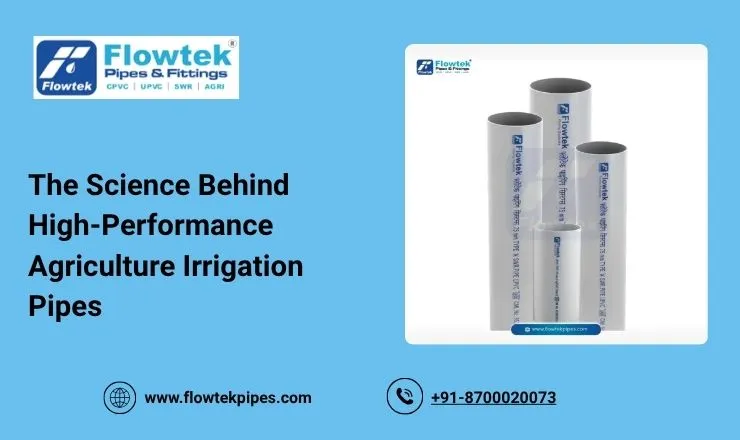
You don’t notice pipe failure in the factory. You notice it in the field—after installation, when pressure drops, joints leak, and crop yield takes the hit. That’s where most Agriculture Irrigation Pipes are judged, not in brochures or lab claims. And yet, buyers still sign off on specs they barely verify.
Most buyers assume pipe performance is just about diameter and price. That’s a mistake. The real science sits in polymer formulation, wall thickness consistency, and how the pipe behaves after 18 months under UV exposure and fluctuating water pressure. Which means your margin depends on decisions made long before the pipes reach the farm.
Material Composition That Actually Holds Pressure
That’s where PVC Pipe Agriculture systems differ widely. High-grade unplasticized PVC (uPVC) used in serious installations typically has tensile strength in the range of 45–55 MPa. Lower-grade compounds? They crack under stress cycles long before their claimed lifespan.
And yet, some suppliers quietly blend recycled content beyond safe thresholds. Nobody tells you that recycled PVC above ~20% can reduce long-term pressure resistance by 18–22%.
Wall Thickness Variation — The Quiet Failure Point
Here’s what buyers skip: tolerance. IS standards allow slight variation, but poor extrusion control leads to uneven wall thickness. A difference of even 0.3 mm across a 63 mm pipe can create localized weak points.
Which means under surge pressure (common in irrigation systems), failure doesn’t happen evenly—it happens suddenly.
Flow Efficiency in PVC Drip Irrigation Pipe
Most PVC Drip Irrigation Pipe systems are designed to maintain flow rates within ±5%. But real-world installations often show 8–10% variation because of internal surface roughness and emitter inconsistency.
And yes, smoother internal walls reduce friction loss by up to 12%, which directly impacts pump energy costs.
Jointing System in SWR Pipes & Fittings
SWR Pipes & Fittings rely heavily on rubber ring joints or solvent cementing. Poor-quality rubber rings degrade faster—especially in regions where water temperature crosses 35°C regularly.
A supplier who cannot specify rubber compound grade (EPDM vs generic) is not ready for large-scale supply.
The Spec Detail Most Buyers Skip
That’s UV stabilization. Pipes exposed to sunlight degrade unless UV stabilizers like TiO₂ are properly dosed. A 2% variation here can cut lifespan by years.
OBJECTIVE
1. Raw Material Transparency
Most suppliers will say “virgin material used.” Ask for batch traceability.
Bad answer: “We source from multiple vendors, all standard quality.”
2. Pressure Rating Verification
Check if pipes are hydrostatically tested at 1.5x working pressure.
Bad answer: “We follow standard testing.” (That’s not a number.)
3. Certification Validity
Look for ISI certification—but verify expiry and scope.
Bad answer: “Certificate is under renewal.” That’s a red flag during procurement.
4. Supply Consistency
Large projects fail due to inconsistent batches.
Bad answer: “Minor variation is normal.” It shouldn’t affect installation.
5. After-Sales Accountability
Ask how defects are handled.
Bad answer: “We review case by case.” That’s not a policy. That’s risk transfer.
BENEFITS
Reduced Water Loss
Precision-manufactured Agricultural Fittings reduce leakage points. Even a 1% leak reduction can save thousands of liters per hectare annually.
Lower Pumping Costs
Smoother pipes reduce friction loss. Field data shows up to 10–15% energy savings in optimized systems.
Longer Service Life
High-quality Agriculture Irrigation Pipes last 8–12 years under Indian conditions, compared to 3–5 years for substandard alternatives.
Installation Efficiency
Consistent dimensions reduce fitting time. Contractors report up to 20% faster installation when tolerances are tight.
Fewer Maintenance Interruptions
Which means less downtime during critical irrigation cycles—something buyers underestimate until the first failure.
Margin Protection
Cheap pipes cost more later. Replacement, labor, and crop loss wipe out any initial savings.
AVAILABILITY
In regions like New Delhi, demand for Agriculture PVC Pipes Manufacturers and PVC Irrigation Pipes Manufacturers has grown sharply—driven by water management policies and increasing drip irrigation adoption.
And here’s the supply chain reality: proximity to manufacturing hubs matters. Transporting bulk pipes over 1,200 km can increase landed cost by 6–9%, not including handling damage.
Which means sourcing from established Agriculture Irrigation Pipes Manufacturers in India—especially those operating near North India logistics corridors—reduces both cost and delivery risk.
Local availability of SWR Pipe Fittings Manufacturer in India networks also ensures faster replacement cycles when needed.
ABOUT US
We’ve spent years working with contractors, dealers, and bulk buyers who don’t want surprises after installation. That’s why we focus on consistency across batches—not just passing tests once.
We’ve rejected entire production runs because wall thickness drifted by 0.2 mm beyond tolerance. That decision cost us in the short term, but it saved our clients from field failures later.
And yes, we’ve learned this the hard way—through real feedback, not assumptions.
If you’re sourcing Agricultural Fittings Manufacturers in India or evaluating PVC Irrigation Pipes Manufacturers in India, send us your requirement list.
We typically respond within 24 hours.
Include:
- Pipe size and pressure rating
- Quantity (MOQ starts from standard bulk loads)
- Project location
- Required certifications
We’ll give you a clear, workable quote—not vague promises.
CONCLUSION
The performance of Agriculture Irrigation Pipes isn’t decided in catalogs—it’s decided under pressure, heat, and time. Buyers who understand the science behind materials, tolerances, and testing avoid costly mistakes. The next wave of irrigation projects in India will reward those who choose smarter, not cheaper.
FAQs
What should I check when selecting Agriculture PVC Pipes Manufacturers?
Look beyond pricing. Verify raw material sourcing, batch consistency, and pressure testing data. Many Agriculture PVC Pipe Manufacturers in India cut corners on recycled content—ask directly.
Are PVC Irrigation Pipes Manufacturers in India reliable for bulk supply?
Some are, some aren’t. Large-scale PVC Irrigation Pipes Manufacturers with automated extrusion lines maintain better consistency.Larger setups tend to deal better with batch consistency.
Are all Agricultural Fittings Manufacturers able to create leak-proof systems?
Not all Rubber and Molding suppliers that Fittings Manufacturers rely on use superior quality molding rubber that lead to early leaks.
What is the life expectancy of PVC Drip Irrigation Pipe?
Average is 5–8 years, but some water quality can be factor. Bad pipes will fail first in high temperature areas.
Do the specifications of Pipes and Fittings Manufacturer standards also apply to irrigation?
To a limited degree. Most of their standards are concerned with drainage, and jointing standards and placement techniques can be used for irrigation.
How to investigate Agriculture Irrigation Pipes Suppliers in India?
Check test reports, and if possible check the factories and construction references. Most suppliers brag of having industry presence but are scale imposters and consistency deficenients.
Are lower quality pipes a good choice?
Not unless for a very limited use or temporary use. Cheaper upfront tend to be more failure prone and result in the construction's unrcosting itself.
Related Reading
Top 10 Hidden Secrets About Business & Finance You Need to Know
Welcome to our in-depth exploration of Business & Finance. In an era defined...
Why Business & Finance is Transforming the Global Industry Landscape
Welcome to our in-depth exploration of Business & Finance. In an era defined...