The Moon's Origin Story: What If the Familiar Explanation Isn't the Only One?
25 Views
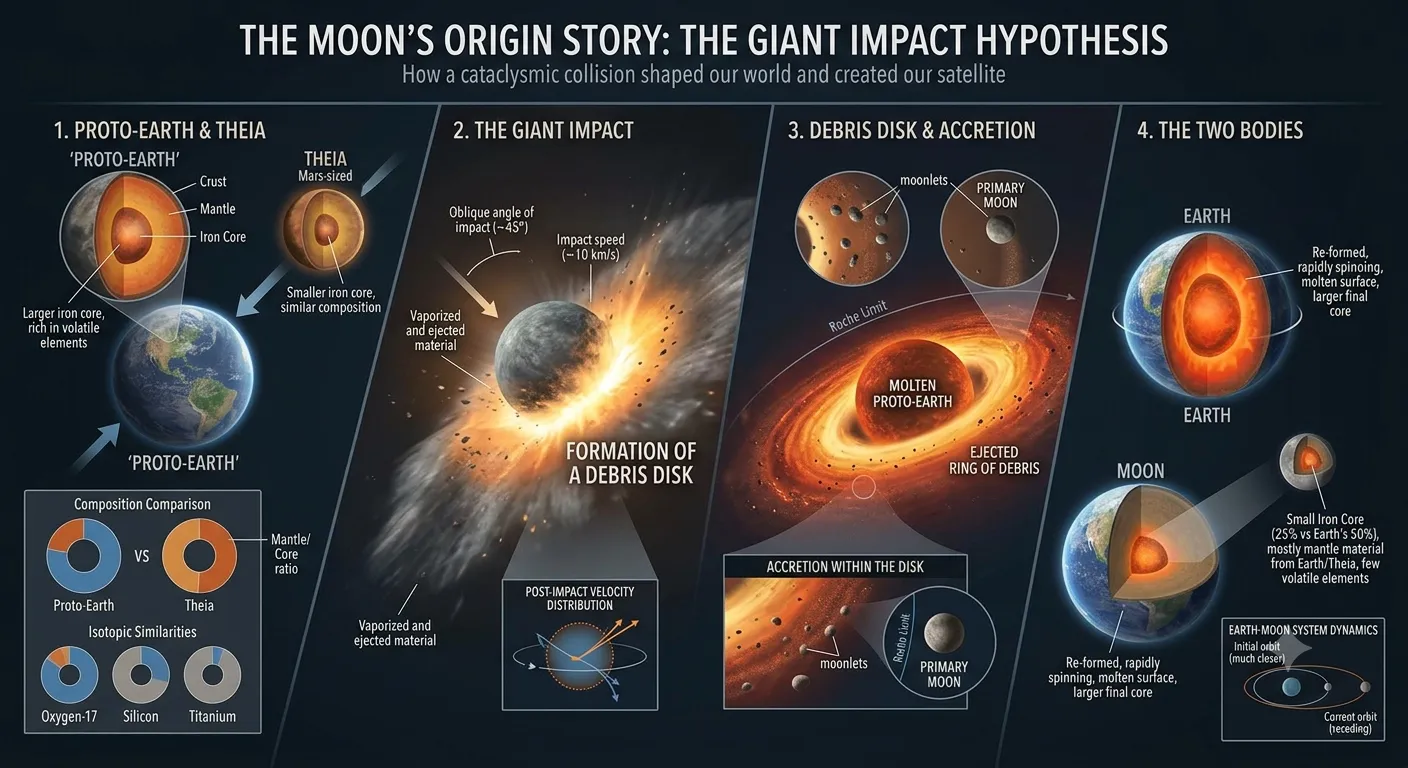
The Moon appears to be a constant in Earth’s story. It goes up and down. It affects the tides of the ocean. It travels a fairly predictable path across our sky. But its origin remains one of the most intriguing questions in planetary science.
The most popular scientific explanation is the giant-impact hypothesis. This is the theory that a large object collided with the young Earth, and flung material into orbit which later coalesced to form the Moon. It describes a number of features of the Earth-Moon system, but researchers are still working on the details of how such an event would have played out.
For Douglas B. Ettinger, the question opens up another possibility: What if the collision actually shifted Earth's position in the solar system, rather than just throwing debris around it?
One Moon, Different Explanations
Scientific hypotheses are useful because they attempt to connect observations into a coherent account. The challenge is that a model must explain more than one striking feature. It must also make sense of the system as a whole.
Other proposed explanations for lunar formation have included co-formation, in which Earth and the Moon developed together, and gravitational capture, in which the Moon formed elsewhere before becoming bound to Earth. Each approach faces questions about the physical processes required to produce the system we observe today.
These competing ideas illustrate an important point: explaining where the Moon came from involves more than identifying a plausible event. The resulting masses, orbits, compositions, and rotational behavior must also fit the evidence.
Ettinger's Earth Metamorphosis Hypothesis
Douglas B. Ettinger’s Earth’s Metamorphosis (EMM) hypothesis provides a different combination of collision and capture.
Ettinger's scenario suggests that the original Earth was orbiting in a region similar to the present-day asteroid belt. Then a rogue planet of ice crashed into it, scattering debris and pushing Earth inward toward the Sun. Later in its course, Earth met another terrestrial body, which the hypothesis identifies as the Moon.
The model implies that gravitational interactions pass energy and angular momentum between the two bodies until they are locked into a common orbital relationship.
This is a big change from the common story of a collision directly making lunar material. Instead, the collision becomes the event that relocates Earth and sets up a later capture.
What Should an Alternative Explain?
A compelling alternative must do more than tell a dramatic story. It needs to account for measurable observations and demonstrate that its proposed sequence is physically plausible.
Ettinger's published calculations examine impact conditions, orbital changes, conservation laws, and the eventual Earth-Moon configuration. The EMM hypothesis also attempts to connect its proposed history with features including the asteroid belt and Earth's axial tilt.
These are proposals to evaluate, not established conclusions of planetary science. Their value depends on how well the model's assumptions and calculations withstand independent scrutiny.
The broader question of Earth Moon Formation therefore remains worth exploring through evidence, competing models, and careful testing. Alternative theories of Moon formation invite us to reconsider familiar explanations, but curiosity works best alongside scientific discipline.
Perhaps the most productive question is not whether an unconventional idea sounds convincing. It is what observations, calculations, and independent tests would establish whether it actually works.
Related Reading
Expert Insights: Navigating the Complex World of Education & Learning
Welcome to our in-depth exploration of Education & Learning. In an era defin...
Why Education & Learning is Transforming the Global Industry Landscape
Welcome to our in-depth exploration of Education & Learning. In an era defin...