The Chemistry Happening in Your Kitchen Right Now (Whether You Notice It or Not)
17 Views
Sear a steak and listen for that hiss the moment it hits the pan. That sound, that smell, that deep brown crust forming in real time, is a chemical reaction called the Maillard reaction: amino acids and sugars rearranging themselves under heat into hundreds of new flavor compounds. You didn't need a lab coat to trigger it. You needed a hot pan and a few minutes of patience.
This is the thing about cooking that rarely gets said out loud: you're already doing chemistry, every single day, whether or not you've ever used the word. Whisk an egg into oil and watch it transform into mayonnaise and you've just built a stable emulsion. Watch bread dough swell on the counter and you're observing yeast metabolize sugar into carbon dioxide gas, inflating a gluten network like a thousand tiny balloons. Caramelize an onion low and slow and sucrose molecules are breaking down and reassembling into the nutty, complex flavors that make your kitchen smell like something worth waiting for.
None of this requires a chemistry degree to execute. People have been searing, rising and emulsifying for millennia without a periodic table in sight. But there's a real difference between doing something and understanding why it works and that difference is where cooking stops being a rote set of steps and starts becoming something you can actually improve.
Why Naming the Reaction Changes How You Cook
Here's a question worth sitting with: have you ever had a steak sear perfectly one night and turn gray and sad the next, despite following what felt like the same steps? The difference usually comes down to one overlooked variable and once you know what it is, you stop guessing.
The Maillard reaction needs a dry surface and high heat to occur efficiently. Water on the surface of meat absorbs heat and keeps the surface temperature below the threshold where browning happens, so the meat steams instead of searing. Pat your steak dry before it hits the pan and you've just applied chemistry, not technique for technique's sake, but an actual understanding of what's happening at a molecular level. This is the gap between a cook who follows recipes and a cook who understands them. Both get fed. Only one knows what to do when something goes sideways.
The same logic applies everywhere in the kitchen:
· Emulsification explains why your vinaigrette separates in the fridge but a proper mayonnaise doesn't. Egg yolk contains lecithin, a molecule with one end that loves fat and one end that loves water, allowing it to hold two substances together that would otherwise refuse to mix.
· Gluten development explains why kneading bread dough longer makes it chewier, while overworking pie crust makes it tough instead of flaky. Same protein, different desired outcome, different technique.
· Acid and protein denaturation explains why ceviche "cooks" fish without heat. Citric acid unfolds proteins the same way heat does, which is why the texture changes even though nothing gets warm.
None of these require specialized equipment. They require curiosity about the "why" behind the "what," which is exactly the instinct a good crossword puzzle is built to reward.
Puzzles as a Way to Name What You Already Know
There's a particular kind of satisfaction in finally having a word for something you've intuitively understood for years. It's the same feeling as learning that the ache in your legs after a long hike has a name or that the specific blue of a late evening sky is called "nautical twilight." The experience doesn't change. Your relationship to it does.
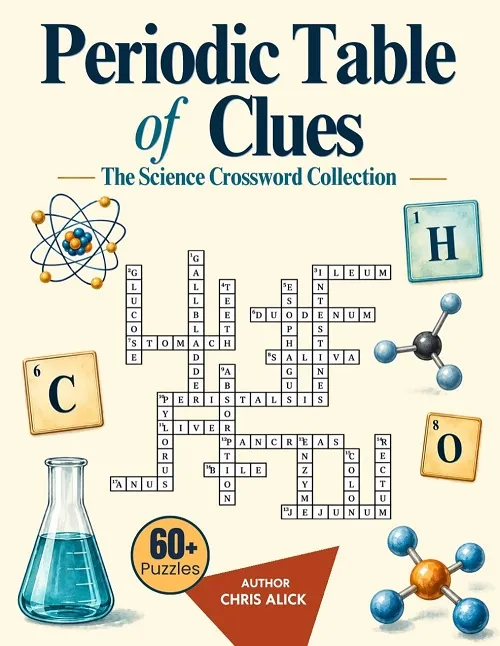
Periodic Table of Clues: The Science Crossword Collection by Chris Alick leans directly into that feeling, with a themed section dedicated specifically to the chemistry of cooking, one of more than 60 scientifically themed crossword puzzles spanning biology, chemistry, physics, anatomy, earth science, space, forensic science, AI, biomimicry, robotics and sleep science. Instead of treating kitchen chemistry as some separate, academic subject, the puzzle format does what good science communication should: it starts from something you already have a felt sense of and gives you the vocabulary to describe it precisely.
That's a meaningfully different approach from a textbook glossary or a cooking show aside that explains a term once and moves on. A crossword clue forces active retrieval. You're not reading a definition of "denaturation" and nodding along. You're reconstructing the word itself, letter by letter, from a clue that connects it to something tangible, maybe a description of what happens to egg whites when they go from clear to white in a hot pan. That kind of effortful recall is exactly what builds vocabulary that sticks, rather than vocabulary that fades the moment you close the book.
Who Actually Benefits From This
This isn't a niche interest for people who already identify as "science people." Consider who's genuinely well-served by a collection built this way:
· Home cooks who've developed real intuition in the kitchen and want the language to match the skill they've already built.
· Foodies who enjoy understanding the mechanics behind a dish as much as the dish itself, the kind of person who reads the "why" section of a recipe, not just the steps.
· Parents of teens looking for a low-pressure way to reinforce real scientific vocabulary outside the classroom, especially for a teen who cooks, bakes or just likes being in the kitchen.
· Gift-givers hunting for something more memorable than a candle or a gadget. A large-format, 101-page puzzle book that connects something a person already loves, cooking, to a sharper understanding of why it works, tends to land better than something generic.
The puzzles are also calibrated carefully for difficulty. They use real scientific vocabulary throughout, no dumbed-down substitutes, but they're structured so a curious teen (13 and up) can make real progress without a chemistry background, while still giving adult solvers something to chew on. Solutions are included with every puzzle, so there's no need for an instructor or an answer key you have to hunt down separately.
Science Was Never Separate From the Stuff You Already Love
The broader point here extends past cooking. Periodic Table of Clues also covers forensic science, biomimicry, robotics and AI and sleep science, because the whole premise of the collection is that science isn't a category you opt into. It's a lens that's already sitting underneath things you interact with constantly, whether that's a crime procedural, the design of a water-resistant jacket or the reason you feel groggy after a bad night's sleep.
Cooking just happens to be one of the most universal entry points, because almost everyone has stood at a stove, wondered why something worked and moved on without an answer. This collection is built for the people who'd rather not move on. It's for the ones who want to know why the onions finally turned sweet, why the dough finally rose right, why the sauce finally held together instead of breaking.
If that's the kind of curiosity you or someone on your gift list already has, the puzzles won't feel like homework. They'll feel like finally getting the answer to a question you've been quietly asking for years.
Periodic Table of Clues: The Science Crossword Collection is available now in paperback for $9.99 on Amazon: https://www.amazon.com/dp/B0HN4ZVD12
Related Reading
Expert Insights: Navigating the Complex World of Education & Learning
Welcome to our in-depth exploration of Education & Learning. In an era defin...
Why Education & Learning is Transforming the Global Industry Landscape
Welcome to our in-depth exploration of Education & Learning. In an era defin...