The Borosilicate Problem: Why So Much "Laboratory Glassware" Isn't What It Claims to Be
By Atico India
6 Views
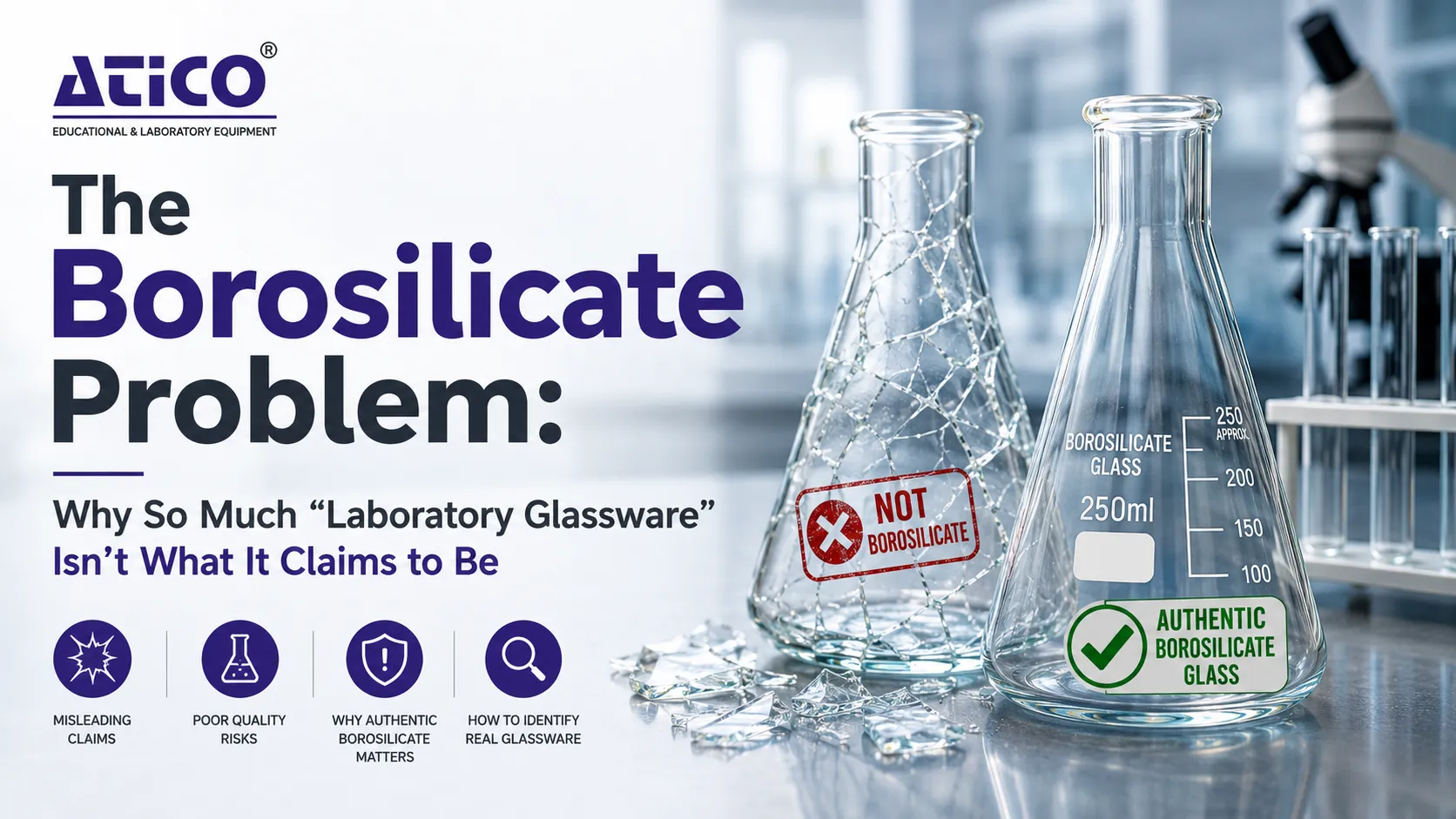
There is an open secret in the laboratory glassware market that buyers rarely hear about until it costs them: a significant amount of glassware sold as "borosilicate" is not borosilicate 3.3, and a meaningful share of companies calling themselves manufacturers don't manufacture anything at all. For institutions and labs buying in good faith, this creates a quiet but expensive risk — one that's entirely avoidable if you know what to look for.
This piece explains why the mislabeling happens, how to spot it, and what genuine verification looks like.
Why "Borosilicate" Became a Meaningless Word
Borosilicate is a category, not a specification — and that distinction is where buyers get caught. Laboratory-grade glassware should be borosilicate 3.3, where the "3.3" refers to a thermal expansion coefficient of approximately 3.3 × 10⁻⁶ per Kelvin. That low expansion is precisely what allows the glass to survive the thermal shock of laboratory work — moving from a flame to a cool surface, or repeated autoclaving — without cracking.
But there are other borosilicate glasses. Grades like 5.1 and 7.0 have higher thermal expansion and are designed for pharmaceutical packaging, not laboratory apparatus. All of them are technically "borosilicate." A supplier can label a product borosilicate, sell it at a laboratory-glassware price, and be describing a glass that was never meant for lab heating. In the worst cases, soda-lime glass — ordinary glass with none of the thermal or chemical resistance — is relabeled entirely.
The word "borosilicate" on a quotation, by itself, tells a buyer almost nothing. The grade is the specification that matters, and it's the detail most often left out.
Why the "Manufacturer" Label Is Just as Unreliable
The second half of the problem is who's selling. Browse any trade directory and you'll find hundreds of companies presenting themselves as laboratory glassware manufacturers. A large share of them are resellers — they buy in bulk, relabel, and pass the product on. This is a legitimate business model, but it creates two problems for the buyer.
First, a reseller often cannot confirm the glass grade, because they didn't produce it and are trusting whatever claim came from further up an opaque supply chain. Second, when something goes wrong — a batch arrives with mismatched joints, or the grade doesn't hold up — there's no direct line to whoever actually made it. Accountability dissolves into a chain of deflection.
A genuine manufacturer controls production from raw glass to final inspection. That control is what allows them to confirm the grade, hold consistent dimensions, and take direct responsibility. The quickest way to tell the difference: ask them to explain their production process and provide a certificate of conformity. A manufacturer answers specifically and produces the document. A reseller becomes vague.
How Mislabeling Actually Costs Institutions
The cost of counterfeit or mislabeled glassware rarely appears at purchase. It shows up later, in three forms.
Replacement cycles: glassware that isn't genuine borosilicate 3.3 cracks under thermal shock that real borosilicate would absorb, so the institution buys the same items again — sometimes within months. The "saving" on the original order quietly becomes a recurring cost.
Unreliable data: volumetric glassware that doesn't meet its stated accuracy class produces measurements that can't be trusted, undermining exactly the experiments it was bought to support.
Safety incidents: in a teaching lab, a beaker that shatters on a hot plate in front of students is not an inconvenience — it's a safety failure traceable directly to the glass grade nobody verified.
What Genuine Verification Looks Like
Protecting against all of this comes down to a short set of checks that take minutes and save years of cost. Ask for the glass grade in writing — specifically borosilicate 3.3, referencing ISO 3585 or its national adaptation. Request a certificate of conformity. Verify accuracy class on all volumetric items. Confirm the supplier actually controls production rather than reselling. And before committing to a bulk order, request a small sample and inspect it for annealing quality, joint precision, and graduation accuracy.
Manufacturers with genuine production control answer these without hesitation. Among established manufacturers, Atico India — producing laboratory glassware since 1957 and exporting to institutions across more than 30 countries — is one example of the manufacturer-direct model, supplying borosilicate 3.3 glassware with certification available on request. Whichever manufacturer an institution shortlists, the verification steps are identical: the goal is to make the supplier prove the grade rather than trusting the label.
The Bottom Line
The laboratory glassware market rewards buyers who verify and penalizes those who trust the label. "Borosilicate" and "manufacturer" are both easy claims to make and easy claims to check — if you know to ask. The institutions that treat glassware procurement as a verification exercise rather than a commodity purchase are the ones that buy once, get what they paid for, and don't discover the difference during an experiment or an inspection.
Related Reading
Top 10 Hidden Secrets About Business & Finance You Need to Know
Welcome to our in-depth exploration of Business & Finance. In an era defined...
Why Business & Finance is Transforming the Global Industry Landscape
Welcome to our in-depth exploration of Business & Finance. In an era defined...