Strategic Management: Elements, Approaches & Stages
By Vishal Y
37 Views
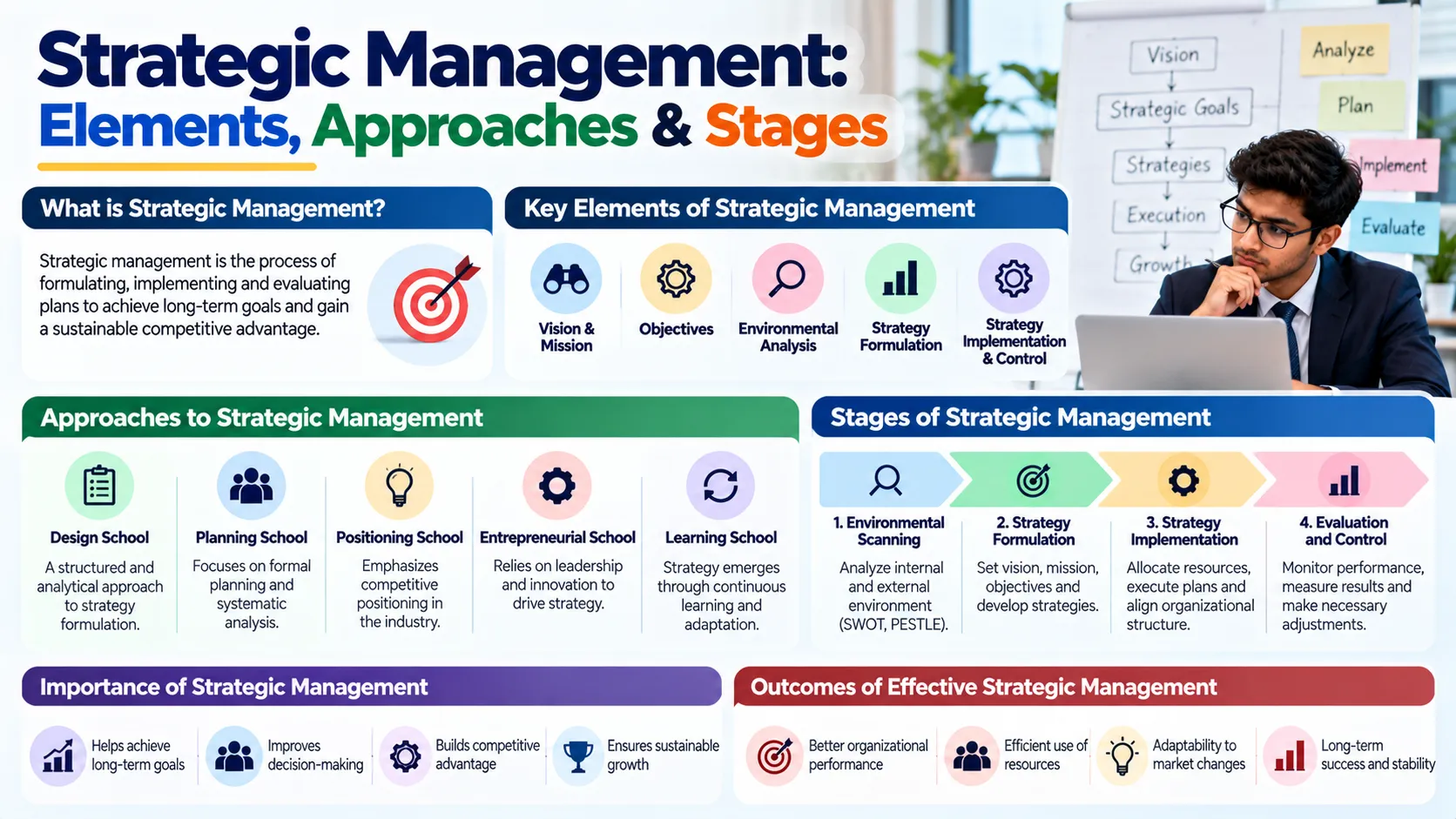
Every organisation, whether a multinational corporation or a small local business, makes strategic choices about where to compete, how to compete, and how to allocate limited resources toward long-term success. Strategic management is the discipline that formalises this process — moving it from ad hoc, reactive decision-making toward a structured, deliberate framework. This blog breaks down the core elements, approaches, and stages involved in strategic management.
What Is Strategic Management?
Strategic management is the ongoing process of formulating, implementing, and evaluating an organisation's long-term direction and competitive positioning, involving the systematic analysis of internal capabilities and external environmental factors to guide decisions that create sustainable competitive advantage and long-term value.
Core Elements of Strategic Management
Vision and Mission
The vision articulates an organisation's aspirational long-term direction — what it ultimately aims to become — while the mission defines its fundamental purpose and reason for existence in more immediate, operational terms. Together, these provide the foundational direction that all subsequent strategic decisions should align with.
Environmental Analysis
Understanding the external environment an organisation operates within — including industry competitive dynamics, macroeconomic conditions, regulatory factors, technological trends, and broader social developments — typically analysed through frameworks like PESTEL analysis (Political, Economic, Social, Technological, Environmental, Legal) and Porter's Five Forces (analysing competitive intensity within an industry).
Internal Analysis
Assessing an organisation's internal capabilities, resources, and competitive strengths and weaknesses — often analysed through frameworks like SWOT analysis (Strengths, Weaknesses, Opportunities, Threats) or the resource-based view, which focuses specifically on identifying valuable, rare, and difficult-to-imitate internal capabilities that can sustain competitive advantage.
Strategic Objectives
Specific, measurable goals derived from the broader vision and mission, providing concrete targets against which strategic progress can be tracked and evaluated.
Strategy Formulation
The actual development of strategic plans and initiatives designed to achieve the organisation's objectives, informed by both external and internal analysis.
Strategy Implementation
Translating formulated strategy into concrete action — involving resource allocation, organisational structure adjustments, and operational execution across the organisation.
Strategic Evaluation and Control
Ongoing monitoring of strategic performance against objectives, with mechanisms for adjusting strategy as circumstances change or initial assumptions prove inaccurate.
Major Approaches to Strategic Management
The Classical/Design School Approach
Emphasises deliberate, analytical strategic planning — a structured, top-down process of environmental analysis, objective-setting, and formal strategy formulation, generally suited to more stable, predictable business environments.
The Emergent Strategy Approach
Recognises that strategy often develops incrementally, through ongoing experimentation and adaptation to unfolding circumstances, rather than purely through deliberate, upfront planning — particularly relevant in fast-changing, uncertain business environments where rigid, long-term plans quickly become outdated.
The Resource-Based View (RBV)
Focuses strategic thinking on identifying and leveraging an organisation's unique, valuable internal resources and capabilities as the primary source of sustainable competitive advantage, rather than focusing primarily on external market positioning.
Porter's Competitive Strategy Approach
Developed by Michael Porter, this approach emphasises choosing a clear generic competitive strategy — cost leadership (competing primarily on lower costs), differentiation (competing through unique value proposition), or focus (targeting a specific market niche) — and building organisational capabilities specifically aligned with the chosen strategic approach.
Blue Ocean Strategy
A more contemporary approach emphasising the pursuit of uncontested market space ("blue oceans") through innovation, rather than competing directly within existing, crowded competitive markets ("red oceans") on traditional dimensions.
Stages of the Strategic Management Process
Stage 1: Goal Setting and Environmental Scanning
Establishing (or revisiting) organisational vision, mission, and objectives, while systematically analysing both external environmental factors and internal organisational capabilities.
Stage 2: Strategy Formulation
Developing specific strategic options based on the environmental and internal analysis, evaluating trade-offs between different strategic alternatives, and selecting the strategy (or combination of strategies) best suited to achieving organisational objectives.
Stage 3: Strategy Implementation
Translating the chosen strategy into concrete organisational action — including resource allocation, organisational structure and process adjustments, and clear communication of strategic priorities throughout the organisation.
Stage 4: Strategy Evaluation and Control
Continuously monitoring strategic performance against established objectives, gathering feedback on both external environmental changes and internal execution effectiveness, and making necessary adjustments — recognising that strategic management is an ongoing, iterative cycle rather than a one-time, linear process.
Levels of Strategy Within an Organisation
-
Corporate-level strategy: Decisions about which businesses or markets an organisation should compete in overall — relevant particularly for diversified, multi-business organisations.
-
Business-level (competitive) strategy: Decisions about how to compete effectively within a specific business or market, typically informed by frameworks like Porter's generic strategies.
-
Functional-level strategy: Decisions within specific functional areas (marketing, operations, HR, finance) about how to support the broader business-level and corporate-level strategic direction.
Why Strategic Management Matters
-
Provides organisational direction and coherence: Ensures individual decisions and initiatives across the organisation align toward shared, well-understood strategic objectives, rather than operating disconnected from broader organisational purpose.
-
Supports better resource allocation: Helps organisations deliberately allocate limited resources (capital, talent, management attention) toward the initiatives most likely to generate sustainable competitive advantage.
-
Builds adaptive capability: A well-functioning strategic management process, particularly one incorporating emergent strategy thinking, helps organisations adapt more effectively to changing competitive and environmental conditions.
-
Improves long-term organisational performance: Extensive research has demonstrated meaningful links between deliberate strategic management practice and improved long-term organisational performance outcomes.
Final Thoughts
Strategic management provides a structured, though genuinely iterative, framework for guiding an organisation's long-term direction — spanning environmental and internal analysis, deliberate strategy formulation, careful implementation, and ongoing evaluation and adjustment. Understanding the various theoretical approaches, alongside the practical stages involved, equips managers and business students with a foundational toolkit for navigating the genuinely complex, ever-evolving challenge of positioning an organisation for sustainable long-term success.
To explore more detailed explanations of strategic management elements and approaches, refer to the strategic management guide for complete, updated information.
Frequently Asked Questions
What are the main stages of the strategic management process?
Goal setting and environmental scanning, strategy formulation, strategy implementation, and strategy evaluation and control.
What is the difference between deliberate and emergent strategy?
Deliberate strategy involves structured, upfront analytical planning, while emergent strategy recognises that strategic direction often develops incrementally through ongoing adaptation to unfolding circumstances.
What are the three levels of strategy within an organisation?
Corporate-level strategy (which businesses to compete in), business-level strategy (how to compete within a specific market), and functional-level strategy (supporting strategic direction within specific functional areas).
Why is strategic management considered an ongoing process rather than a one-time activity?
Because business environments continuously change, requiring organisations to regularly monitor performance, gather new information, and adjust their strategic direction accordingly, rather than treating strategy as a fixed, unchanging plan.
Related Reading
Expert Insights: Navigating the Complex World of Education & Learning
Welcome to our in-depth exploration of Education & Learning. In an era defin...
Why Education & Learning is Transforming the Global Industry Landscape
Welcome to our in-depth exploration of Education & Learning. In an era defin...