Stock Market Cycles Explained for Every Investor
51 Views
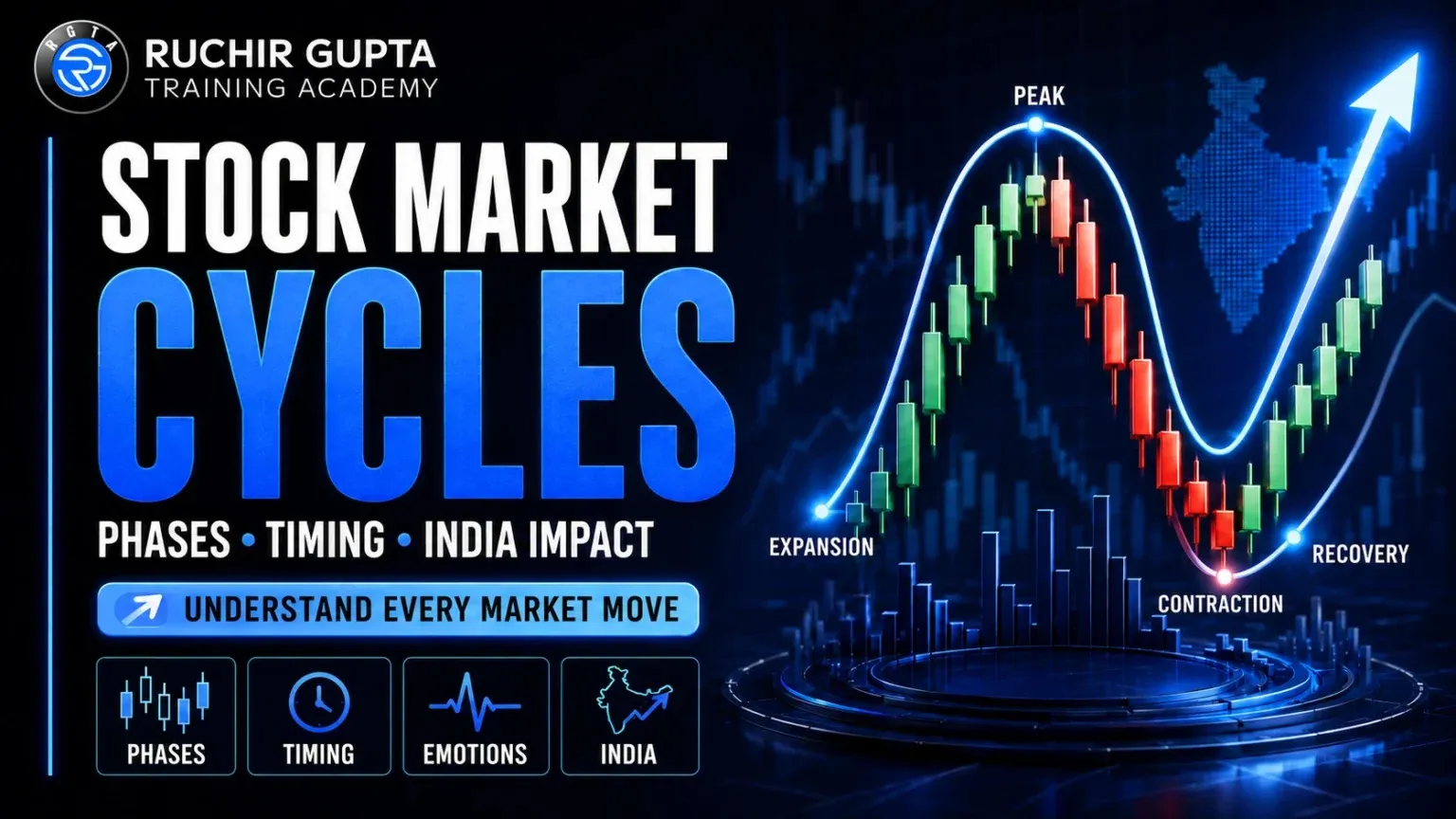
Stock Market Cycles: Understanding the Market's Natural Rhythm for Smarter Investing | Ruchir Gupta
The stock market rarely moves in a straight line. Sometimes prices climb rapidly, making everyone optimistic. At other times, fear spreads, and investors rush to sell. If you've ever wondered why this happens, the answer lies in stock market cycles.
Think of the market like the changing seasons. Spring brings growth, summer represents strength, autumn signals caution, and winter reminds us that difficult periods don't last forever. Just as seasons repeat, the stock market also moves through recurring phases. Understanding these patterns can help you stay calm, make better decisions, and avoid emotional investing.
Whether you're a beginner or someone looking to improve your investing skills through online stock trading courses, learning about the cycle of market emotions and the trading cycle is one of the smartest investments you can make.
Learn stock market cycles, the cycle of market emotions, trading cycle, online stock trading courses and make smarter investment decisions.
What Are Stock Market Cycles?
Stock market cycles refer to the recurring patterns of rising and falling prices over time. Every financial market experiences these cycles because investor behavior, economic conditions, corporate earnings, and global events constantly change.
No market remains bullish forever, and no bear market lasts indefinitely. History has shown that markets recover after downturns and eventually enter new growth phases.
Understanding these cycles helps investors avoid panic and make informed decisions instead of reacting emotionally.
Why Do Stock Market Cycles Exist?
Markets move because people make decisions based on expectations, news, emotions, and financial data.
Several factors influence market cycles:
- Economic growth
- Interest rates
- Inflation
- Corporate earnings
- Government policies
- Global events
- Investor sentiment
When confidence grows, buying increases. When uncertainty appears, selling accelerates. These changing emotions create recurring trading cycles.
The Four Main Phases of the Trading Cycle
Every trading cycle generally consists of four important stages.
Accumulation
Smart investors quietly begin buying quality stocks after prices have fallen significantly.
Markup
Confidence returns, demand increases, and stock prices begin climbing steadily.
Distribution
Professional investors slowly start booking profits while public enthusiasm reaches its highest level.
Markdown
Selling pressure increases, prices decline, and fear spreads throughout the market.
Recognizing these stages can dramatically improve investment timing.
Accumulation Phase Explained
The accumulation phase begins after a prolonged decline.
Most investors remain pessimistic because recent losses are still fresh in their minds. However, experienced investors recognize attractive valuations and gradually start buying.
Characteristics include:
- Low trading volume
- Stable prices
- Negative news dominates headlines
- Limited public interest
This phase often presents excellent long-term investment opportunities.
Markup Phase Explained
The markup phase represents the strongest growth period.
Corporate earnings improve, economic data becomes positive, and investors regain confidence.
Signs include:
- Rising prices
- Increasing trading volume
- Positive media coverage
- Growing investor participation
Many long-term investors enjoy substantial gains during this stage.
Distribution Phase Explained
Eventually, optimism reaches extreme levels.
Everyone seems convinced that prices will continue rising forever.
Professional investors often begin reducing positions because they recognize that markets have become expensive.
Indicators include:
- High valuations
- Strong public participation
- Heavy trading activity
- Mixed price movements
Ignoring warning signs during this stage can be costly.
Markdown Phase Explained
The markdown phase begins when sellers outnumber buyers.
Prices fall rapidly, confidence disappears, and fear dominates the market.
Common characteristics include:
- Sharp declines
- Negative headlines
- Panic selling
- Increased volatility
Although this phase feels uncomfortable, history shows it eventually creates opportunities for the next accumulation phase.
The Cycle of Market Emotions
One of the most fascinating concepts in investing is the cycle of market emotions.
Markets are driven not only by numbers but also by human psychology.
The emotional cycle usually follows this sequence:
- Hope
- Optimism
- Excitement
- Thrill
- Euphoria
- Complacency
- Anxiety
- Denial
- Fear
- Desperation
- Panic
- Capitulation
- Depression
- Disbelief
- Recovery
Notice how investors often buy during excitement and sell during fear—the exact opposite of what successful investing usually requires.
Learning to control emotions is just as important as analyzing financial statements.
Common Mistakes During Market Cycles
Many investors repeat the same mistakes.
Buying at Market Peaks
Excitement encourages investors to purchase stocks after large price increases.
Selling During Panic
Fear causes many investors to sell quality companies at the worst possible time.
Following the Crowd
People naturally feel comfortable doing what everyone else is doing, even when it's the wrong decision.
Ignoring Diversification
Putting all investments into one sector increases risk significantly.
Trying to Predict Every Market Move
Nobody consistently predicts every market top and bottom.
How to Identify the Current Market Cycle
Although predicting exact turning points is impossible, investors can look for useful clues.
Watch:
- Economic indicators
- Corporate earnings
- Interest rate trends
- Inflation data
- Market valuation
- Trading volume
- Investor sentiment
Combining these indicators provides a clearer picture of where markets may be within the stock market cycles.
Investment Strategies for Every Phase
Different market phases require different approaches.
Accumulation Phase
- Focus on quality companies.
- Invest gradually.
- Think long term.
Markup Phase
- Hold winning investments.
- Continue disciplined investing.
- Avoid chasing overpriced stocks.
Distribution Phase
- Review portfolio allocation.
- Book partial profits if necessary.
- Increase diversification.
Markdown Phase
- Stay patient.
- Avoid emotional selling.
- Prepare for future buying opportunities.
Importance of Risk Management
Even experienced investors cannot predict every market movement.
Risk management helps protect your capital.
Important techniques include:
- Diversification
- Position sizing
- Asset allocation
- Emergency funds
- Regular portfolio reviews
Successful investing is less about making perfect predictions and more about managing risk effectively.
Learning Through Online Stock Trading Courses
Today's investors have access to high-quality online stock trading courses that explain market behavior in simple language.
A good course helps you understand:
- Technical analysis
- Fundamental analysis
- Risk management
- Portfolio construction
- Market psychology
- Stock market cycles
- Trading cycle strategies
Structured learning shortens the learning curve and helps investors avoid costly beginner mistakes.
However, remember that education builds knowledge—not guaranteed profits. Success still depends on discipline, research, and consistent decision-making.
Long-Term Investing vs Short-Term Trading
Both investing styles can benefit from understanding stock market cycles.
Long-Term Investors
Focus on business quality, earnings growth, and long-term wealth creation.
Short-Term Traders
Analyze price movements, trends, and market momentum within shorter trading cycles.
Neither approach is inherently better. The best choice depends on your goals, risk tolerance, available time, and experience.
Final Thoughts
Understanding stock market cycles is like having a roadmap before starting a journey. You may not know every twist and turn ahead, but you gain a much better sense of direction.
Markets will always experience periods of optimism, fear, growth, and decline. These movements are natural and have repeated throughout financial history. Instead of reacting emotionally, successful investors focus on discipline, patience, continuous learning, and sound risk management.
By understanding the cycle of market emotions, recognizing each trading cycle, and improving your knowledge through online stock trading courses, you'll be better prepared to navigate changing market conditions with confidence. Remember, the goal isn't to predict every market move—it's to make informed decisions that support your long-term financial objectives.
Frequently Asked Questions (FAQs)
1. What are stock market cycles?
Stock market cycles are recurring periods of rising and falling market prices influenced by economic conditions, investor behavior, and market sentiment.
2. Why is the cycle of market emotions important?
The cycle of market emotions explains how fear and greed influence investment decisions. Understanding it helps investors avoid emotional mistakes and stay disciplined.
3. What are the four phases of the trading cycle?
The four phases are Accumulation, Markup, Distribution, and Markdown. Each phase represents a different stage of market movement and investor behavior.
4. Can online stock trading courses help beginners understand market cycles?
Yes. Quality online stock trading courses teach market fundamentals, technical analysis, risk management, and how to identify different stages of stock market cycles.
5. Is it possible to predict stock market cycles accurately?
No one can predict market cycles with complete accuracy. However, studying economic trends, valuations, investor sentiment, and historical patterns can help investors make better-informed decisions.
Related Reading
Expert Insights: Navigating the Complex World of Education & Learning
Welcome to our in-depth exploration of Education & Learning. In an era defin...
Why Education & Learning is Transforming the Global Industry Landscape
Welcome to our in-depth exploration of Education & Learning. In an era defin...