South Africa ATM Market Outlook: Technology and Industry Trends 2026-2034
By Sonpal Singh
5 Views
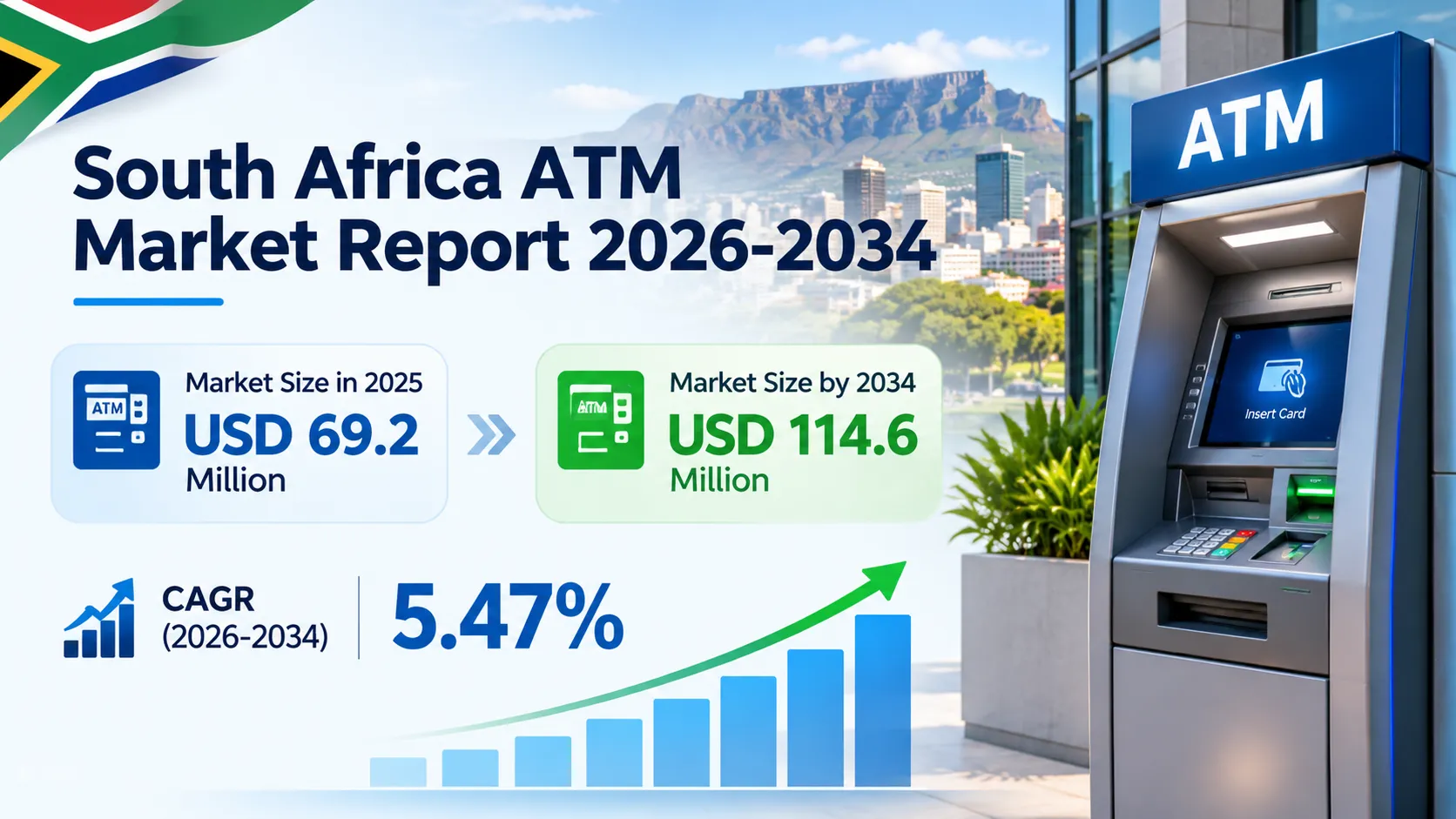
IMARC Group, a leading global market research and management consulting firm, has published its latest market intelligence report on the South Africa ATM market size reached USD 69.2 Million in 2025. Looking forward, the market is expected to reach USD 114.6 Million by 2034, exhibiting a growth rate (CAGR) of 5.47% during 2026-2034. The market is driven by the country’s deep reliance on cash, the ongoing modernization of bank-owned and independent ATM fleets, and the expansion of cash access points into underserved communities. Regulatory reform, digital payment integration, and continuous upgrades in ATM hardware, software, and managed services are also supporting it.
The market is shaped by the balance between South Africa’s cash-centric consumer behavior and the push toward efficient, secure, and inclusive cash infrastructure. Cash still accounts for about 56% of all consumer transactions by volume, even as digital payments grow. Large independent deployers operate alongside the major banks and are extending ATM access into retail, hospitality, and convenience locations. Banks are replacing older machines with higher-capacity, next-generation devices, so fewer terminals can serve the same or a larger customer base. At the same time, the central bank is working to prevent “cash deserts,” where people need cash but cannot reach it.
How is AI Reshaping the Future of the South Africa ATM Market?
- AI-Powered Predictive Maintenance and Cash Replenishment: Machine learning platforms help banks and independent deployers forecast cash demand at the terminal level, plan replenishment routes, and anticipate component failures before they cause downtime. This is valuable in a market where cash logistics are costly and cash-in-transit vehicles are a frequent criminal target. Smarter replenishment reduces unnecessary cash holdings, which cost banks money, and lowers the number of risky cash runs.
- Intelligent Fraud Detection and ATM Security Analytics: AI-driven analytics monitor transaction behavior, device sensors, and video feeds in real time to detect card skimming, jackpotting, and suspicious withdrawal patterns. Faster anomaly detection protects customers and operators as ATM fleets become more connected and more exposed to cyber and physical attacks.
- Network Optimization and Data-Driven Placement Decisions: Banks are using geospatial and transaction analytics to decide where to keep, relocate, or retire ATMs. By reading footfall, withdrawal volumes, and device economics, operators can keep machines where demand is real and still serve rural and informal-economy areas. This supports efficient fleets and the national goal of equitable cash access.
Grab a sample PDF of this report: https://www.imarcgroup.com/south-africa-atm-market/requestsample
South Africa ATM Market Trends and Drivers:
The South Africa ATM market is evolving as cash dependence, infrastructure modernization, and regulatory reform shape how cash is distributed and accessed. Cash remains central to everyday commerce, especially for lower-income households and the informal economy. About 94% of South Africans withdraw cash monthly, and 34% withdraw all deposited funds at once. The South African Reserve Bank found that ATMs remain the dominant access point for cash at 55%. This sustained demand keeps ATMs a core part of the national payments landscape, even as banks rationalize their networks.
The structure of the installed base is also changing. South Africa has about 30,634 ATMs, of which 21,443 are operated by commercial banks and around 9,200 by independent ATM deployers. Network strategies differ widely among the large banks. Recent network data shows Capitec growing its ATM base by 11.4% and Standard Bank by 1.3% over a three-year period, while Nedbank declined 4.4%, Absa 2.7%, and FNB 0.3%. Capitec’s leadership has stated plans to add 800 new ATMs across the country. Standard Bank has upgraded all its ATMs to faster, next-generation machines while reducing device counts and making more branches cashless. Independent deployers are filling the gaps. ATM Solutions, a Paycorp group company, operates over 4,500 Cash Express ATMs in underserved rural, urban, retail, and hospitality locations.
Cost and security are the main pressures on the market. The Reserve Bank has put the amount of cash in the economy at about R180 billion and noted that cash still accounts for about two-thirds of transaction volumes. Some banks charge up to R23.50 to withdraw R500 at an ATM, far above typical till-point fees. Many major banks charge R10 to R20 per ATM withdrawal, versus R1 to R3 at tillpoints, and the country recorded 31 cash-in-transit heists in the first three months of 2026. These factors are encouraging more efficient devices, smarter cash logistics, and stronger security features across fleets.
Government and regulatory initiatives are reshaping the market’s long-term structure. The South African Reserve Bank proposed independent white-label ATMs that sit outside the traditional bank-branded infrastructure, backed by a national cash utility and licensing of non-banks for wholesale cash. The central bank also plans to rationalize its roughly 109 cash centres to 50 at most. Banks have also expanded cash-accepting ATMs with automated deposits to shift routine branch transactions to self-service channels. These steps aim to cut system-wide costs, protect access in rural communities, and strengthen the resilience of the cash network.
South Africa ATM Industry Segmentation:
The report has segmented the market into the following categories:
Breakup By Offering:
- Hardware
- Software
- Services
Hardware accounts for a leading share of the offering segment, driven by continuous fleet upgrades as banks and independent deployers replace aging machines with higher-capacity, cash-recycling, and security-enhanced terminals that serve more customers with fewer devices.
Breakup By Deployment Type:
- On-Site ATMs
- Off-Site ATMs
- Mobile ATMs
- White-Label ATMs
Off-site ATMs hold a significant share, supported by the placement of machines in retail centres, petrol stations, hospitality venues, and community locations where consumers need cash close to where they shop and live.
Breakup By Ownership:
- Bank-Owned ATMs
- Independent ATM Deployers
Bank-owned ATMs account for the largest share, as the major banks operate the majority of the national fleet and continue to invest in next-generation devices and optimized network footprints.
Breakup By Application:
- Cash Withdrawal
- Cash Deposit
- Fund Transfer and Bill Payment
- Others
Breakup By Region:
- Gauteng
- Western Cape
- KwaZulu-Natal
- Eastern Cape
- Others
Gauteng leads the regional landscape, driven by its dense urban population, concentration of commercial activity, and strong retail and banking infrastructure, while rural provinces remain a priority for improved cash access.
Competitive Landscape:
The report provides a comprehensive analysis of the competitive landscape in the South Africa ATM market with detailed profiles of all major companies, including:
- Absa Group Limited
- ATM Solutions (Paycorp)
- Capitec Bank
- Diebold Nixdorf, Incorporated
- FirstRand Limited (FNB)
- GRG Banking
- Hyosung TNS
- Nedbank Group Limited
- NCR Atleos Corporation
- Spark ATM Systems
- Standard Bank Group
Recent News and Developments in South Africa ATM Market
- October 2026: The South African Reserve Bank released its Cost of Cash Industry Report. It found that consumers are shifting toward supermarket tills for cash because of high ATM fees, long queues, travel costs, and limited access. The report counted about 30,634 ATMs nationwide, including 21,443 bank-operated and around 9,200 independently operated machines.
- August 2026: Industry reports highlighted diverging ATM strategies among the major banks. Capitec and Standard Bank continue to see profitability in physical currency, while other institutions scale back their networks.
- June 2026: The South African Reserve Bank published a Position Paper on Cash outlining three goals: lower costs, equitable access, and secure physical currency. It proposed a national cash utility and independent white-label ATMs.
- January to March 2026: South Africa recorded 31 cash-in-transit heists in the first three months of 2026, reinforcing the need for safer cash logistics and optimized replenishment.
- July 2025: Capitec announced plans to add 800 new ATMs across South Africa, in contrast to the Big Four banks that were reducing their networks.
- August 2024: The South African Reserve Bank’s Payments Study found that 87% of South Africans use cash most often as a payment method.
- January to June 2024: Standard Bank, Absa, Nedbank, and FNB closed a combined 233 ATMs in the first half of the year, while upgrading remaining fleets.
About Us:
IMARC Group is a global management consulting firm that helps the world’s most ambitious changemakers to create a lasting impact. The company provides a comprehensive suite of market entry and expansion services. IMARC offerings include thorough market assessment, feasibility studies, company incorporation assistance, factory setup support, regulatory approvals and licensing navigation, branding, marketing and sales strategies, competitive landscape and benchmarking analyses, pricing and cost research, and procurement research.
Media and Sales Contact
IMARC Group
Email: sales@imarcgroup.com
United States: +1-201-971-6302
India: +91-120-433-0800
United Kingdom: +44-753-714-6104
Related Reading
Top 10 Hidden Secrets About Business & Finance You Need to Know
Welcome to our in-depth exploration of Business & Finance. In an era defined...
Why Business & Finance is Transforming the Global Industry Landscape
Welcome to our in-depth exploration of Business & Finance. In an era defined...