Sourcing Organic Sunflower Lecithin Powder: What B2B Buyers Should Evaluate Before Scaling
By Angela Brown
87 Views
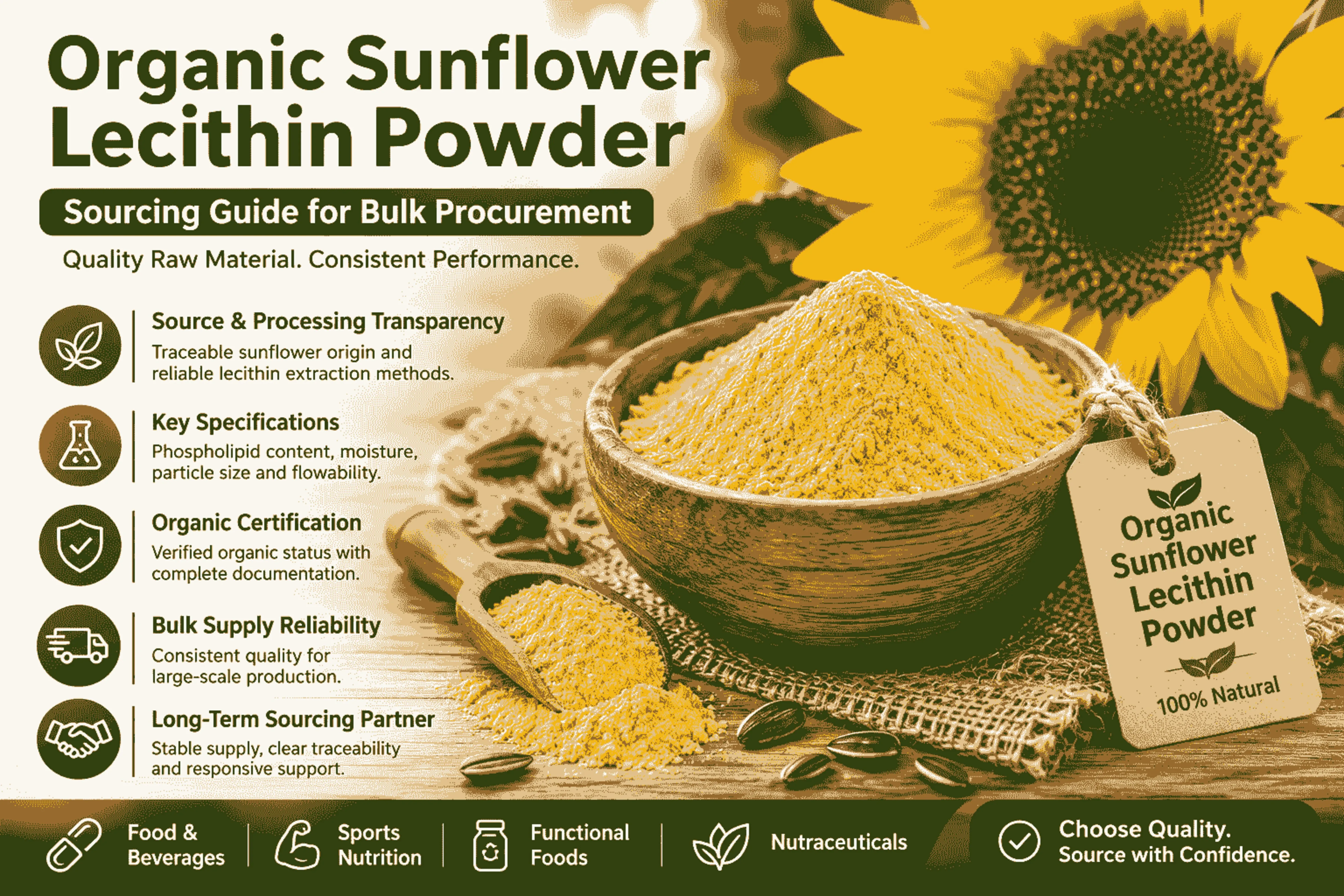
For procurement teams, sourcing a lecithin powder that looks acceptable on paper is rarely the difficult part. The real challenge begins when the ingredient enters a commercial formulation. Differences in phospholipid composition, moisture, particle size, processing conditions, and storage can affect dispersion, flow, emulsification, and batch consistency. This is why Organic Sunflower Lecithin Powder and conventional Sunflower Lecithin Powder should be evaluated as functional ingredients rather than treated as interchangeable commodity powders.
Start With the Intended Function
In most sourcing projects, the first question should be: what does the lecithin need to accomplish in the finished product?
Sunflower lecithin is naturally rich in phospholipids, including phosphatidylcholine and other phospholipid fractions. These surface-active components allow lecithin to interact with both oil and water phases, making it useful in emulsification, wetting, dispersion, and processing.
For formulators, however, the practical behavior depends on more than phospholipid content. Powder structure, residual moisture, carrier materials, particle size, and manufacturing conditions can influence how quickly the ingredient disperses and how consistently it performs.
Organic and Conventional Materials Need Separate Qualification
A common procurement mistake is assuming that organic and conventional Sunflower Lecithin Powder can be substituted without reformulation. From a functional perspective, they may perform similarly, but their raw-material sourcing, processing controls, documentation, and certification requirements can differ.
For Organic Sunflower Lecithin Powder, buyers should verify the organic certification applicable to the intended market and confirm that the certification covers the actual ingredient and processing chain. Traceability from sunflower seed to finished powder also becomes more important when customers require certified-organic finished products.
For conventional material, the documentation burden may be different, but identity, purity, allergen status, microbiological quality, heavy metals, pesticide controls, and manufacturing traceability still require attention.
Formulation Behavior Can Change at Scale
One issue R&D teams often encounter is that a lecithin powder behaves well during bench testing but becomes less predictable during production.
Particle size can influence blending and dispersion. Moisture can affect powder flow and storage stability. Hygroscopicity may become a concern in humid manufacturing environments, particularly when the material is repeatedly exposed during handling.
In beverage powders and nutritional mixes, dispersion time matters. In bakery and food systems, lecithin may be selected to support processing and emulsion performance. In supplement formulations, it can be incorporated into powdered blends where consistent distribution is important.
The appropriate specification therefore depends on the application. A buyer focused only on a single headline value may miss the characteristics that actually determine production performance.
What Procurement Should Put on the Specification
A supplier COA should be reviewed alongside an agreed technical specification. Typical checkpoints may include phospholipid profile, moisture, particle size, bulk density, microbiological limits, heavy metals, pesticide residues where relevant, and identity testing.
For organic materials, certification documents and supply-chain traceability should be verified independently of the standard COA. Buyers should also establish allergen statements, GMO status, country of origin, processing aids or carriers, packaging configuration, storage conditions, and shelf-life expectations.
One useful sourcing practice is to request samples from more than one production lot. A single sample can demonstrate that a material works; multiple lots provide a better indication of whether the supplier can reproduce that performance.
Hidden Sourcing Variables Matter
The biggest sourcing differences are not always visible in product names. Sunflower seed origin, extraction or processing conditions, drying technology, powder agglomeration, and packaging can all influence the final ingredient.
Storage is another overlooked factor. Lecithin powders should be protected from excessive heat, moisture, and unsuitable warehouse conditions. Even when the material remains within specification, poor storage can affect handling characteristics and formulation performance.
For procurement managers, this makes supplier qualification more important than simply comparing price per kilogram. A lower purchase price has little value if inconsistent dispersion or flow creates production adjustments, rejects, or additional processing time.
A More Practical Sourcing Decision
The strongest approach is to qualify Organic Sunflower Lecithin Powder or conventional Sunflower Lecithin Powder against the actual manufacturing process. Test it in the finished formulation, evaluate several lots, compare key analytical parameters, and document how the powder behaves during receiving, storage, blending, and processing.
For sourcing teams, consistency should be treated as a specification in its own right. The best ingredient is not necessarily the one with the most impressive certificate. It is the one that delivers predictable functional performance while maintaining traceability, compliance, and supply continuity as volumes increase.