Social Media in 2026: Generic AI Content Is Starting to Lose Distribution
19 Views
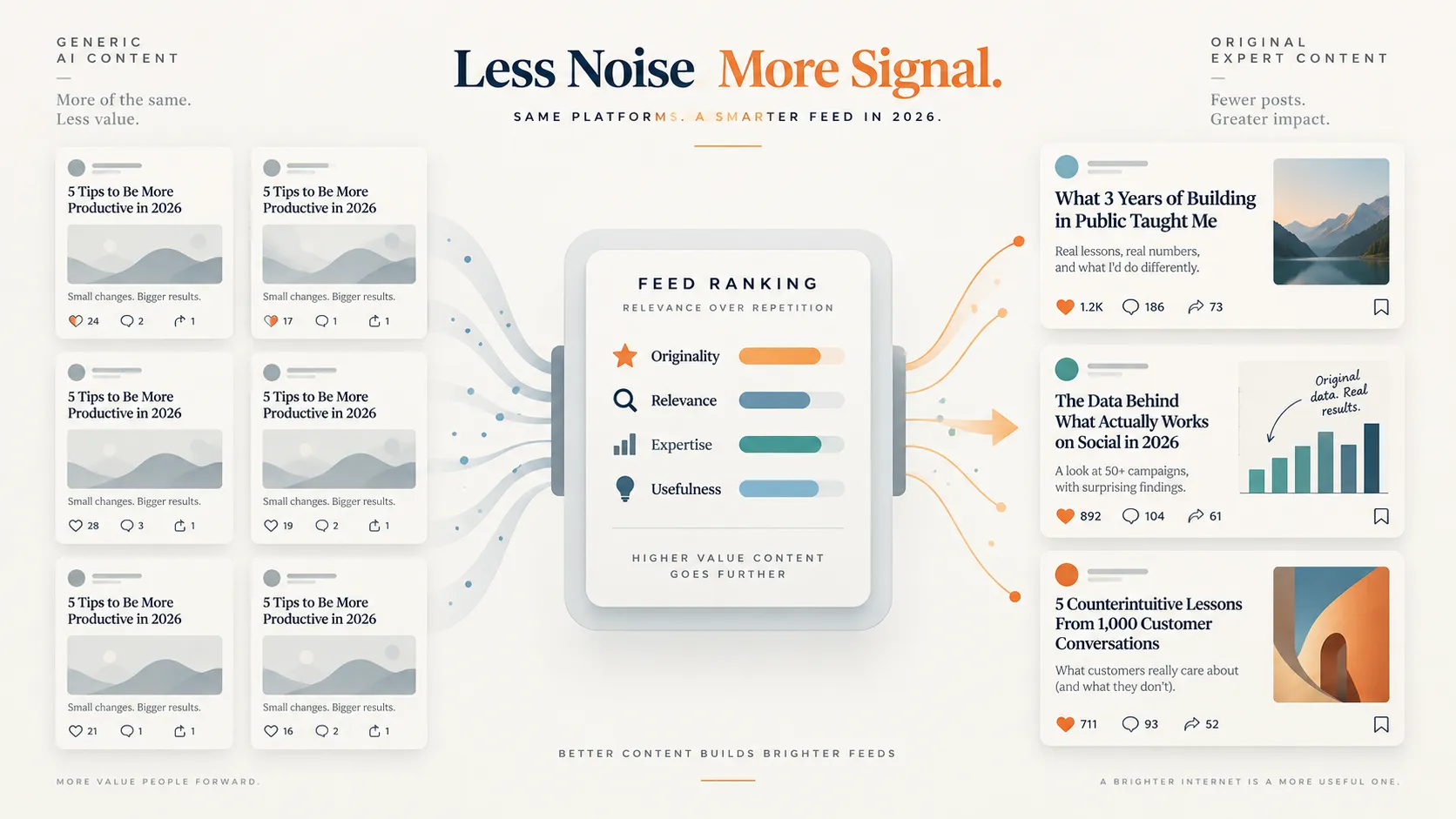
AI has made social content dramatically easier to produce. A team can generate captions, carousels, replies, scripts, and post ideas within minutes.
That abundance is creating a new problem for social media management. Platforms increasingly need to separate useful expertise from repetitive content created mainly to maintain posting frequency.
LinkedIn made that direction unusually clear this month.
On September 15, LinkedIn said recent efforts had already reduced views of content classified as “AI slop” by 40 percent. More than one million members had also used its new “Seems Like AI Slop” feedback option since August.
This matters beyond LinkedIn.
Social algorithms are becoming better at understanding what a post actually says, who may find that information relevant, and whether the content provides something meaningful.
Publishing volume is becoming a weaker advantage
For years, many social strategies followed a simple assumption:
Publish frequently and increase the chances of earning reach.
AI makes that approach easy for almost everyone.
A business can now create thirty polished posts around one topic in an afternoon. Competitors can do exactly the same.
LinkedIn describes low value AI content as material that may appear polished while lacking a clear perspective, unique insight, or substance. The company says generic, repetitive, recycled content is less likely to receive broad distribution.
That changes the useful question.
Instead of asking:
How many posts should we publish?
Teams should ask:
What does this post contain that could not have been written from a generic prompt?
Social algorithms understand topics more deeply
LinkedIn has also changed how content is ranked.
The company says its feed now uses larger sequence models and language models to understand post topics and how member interests change over time. Distribution is becoming more dependent on relevance to a person’s professional interests.
This makes topical consistency valuable.
A company known for enterprise software should repeatedly publish credible ideas around areas such as software architecture, implementation lessons, security, integrations, automation, and operational challenges.
Jumping constantly between unrelated trending subjects may generate occasional impressions while giving recommendation systems weaker information about who should see future posts.
First hand information becomes more valuable
AI can summarize common knowledge extremely well.
A company has a stronger content advantage when posts contain information AI cannot easily recreate from public sources.
Examples include:
- lessons from actual projects
- anonymized customer questions
- internal research or data
- unexpected implementation problems
- screenshots of real processes
- expert commentary on current product updates
- experiments and observed results
- informed disagreement with common industry assumptions
This type of material gives the post a reason to exist.
A generic post about “five benefits of CRM automation” can be produced almost instantly.
A post explaining why a specific automation failed during implementation and how the team corrected the issue provides experience that readers can use.
AI should help with production without becoming the voice
LinkedIn has not rejected AI assisted writing.
The company says AI can be useful for refining language. Its concern is content produced at scale with little individual perspective. LinkedIn is even replacing its broader “enhance your post” capability with tools focused more narrowly on proofreading and clarity.
That provides a useful working model for businesses.
AI can help with research, structure, editing, adaptation, and quality checks.
The underlying point of view should still come from people who understand the subject.
A useful workflow looks like:
Expert input → research → draft → AI assistance → human refinement → publish → conversation
Starting entirely from AI and adding a company name near the end usually produces the generic tone platforms are increasingly trying to reduce.
Comments need substance too
Another significant change concerns engagement.
LinkedIn says automated comments, engagement pods, and artificial conversations are being actively targeted. The platform reports blocking hundreds of thousands of automated comment attempts every day and billions of automated activities during recent months.
This weakens another old social tactic: publishing a post and asking employees or automation tools to add shallow comments immediately.
Comments should add new information.
A useful response might provide another example, challenge part of the argument, share data, answer a question, or explain a related experience.
“Great post” provides almost nothing.
Social content is also becoming searchable
Social visibility increasingly extends beyond the feed.
Search behavior inside platforms continues to grow, while social pages and posts can also appear in broader web and AI search experiences. Recent monitoring during September found LinkedIn citations across AI search systems rising during the month, although citation behavior differs significantly between platforms and can change quickly.
This creates another reason to make posts clear and specific.
A strong social post should make the subject obvious through the headline, opening paragraph, terminology, and supporting details.
Cryptic copy may earn curiosity.
Clear expert content has a better chance of being understood, retrieved, and referenced later.
The useful metrics are changing
Follower count and raw impressions still provide context.
Teams should also examine:
engagement from relevant audiences, qualified profile visits, saves, meaningful comments, website visits, branded searches, assisted leads, and repeat visibility around important topics.
A post reaching 2,000 relevant professionals can have more business value than one reaching 50,000 unrelated accounts.
LinkedIn’s 2026 feed changes emphasize relevance and authentic professional content rather than popularity alone.
The 2026 social strategy is becoming clearer
AI has reduced the cost of producing content.
That makes publishing more competitive.
Platforms now have more reasons to identify content containing real expertise, original observations, useful information, and genuine conversation.
Social teams should use AI to remove repetitive production work and spend more time obtaining information worth publishing.
Posting frequency will still matter.
The stronger advantage comes from having something specific to say every time a brand appears in the feed.