Single-Speed Scroll Compressors Explained: Benefits, Applications, and Performance
By pvcboard1
2 Views
Single-speed scroll compressors have become an important component in many modern heating, ventilation, and air conditioning (HVAC) systems. Known for their relatively simple design, dependable operation, and consistent cooling performance, these compressors are widely used in residential, commercial, and light industrial applications. While variable-speed compressor technology continues to gain attention for its energy-saving capabilities, single-speed scroll compressors remain a practical choice when reliability, straightforward operation, and cost-effectiveness are key priorities.
Understanding how single-speed scroll compressors work, their major benefits, and where they are best applied can help HVAC professionals, building owners, and equipment buyers make more informed decisions.
What Is a Single-Speed Scroll Compressor?
A single-speed scroll compressor is a type of positive-displacement compressor designed to circulate refrigerant through an HVAC or refrigeration system. Unlike variable-speed compressors, which can adjust their operating speed according to cooling demand, a single-speed compressor generally operates at one predetermined speed.
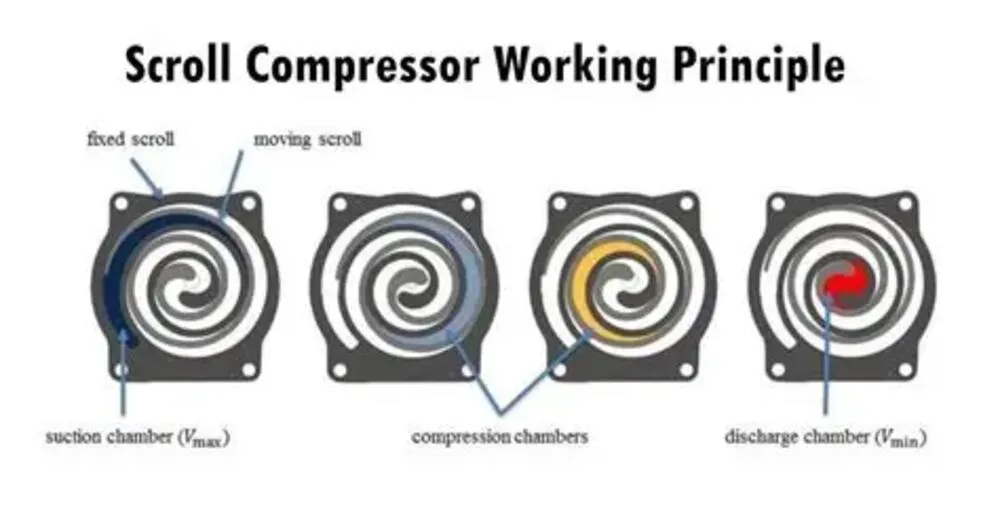
The compressor uses two spiral-shaped components called scrolls. One scroll remains stationary while the other moves in an orbiting motion. This movement creates a series of compression pockets that gradually reduce in volume as they move toward the center of the scroll assembly. Refrigerant entering the compressor is progressively compressed before being discharged into the high-pressure side of the system.
This continuous compression process allows scroll compressors to provide smooth refrigerant flow with fewer moving parts than many traditional compressor designs.
How Single-Speed Scroll Compressors Work
The operating cycle begins when low-pressure refrigerant vapor enters the compressor. The orbiting scroll traps the refrigerant between the two scrolls and moves it toward the center. As the trapped volume decreases, the refrigerant pressure increases.
Once compression is complete, the high-pressure refrigerant exits through the discharge port and continues toward the condenser. The cycle then continues as the HVAC system transfers heat from the conditioned space to the outside environment.
Because the scroll mechanism produces continuous compression rather than the intermittent compression associated with some other compressor technologies, operation can be relatively smooth and quiet. The streamlined mechanical design also reduces the number of components that can experience wear.
Key Benefits of Single-Speed Scroll Compressors
1. Reliable Operation
Reliability is one of the strongest advantages of single-speed scroll compressors. Their relatively simple mechanical construction can reduce potential failure points. When properly installed, operated, and maintained, they can provide consistent performance over many years.
This reliability is particularly valuable in applications where dependable temperature control is essential.
2. Simple System Design
A single-speed compressor is generally easier to integrate into conventional HVAC equipment than a variable-speed system. Because the compressor operates at a fixed speed, control requirements are comparatively straightforward.
This simplicity can benefit manufacturers, installers, and service technicians by making system design, troubleshooting, and maintenance more manageable.
3. Smooth and Quiet Performance
Scroll compressors are recognized for their relatively low vibration and noise characteristics. The continuous compression process helps create smoother operation compared with some reciprocating compressor designs.
For residential air conditioners, offices, hotels, and other noise-sensitive environments, this can contribute to a more comfortable indoor atmosphere.
4. Cost-Effective Performance
Single-speed scroll compressors can provide a good balance between performance and initial equipment cost. Although variable-speed technology can deliver greater efficiency under certain operating conditions, it often requires more sophisticated controls and electronics.
For applications with relatively stable cooling requirements, a single-speed compressor may offer an economical solution without unnecessary system complexity.
5. Durable Construction
Many scroll compressors are engineered to withstand the demanding operating conditions found in HVAC systems. Proper lubrication, refrigerant management, electrical protection, and correct installation are essential to achieving long service life.
Common Applications
Single-speed scroll compressors are used in a wide variety of HVAC equipment. Residential split air conditioners and heat pumps are among the most common applications. They can also be found in packaged HVAC units, rooftop systems, commercial air-conditioning equipment, and certain refrigeration systems.
Commercial buildings with predictable cooling loads can benefit from their straightforward operation. They are also suitable for smaller facilities where advanced capacity modulation is not necessarily required.
In heat pump systems, scroll compressors can support both heating and cooling functions by moving refrigerant through the system in the appropriate operating direction.
Performance Considerations
The performance of a single-speed scroll compressor depends on several factors, including system design, refrigerant type, outdoor temperature, indoor load, airflow, and operating pressure. Since the compressor has a fixed operating speed, it delivers approximately the same capacity whenever it is running under similar conditions.
This characteristic can be advantageous when the system frequently operates near its design load. However, during periods of low demand, the compressor may need to cycle on and off rather than continuously adjusting its capacity.
Proper equipment sizing is therefore particularly important. An oversized HVAC system using a single-speed compressor may cycle frequently, potentially affecting efficiency, humidity control, and comfort.
Maintenance and Efficiency
Although scroll compressors generally require limited direct maintenance, the overall HVAC system still needs regular servicing. Technicians should inspect electrical connections, refrigerant levels, airflow, filters, coils, and other components according to the equipment manufacturer's recommendations.
Maintaining clean condenser and evaporator coils is especially important because restricted heat transfer can increase operating pressures and place additional stress on the compressor.
Efficiency also depends heavily on the surrounding system. Proper ductwork, adequate airflow, correct refrigerant charge, and an appropriately sized compressor can help the equipment operate closer to its intended performance range.
Single-Speed vs. Variable-Speed Compressors
The primary difference between single-speed and variable-speed compressors is capacity control. A single-speed compressor generally runs at a fixed speed and responds to demand through cycling. A variable-speed compressor can increase or decrease its operating speed to more closely match the current heating or cooling requirement.
Variable-speed systems may provide better part-load efficiency, improved temperature stability, and longer operating cycles. However, single-speed scroll compressors can remain attractive because of their simpler controls, lower complexity, and potentially lower upfront cost.
The best option depends on the application, climate, operating schedule, energy goals, and project budget.
Conclusion
Single-speed scroll compressors continue to provide a dependable foundation for many HVAC systems. Their combination of reliable operation, relatively simple construction, smooth performance, and cost-effective design makes them suitable for residential, commercial, and selected industrial applications.
While variable-speed technology offers important advantages for applications demanding advanced capacity modulation and high part-load efficiency, single-speed scroll compressors remain highly relevant where consistent performance and straightforward system design are priorities.
ACJAKARTA: For the best results, compressor selection should always consider the complete HVAC system rather than the compressor alone. Correct sizing, proper installation, routine maintenance, and suitable operating conditions are essential for achieving reliable performance and maximizing equipment life.
Related Reading
Expert Insights: Navigating the Complex World of Home Improvement
Welcome to our in-depth exploration of Home Improvement. In an era defined by ra...
Why Home Improvement is Transforming the Global Industry Landscape
Welcome to our in-depth exploration of Home Improvement. In an era defined by ra...