Silent Webflow Partner for Marketing Agencies: Scale Web Projects Without Expanding Your Team
By teckcod
18 Views
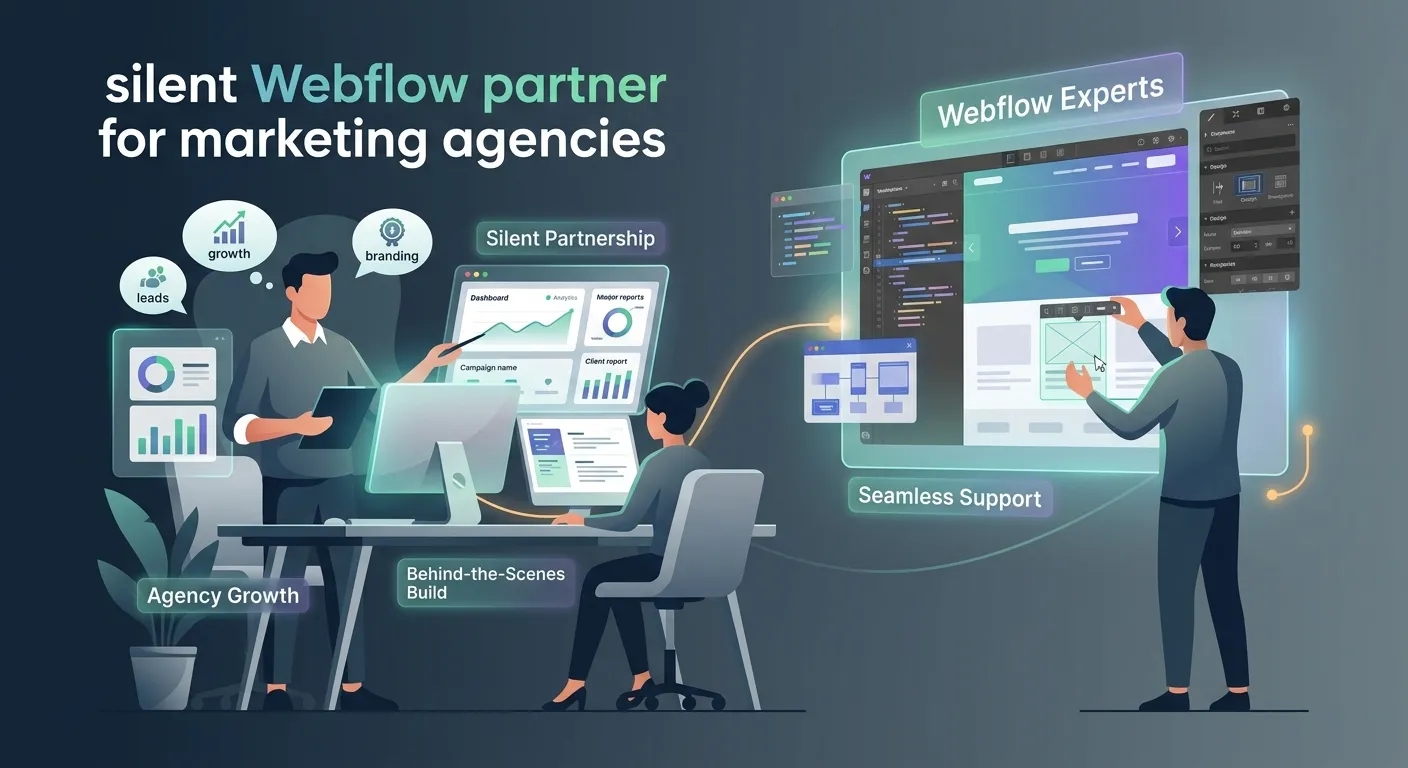
Marketing agencies are expected to deliver more than campaigns, ads, SEO, and strategy. Clients increasingly expect polished websites, high-converting landing pages, responsive designs, CMS functionality, and fast updates as part of the overall marketing experience.
That creates a common challenge: your agency wins the project, but your internal team does not always have enough Webflow development capacity to deliver it.
This is where a silent Webflow partner for marketing agencies can become a valuable part of your delivery model. Instead of hiring another full-time developer or turning away projects, you can work with an experienced Webflow professional behind the scenes while your agency remains the primary point of contact for the client.
A silent partnership can give marketing agencies additional development capacity without disrupting their existing client relationships, branding, communication process, or project management structure.
What Is a Silent Webflow Partner?
A silent Webflow partner is a Webflow developer or development team that works behind the scenes for a marketing, branding, SEO, or creative agency.
The agency manages the client relationship, strategy, communication, and overall project. The Webflow partner handles the technical implementation according to the agency's requirements.
The client may never need to communicate directly with the development partner.
This model is particularly useful for agencies that sell website design and development services but prefer not to maintain a large in-house development team.
Depending on the agreement, the partner can support tasks such as:
- Webflow website development
- Figma to Webflow development
- Responsive implementation
- CMS setup
- Landing page development
- Webflow interactions and animations
- Website migrations
- Custom code implementation
- Third-party integrations
- Website updates and maintenance
- Technical fixes and improvements
The exact responsibilities can be defined according to each agency's workflow.
Why Marketing Agencies Work With Silent Webflow Partners
Running every project internally sounds attractive, but it can become difficult when several clients need websites at the same time.
One project may require a complete website build while another needs multiple landing pages for an upcoming campaign. At the same time, your SEO team may need technical changes and your designers may be preparing another client project.
A reliable development partner gives your agency another layer of capacity.
Instead of immediately hiring, you can bring additional expertise into the workflow when demand increases.
Webflow also supports agency workflows by allowing marketers and designers to work with visual development while maintaining control over website experiences. Its partner ecosystem includes professionals who support design, development, SEO, migrations, integrations, and other website-related services.
Maintain Your Client Relationship
One of the biggest advantages of a silent partnership is that your agency remains in control of the client relationship.
Your client communicates with your agency.
Your project manager manages deadlines.
Your designer controls the visual direction.
Your marketing team manages strategy.
The Webflow partner focuses on the development work assigned by your team.
This creates a clean structure where every person has a specific responsibility.
For example, imagine your agency has designed a 15-page website for a B2B client. Your designers have completed the Figma files, your content team has prepared the copy, and the client has approved the design.
Instead of asking your internal team to spend several weeks developing the website, you can send the approved design to your silent Webflow partner.
The partner builds the website according to your specifications while your agency manages the client-facing process.
White-Label Webflow Development for Agencies
Silent partnerships are closely connected with white-label development.
In a white-label arrangement, development work is delivered under your agency's brand rather than being presented as a separate service provider.
This can be particularly useful for marketing agencies that want to offer Webflow development without building a large technical department.
Your agency can package the service as part of its own website, branding, and client offering.
The development partner works according to your processes and communicates with the people you designate.
This arrangement allows agencies to expand their service capabilities while maintaining a consistent client experience.
Handle More Webflow Projects
Capacity is one of the biggest limitations for growing agencies.
Suppose your agency can comfortably manage three Webflow projects with its existing team, but suddenly five clients request new websites.
You have several choices.
You could hire developers, delay projects, outsource individual tasks, or turn away some of the work.
A silent Webflow partnership gives you another option: increase development capacity without immediately increasing your permanent headcount.
This can be especially useful for agencies with fluctuating workloads.
You may need substantial development support one month and much less the next. A flexible partner allows you to scale your technical resources according to project demand.
Reduce Development Bottlenecks
Design teams can work quickly, but development often becomes the bottleneck.
A website design may already be approved while the development queue continues to grow.
That delay can affect:
- Project launch dates
- Marketing campaigns
- Client satisfaction
- Internal team productivity
- Agency revenue
- New business opportunities
A dedicated Webflow development partner can help remove some of that pressure.
Instead of waiting for an internal developer to become available, your agency can allocate specific builds or development tasks to an external specialist.
The key is having a clearly defined process for handing projects over.
Figma to Webflow Development
Many marketing and creative agencies begin their website projects in Figma.
The designer creates the visual system, layouts, components, typography, interactions, and responsive concepts. The development partner then translates that approved design into Webflow.
A strong Figma-to-Webflow workflow should involve more than simply copying the visual appearance.
The developer needs to understand:
- Layout structure
- Responsive behavior
- Typography
- Spacing systems
- Components
- CMS requirements
- Interactions
- Animations
- Accessibility considerations
- Content structure
- Reusable sections
The goal is to turn the design into a functional website while preserving the original creative direction.
Webflow Landing Pages for Marketing Campaigns
Marketing agencies frequently need landing pages at short notice.
A campaign may require a dedicated page for paid advertising, an SEO campaign, product launch, webinar, lead-generation offer, or seasonal promotion.
These projects can be difficult to manage when the agency's development team is already busy with larger websites.
A silent Webflow partner can handle landing page implementation while your marketing team concentrates on campaign strategy, content, targeting, and conversion optimization.
This makes the development process more flexible.
Once the page structure is established, additional campaign pages may also be easier to produce using reusable components and established design systems.
CMS Development and Content Management
Webflow projects often involve more than static pages.
Clients may need blogs, case studies, team profiles, services, projects, resources, locations, or other dynamic content.
A Webflow partner can help structure CMS collections and templates so the client can manage recurring content more efficiently.
For marketing agencies, this is particularly important because websites are rarely finished after launch.
Content teams may need to publish articles.
SEO teams may add new landing pages.
Marketing teams may create campaign content.
Sales teams may require new case studies or resources.
A well-structured CMS can make these ongoing tasks easier to manage.
Custom Webflow Interactions and Animations
Modern marketing websites often use subtle interactions to improve the user experience.
These can include:
- Scroll-based animations
- Hover effects
- Page transitions
- Animated navigation
- Reveal effects
- Interactive cards
- Sticky elements
- Micro-interactions
- Custom visual effects
However, animations should support the website rather than distract from its purpose.
A development partner can help implement the technical side while your creative team remains responsible for the overall visual direction.
The result should be a website that feels polished without sacrificing usability or performance.
Webflow Migration Support
Marketing agencies sometimes inherit websites built on other platforms.
A client may want to move from WordPress, another CMS, or an older website setup to Webflow.
Migration projects require careful planning because the goal is not simply to recreate the design.
Important considerations can include:
- Page structure
- URL mapping
- Redirects
- Metadata
- Content migration
- Images
- CMS collections
- Internal linking
- Forms
- Analytics
- Search visibility
- Technical functionality
Having a Webflow development partner can allow the agency to manage the marketing and SEO strategy while the technical migration work is handled by someone experienced with Webflow implementation.
Keep Your Agency Lean
Not every marketing agency needs a large development department.
For some businesses, maintaining a small core team and working with trusted specialists is a more practical model.
Your internal team can focus on high-value activities such as:
- Strategy
- Client management
- SEO
- Paid advertising
- Branding
- Content
- Creative direction
- Conversion optimization
- Business development
The development partner provides technical capacity when required.
This creates a flexible team structure without requiring every skill to exist permanently in-house.
How the Silent Partnership Workflow Works
A successful partnership should have a simple and repeatable workflow.
Step 1: Project Discovery
Your agency collects the project requirements, sitemap, design files, content, functionality requirements, and deadlines.
The development partner reviews the information and identifies technical requirements.
Step 2: Scope and Timeline
Before development begins, both sides agree on the scope.
This should cover the number of pages, CMS requirements, integrations, animations, responsive implementation, revisions, and expected delivery date.
Step 3: Development
The Webflow partner builds the website according to the approved design and technical requirements.
Your agency can monitor progress without needing to manage every development detail.
Step 4: Quality Assurance
The website should be reviewed across relevant screen sizes and browsers.
Forms, navigation, CMS functionality, responsive layouts, interactions, links, and other important elements should be checked before launch.
Step 5: Agency Review
Your internal team reviews the completed build.
Any required revisions are collected and communicated through one organized process.
Step 6: Client Presentation and Launch
Once your agency approves the website, it can be presented to the client under your normal agency workflow.
The development partner remains behind the scenes unless both parties agree otherwise.
What Should You Look for in a Silent Webflow Partner?
Not every developer is suitable for an agency partnership.
Technical ability is important, but the partner also needs to understand how agencies operate.
Look for someone who can:
- Follow existing design systems
- Work from detailed Figma files
- Meet agreed deadlines
- Communicate clearly
- Handle revisions professionally
- Understand responsive design
- Work with CMS structures
- Implement integrations when required
- Follow your project management process
- Respect client confidentiality
- Maintain consistent development quality
Reliability can be just as important as technical skill.
A developer who produces excellent work but repeatedly misses deadlines can create problems for your agency.
Confidentiality and Client Privacy
For a silent partnership to work effectively, confidentiality should be taken seriously.
Before sharing client information, agencies should establish appropriate agreements covering confidential information, project materials, access credentials, intellectual property, and communication expectations.
Your partner may receive access to design files, project documentation, CMS accounts, analytics tools, or other sensitive business information.
Access should therefore be limited to what is actually required for the project.
Clear expectations at the beginning can prevent misunderstandings later.
When Should a Marketing Agency Consider a Silent Webflow Partner?
A silent partnership can make sense in several situations.
You may benefit from one if:
- Your agency receives more Webflow projects than your team can handle.
- You have strong designers but limited development resources.
- You want to offer Webflow without hiring a full-time developer.
- Your developers are overloaded.
- You need additional support during busy periods.
- You want to accept larger website projects.
- You need specialized Webflow expertise.
- You want to keep your team lean.
- You regularly need campaign landing pages.
- You want a reliable resource for ongoing Webflow work.
The right model depends on your agency's workload, budget, project volume, and internal capabilities.
Silent Webflow Partner vs. Hiring In-House
Both models have advantages.
An in-house developer gives your agency a dedicated resource who becomes deeply familiar with internal processes.
However, hiring also creates fixed costs and requires ongoing management.
A silent Webflow partner can provide more flexibility because development support can be added according to project demand.
For agencies with inconsistent Webflow workloads, this can be particularly useful.
The decision should ultimately come down to how frequently you need development support and how important permanent technical capacity is to your business model.
Build a Long-Term Development Partnership
The biggest value of a silent Webflow partnership usually comes from consistency.
Working with a different developer for every project can create communication problems and inconsistent development standards.
A long-term partner can gradually learn your:
- Design systems
- Coding preferences
- QA process
- Project management style
- Client expectations
- Documentation standards
- Delivery process
Over time, the handoff becomes easier.
Your team knows what information the developer needs, and the developer understands how your agency works.
That can make future projects faster and more predictable.
Frequently Asked Questions
What is a silent Webflow partner for marketing agencies?
A silent Webflow partner is a Webflow developer or development team that works behind the scenes for a marketing agency. The agency maintains the client relationship while the partner handles Webflow development.
Is silent Webflow development the same as white-label development?
They can be very similar. In both models, the development partner typically works behind the agency's brand and does not independently manage the client relationship.
Can a silent Webflow partner work from Figma?
Yes. Figma-to-Webflow development is a common workflow where the agency's design team provides approved designs and the Webflow developer handles implementation.
Can marketing agencies outsource Webflow landing pages?
Yes. Agencies can use development partners to build campaign landing pages while their internal teams focus on strategy, content, SEO, advertising, and conversion optimization.
Can a Webflow partner handle CMS development?
Yes. Depending on their capabilities, a Webflow developer can structure CMS collections, dynamic templates, and related functionality for websites that require regularly updated content.
Is a silent Webflow partner useful for small agencies?
Yes. Small agencies can use a development partner to offer Webflow services without maintaining a large in-house technical team.
How can an agency maintain quality control?
The agency should define project requirements, development standards, QA procedures, revision limits, deadlines, and approval stages before development begins.
What makes a good Webflow development partner?
Technical Webflow expertise, reliable communication, consistent quality, deadline management, responsive development skills, attention to detail, and an understanding of agency workflows are all important.
Final Thoughts
A silent Webflow partner for marketing agencies can provide the development capacity needed to grow without immediately expanding the internal team.
Instead of turning away Webflow projects because your developers are busy, you can create a flexible delivery model where your agency manages strategy, design, marketing, and client relationships while a trusted Webflow specialist handles development behind the scenes.
The most successful partnerships are built around clear communication, defined responsibilities, confidentiality, consistent quality, and reliable delivery.
For agencies that want to expand their Webflow offering while keeping their operations lean, the right development partner can become an extension of the team rather than simply another outsourced resource.
Related Reading
Top 10 Hidden Secrets About Business & Finance You Need to Know
Welcome to our in-depth exploration of Business & Finance. In an era defined...
Why Business & Finance is Transforming the Global Industry Landscape
Welcome to our in-depth exploration of Business & Finance. In an era defined...