Sentiment Annotation for Emotion-Aware AI Systems
By Annotera AI
22 Views
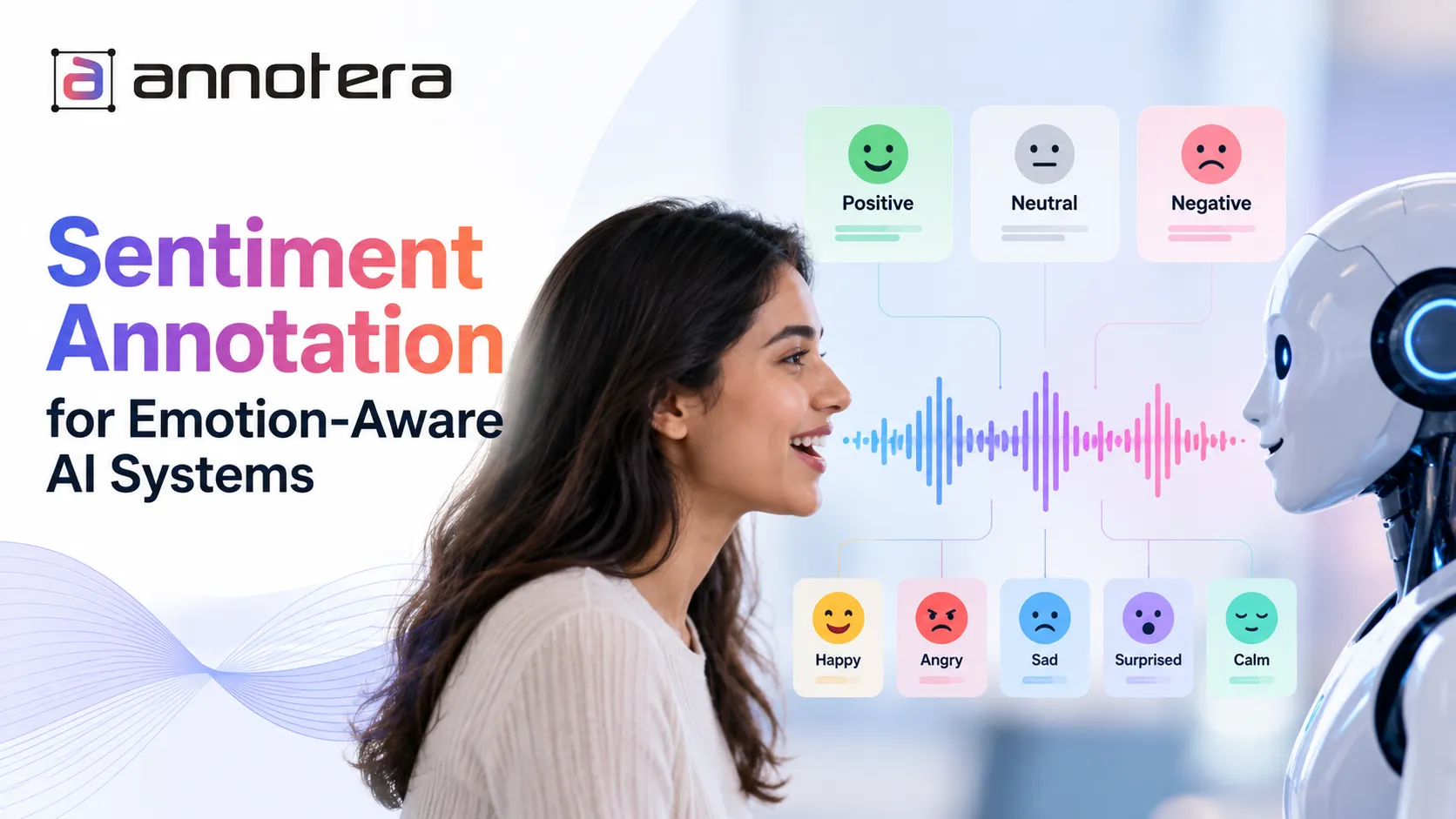
Artificial intelligence is becoming increasingly capable of understanding language, but recognizing what a person feels is a much more complex challenge. Words alone often fail to communicate the complete meaning of a conversation. A customer may say they are “fine” while their voice suggests frustration, hesitation, disappointment, or stress. For AI systems designed to interact naturally with people, identifying these emotional signals can make a significant difference.
This is where sentiment annotation for emotion-aware AI systems becomes valuable. By labeling sentiment, emotion, tone, intensity, and other contextual signals in datasets, organizations can develop AI models that understand conversations beyond their literal words.
What Is Sentiment Annotation?
Sentiment annotation is the process of assigning structured labels to data based on the emotional attitude or sentiment expressed within it. Depending on the project, annotations may classify content as positive, negative, or neutral, or use more detailed categories such as happiness, anger, sadness, fear, frustration, excitement, or calmness.
For audio datasets, annotation goes beyond the spoken words. Annotators may evaluate vocal characteristics such as pitch, pace, pauses, emphasis, stress, intensity, and changes in tone. These signals can provide important context for understanding how a speaker feels.
Modern conversational AI applications increasingly require this richer layer of information. Speech sentiment annotation, for example, can help models distinguish between a neutral statement and the same words delivered with irritation or excitement.
Why Emotion Awareness Matters in AI
Traditional AI systems often focus primarily on recognizing what a person says. Emotion-aware systems aim to understand how and why something is being communicated.
Consider a customer saying, “That is exactly what I needed.” Depending on the speaker's tone and delivery, the statement could represent genuine satisfaction or sarcasm. A system that only processes the transcript may interpret both situations identically.
Emotion-aware AI can incorporate additional signals to make a more context-sensitive interpretation. This can support applications such as:
-
Conversational AI and virtual assistants
-
Customer experience and contact-center analytics
-
Voice-based recommendation systems
-
Emotion-aware chatbots
-
Automotive voice interfaces
-
Healthcare and wellness applications
-
Sentiment monitoring and feedback analysis
-
Human-computer interaction
-
Media and audience analytics
High-quality annotated datasets provide the training foundation required to build these capabilities.
How Sentiment Annotation Supports Emotion-Aware AI
The effectiveness of an emotion-aware model depends heavily on the quality and consistency of its training data. Sentiment annotation transforms unstructured conversations into structured information that machine learning systems can learn from.
For example, an audio dataset may contain a customer saying something positive while displaying vocal hesitation. An annotation framework could capture the overall sentiment along with emotion, intensity, tone, and relevant contextual information.
This enables models to learn relationships between speech patterns and emotional states.
A comprehensive annotation workflow can include:
1. Sentiment Classification
Audio segments can be categorized into broad sentiment classes such as positive, negative, and neutral. These labels provide a foundational sentiment layer for machine learning models.
2. Emotion Classification
More granular emotion labels can identify states such as anger, joy, sadness, fear, frustration, surprise, or calmness. The appropriate taxonomy depends on the intended AI application.
3. Emotional Intensity
Not every instance of an emotion has the same strength. An annotation scheme can distinguish between mild frustration and severe anger, allowing models to recognize changes in emotional intensity.
4. Tone and Prosody Annotation
Pitch, speaking rate, emphasis, pauses, volume, and rhythm can reveal emotional information that is not apparent from a transcript. Annotating these characteristics can strengthen speech-based emotion recognition systems.
5. Context-Aware Annotation
Emotion cannot always be interpreted accurately from a single sentence or audio segment. Previous statements, speaker intent, conversational history, and changes in emotional state may influence the appropriate label.
Challenges in Sentiment Annotation for Emotion-Aware Systems
Emotion is inherently subjective, making annotation more complicated than simply identifying words or objects in a dataset.
One major challenge is ambiguous emotional expression. A speaker can communicate multiple emotions simultaneously, while sarcasm can make literal sentiment misleading. Background noise, overlapping speech, accents, pronunciation differences, and inconsistent recording quality can also affect interpretation.
Cultural and linguistic differences introduce another layer of complexity. The same expression, tone, or conversational behavior may communicate different emotional meanings across languages or cultures.
To address these challenges, annotation projects require clearly defined taxonomies, detailed labeling guidelines, annotator training, calibration exercises, and systematic quality control. Research on conversational speech emotion datasets has similarly emphasized standardized annotation procedures, annotator training, segmentation, and clearly defined emotion frameworks as important components of reliable datasets.
The Role of Human Annotators
Although automated tools can assist with preprocessing and quality checks, human judgment remains important when datasets contain subtle or context-dependent emotions.
Experienced annotators can consider both linguistic and paralinguistic information. They can identify cases where the speaker's words and vocal delivery communicate different signals and flag ambiguous examples for additional review.
A human-in-the-loop workflow can also improve consistency by using multiple annotators for challenging samples, measuring agreement, and reviewing disagreements against established guidelines.
For businesses developing emotion-aware AI, working with an experienced audio annotation company can provide access to trained annotation teams and structured quality assurance processes without requiring the organization to build an internal annotation operation from scratch.
Why Outsource Audio Sentiment Annotation?
Large-scale AI projects can generate substantial volumes of speech data. Annotating these datasets internally may require significant investment in recruitment, training, project management, quality control, infrastructure, and data security.
Using professional audio annotation outsourcing services can help organizations scale annotation capacity according to project requirements. A specialized provider can establish custom taxonomies, annotation guidelines, review workflows, and quality-control procedures aligned with a model's intended application.
For emotion-aware AI, this flexibility is particularly useful because different projects may require very different annotation structures. A customer-service application might prioritize satisfaction, frustration, and escalation, while an automotive voice system may focus on stress, urgency, and calmness.
Building Better Emotion-Aware AI With High-Quality Data
Emotion-aware AI is only as reliable as the data used to train and evaluate it. Poorly defined labels, inconsistent annotations, and insufficient representation of different speakers can introduce noise into a dataset and ultimately affect model performance.
A well-designed sentiment annotation project should therefore focus on more than simply assigning emotion labels. It should establish a clear taxonomy, capture relevant contextual signals, maintain annotation consistency, conduct multi-stage quality checks, and account for variations in speakers, accents, languages, environments, and communication styles.
At Annotera, sentiment-focused audio annotation workflows are designed to capture emotion, tone, intent, sentiment, and contextual signals for voice AI applications. Its approach combines standardized guidelines, human validation, customized sentiment taxonomies, and quality-control processes to support reliable speech datasets.
Conclusion
The next generation of AI will need to understand more than words. It will need to recognize context, tone, sentiment, and emotional changes to interact with people more naturally.
Sentiment annotation for emotion-aware AI systems provides the structured training data required to move toward this goal. By carefully labeling sentiment, emotion, intensity, prosody, and contextual signals, organizations can create datasets that help AI models interpret human communication more effectively.
Whether the goal is to improve conversational assistants, analyze customer interactions, develop emotionally intelligent voice interfaces, or build advanced speech recognition systems, high-quality annotation remains a critical foundation.
For organizations working with large volumes of speech data, partnering with a specialized audio annotation company and using professional audio annotation outsourcing services can provide the expertise, scalability, and quality controls needed to turn raw audio into valuable AI training data.