How to Select the Right Industrial Tyres for Forklifts
By tyresshoppe
57 Views
Forklift tyres play a crucial role in a machine's safety and performance, whether in a warehouse, distribution centre, or on a construction site.
Selecting the wrong tyres can lead to premature wear, poor traction, increased fuel or battery consumption, excessive operator vibration, and unnecessary downtime.
Conversely, the right tyres enhance the forklift's stability, grip, and operational efficiency, thereby reducing maintenance costs and ensuring superior long-term performance.
Therefore, when selecting forklift tyres, it is essential to consider key factors such as the machine type, operating environment, load capacity, floor conditions, and tyre quality.
Before proceeding, we would like to mention that if you live in Noida, Delhi, or the NCR region and wish to buy industrial tyres, you can contact Tyres Shoppe. This is a branded tyre dealer in Noida.
Understanding Forklift Tyre Types
Before you can pick the right tyre, it helps to understand the main categories available and where each one performs best.
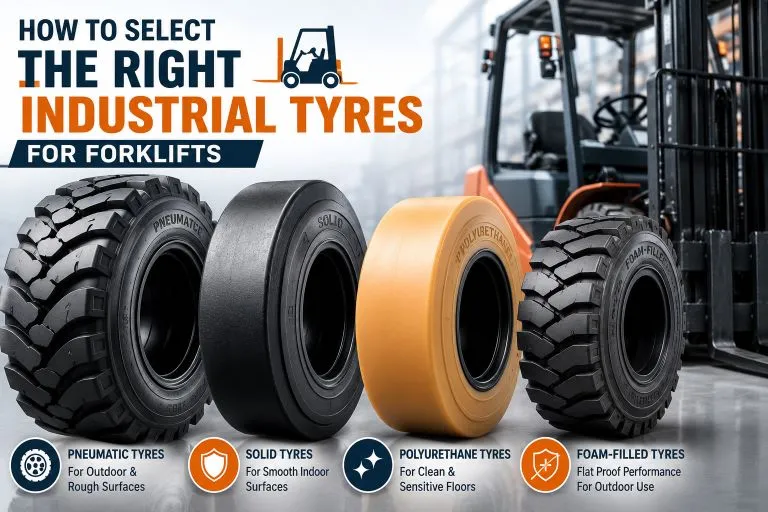
Pneumatic tyres are air-filled, similar in concept to car tyres, and they are built for outdoor use and rougher terrain. Their air cushioning absorbs shocks well on uneven surfaces like gravel, dirt, or broken pavement, which makes them a common choice for construction sites, lumber yards, and outdoor storage yards.
Solid tyres, sometimes called cushion tyres, are made of solid rubber and are designed for indoor use on smooth, flat surfaces such as warehouse floors. Because there is no air chamber, there is no risk of a flat, and they generally have a lower profile, which is useful in facilities with limited overhead clearance.
Polyurethane tyres are a step up in refinement. They are typically used in cleanrooms, food processing facilities, or any environment where floor damage, noise, and cleanliness matter. They tend to work best with lighter loads and controlled indoor conditions.
Foam-filled tyres, also known as flat-proof tyres, are essentially pneumatic tyres injected with polyurethane foam instead of air. They give you the shock absorption of a pneumatic tyre without the risk of punctures, which makes them popular in outdoor environments where nails, debris, or sharp materials are a regular hazard.
Key Factors to Consider Before Choosing
Choosing the right tyre is essentially about matching the tyre's characteristics to your specific operating conditions. As an industrial tyre dealer in Noida, we want to highlight a few key factors that are beneficial to consider before purchasing industrial tyres.
Start with your work environment. Is the forklift primarily used indoors on polished concrete, or does it mostly operate outdoors on gravel, dirt, or uneven terrain? This single factor often narrows down your options significantly.
Next, think about load capacity and weight distribution. Heavier and more frequent lifting puts more stress on tyres, and undersized or poorly rated tyres will wear out fast or even become unsafe under repeated heavy loads.
Surface conditions matter just as much as the environment itself. A tyre that performs beautifully on dry concrete might struggle badly on a wet, oily, or icy floor, so it's worth considering the actual surface texture and cleanliness your forklift deals with daily.
Temperature is another factor people forget. Cold storage facilities and freezers require tyre compounds that stay flexible in low temperatures, since standard rubber can harden and crack in extreme cold.
You should also factor in speed and duty cycle. A forklift that runs long shifts over long distances will wear tyres differently than one making short, occasional lifts, so high-usage fleets often need more durable tyre options.
Finally, consider chemical or debris exposure. Facilities that deal with oils, chemicals, sharp scrap, or construction debris need tyres that can resist cuts, chemical degradation, and punctures.
Tyre Size and Compatibility
Getting the right tyre type is only half the job. It also has to be the right size and fit for your specific forklift. Every make and model has manufacturer-specified tyre dimensions, and installing tyres outside that range can throw off ground clearance, load ratings, and even the accuracy of the forklift's speed and stability systems.
This is also where the OEM versus aftermarket decision comes in. OEM tyres are built to match the exact specifications of your forklift and often come with predictable performance, while aftermarket options can offer cost savings but vary more in quality.
It is worth checking that any aftermarket tyre still meets your forklift's load and size requirements before making a purchase based on price alone.
Tread pattern is another detail that is easy to overlook. Smooth or lightly grooved treads are usually fine for indoor concrete floors, while deeper, more aggressive tread patterns are better suited to outdoor, uneven, or slippery surfaces where extra grip is needed.
Cost vs Longevity: Making the Right Investment
It is tempting to choose the cheapest tyre option available, but that decision often costs more in the long run. A lower upfront price can be offset by faster wear, more frequent replacements, and even increased downtime if a cheaper tyre fails sooner than expected.
Thinking in terms of total cost of ownership, rather than just the sticker price, gives you a clearer picture. Solid and polyurethane tyres, for instance, often last longer in controlled indoor settings, while pneumatic tyres may need more frequent replacement in harsh outdoor conditions simply due to the nature of the terrain.
Knowing the signs that a tyre needs replacing, such as visible cracking, uneven wear, chunking, or a noticeable drop in cushioning, helps you replace tyres proactively instead of waiting for a failure that could interrupt your operations.
Maintenance Tips to Extend Tyre Life
Even the best tyre will underperform without proper care. Building a routine of regular visual inspections helps you catch cracks, cuts, or uneven wear before they turn into bigger problems.
For pneumatic tyres, keeping the correct inflation pressure is one of the simplest and most effective ways to extend tyre life, since both under-inflation and over-inflation cause uneven wear and reduce load capacity.
It also helps to be mindful of common causes of premature wear, such as sharp turns at high speed, dragging loads, or running over debris that could have been cleared from walkways and yard surfaces. Small habits like these add up to significantly longer tyre life across your fleet.
Common Mistakes to Avoid
One of the most common mistakes is choosing a tyre purely based on price, without checking whether it actually suits the environment and load requirements of the forklift. This often leads to faster wear and higher costs down the line.
Another frequent misstep is ignoring the mismatch between tyre type and surface. Using a tyre designed for smooth indoor floors on a rough outdoor yard, or vice versa, usually results in poor performance and shortened tyre life.
Overlooking load ratings is another mistake worth avoiding. A tyre that is not rated for the forklift's typical load can wear out quickly or, worse, fail under stress, creating a safety risk for operators and anyone working nearby.
Conclusion
Selecting the right industrial tyre for your forklift comes down to understanding your operating environment, load requirements, and surface conditions, then matching those needs to the right types of tyre.
Taking the time to make this decision carefully pays off through fewer breakdowns, lower long-term costs, and safer day-to-day operations. If you are unsure which tyre best fits your specific forklift and workplace, it is always a good idea to consult a tyre specialist or reach out to your supplier for a tailored recommendation.
Frequently Asked Questions
1. How often should forklift tyres be replaced?
This depends on usage, tyre type, and operating conditions, but most forklift tyres need replacing anywhere between 1,500 and 2,500 hours of use. Regular inspections are the best way to know when it's actually time for a change, rather than relying on a fixed schedule alone.
2. Can I use pneumatic tyres indoors?
Yes, pneumatic tyres can be used indoors, but they are generally better suited to outdoor or rough terrain. Indoor facilities with smooth concrete floors usually get better performance and longer life from cushion or polyurethane tyres instead.
3. What is the difference between solid and cushion tyres?
In most industry usage, the terms are used interchangeably, since cushion tyres are a type of solid tyre designed specifically for forklifts. Both are made from solid rubber and are built for smooth, indoor surfaces.
4. Do foam-filled tyres perform as well as pneumatic tyres?
Foam-filled tyres offer similar shock absorption to pneumatic tyres while eliminating the risk of flats, making them a strong choice for outdoor environments with debris or sharp objects. They can be slightly heavier and firmer than standard pneumatic tyres, but the trade-off is often worth it for reduced downtime.
5. How do I know if my forklift tyres are the correct size?
Your forklift's manufacturer manual or the sidewall of your current tyres will list the correct size specifications. Always confirm sizing with your supplier or manufacturer before ordering replacements, especially if you are switching tyre types.
6. Does tyre choice really affect fuel or battery efficiency?
Yes, it can. Tyres that create more rolling resistance, either due to type, wear, or incorrect inflation, make the forklift work harder to move, which increases fuel consumption or drains battery charge faster over time.