Section 8 Company Registration in India: Process, Eligibility & Benefits
46 Views
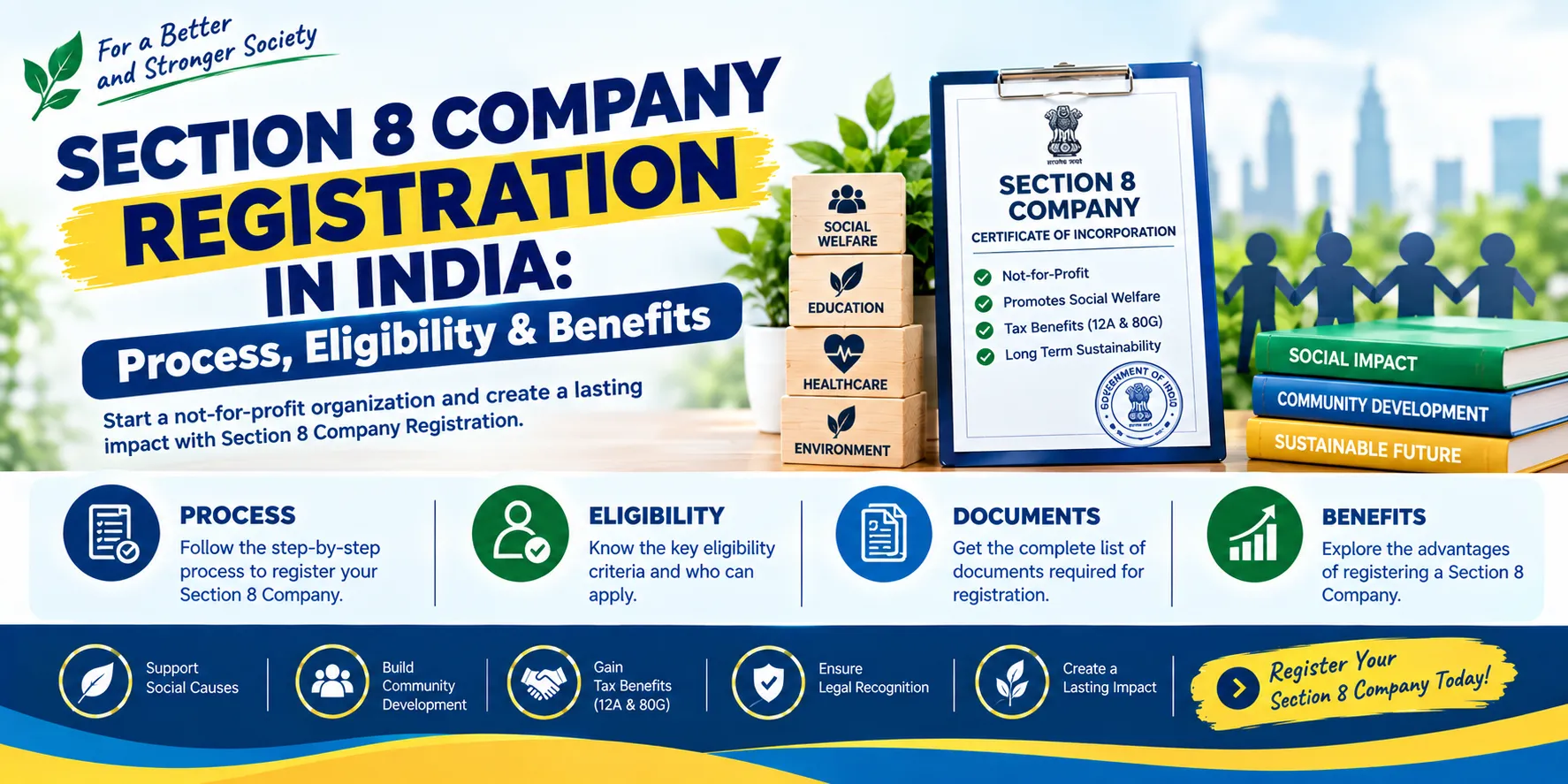
Starting an organisation for social work is a great way to help people and make a positive difference. In India, one popular legal structure for such organisations is a Section 8 Company.
A Section 8 Company is formed for purposes such as education, charity, social welfare, environmental protection, research, sports, and other useful activities. The Companies Act, 2013 provides the legal framework for these companies.
If you are planning NGO registration, understanding the Section 8 Company registration process can help you choose the right structure for your organisation.
What Is a Section 8 Company?
A Section 8 Company is a company created for charitable or non-profit purposes. Its main goal is not to earn profits for its members.
The company can earn income, but the money should be used for achieving its stated objectives. It is not meant to be distributed as profit among the members.
For example, a Section 8 Company can work in areas such as:
- Education and skill development
- Health and medical support
- Social welfare
- Environmental protection
- Women and child welfare
- Sports and research
- Promotion of art, culture and science
- Charitable activities
The Ministry of Corporate Affairs also lists areas such as commerce, education, research, social welfare, charity and environmental protection among possible Section 8 objectives.
Who Can Register a Section 8 Company?
People who genuinely want to work for a social or charitable purpose can consider Section 8 Company registration.
Generally, the proposed organisation should have a clear charitable or non-profit objective. Its proposed name and documents should also meet the requirements under the Companies Act and applicable rules.
The organisation must clearly explain what it plans to do through its MOA (Memorandum of Association) and AOA (Articles of Association).
Section 8 Company Registration Process
The registration process is mainly completed online through the MCA portal.
1. Decide the Objective
First, decide what your organisation will work for. For example, it may focus on education, healthcare, environmental protection or social welfare.
2. Select a Suitable Name
Choose a unique name that matches the organisation's objectives. Section 8 companies generally use words such as Foundation, Association, Forum, Council or similar terms as permitted under the applicable rules.
3. Prepare the Required Documents
The promoters and directors need to prepare documents such as identity and address proofs, registered office documents, declarations, and other incorporation documents as applicable.
The MOA and AOA are also important because they explain the purpose and internal rules of the company.
4. File the Incorporation Application
The incorporation application is submitted through the MCA's online system. For a new Section 8 Company, the Section 8 licence is issued through the SPICe+ incorporation process; a separate INC-12 filing is not required for obtaining the licence for a new Section 8 Company.
5. MCA Reviews the Application
The MCA reviews the information and documents submitted with the application. If clarification or correction is required, the applicant may need to resubmit the documents.
6. Receive the Certificate of Incorporation
After approval, the company receives its Certificate of Incorporation and becomes a legally registered company.
Benefits of Section 8 Company Registration
1. Separate Legal Identity
A registered Section 8 Company has its own legal identity. This helps the organisation operate in its own name.
2. Better Credibility
Registration can give an organisation a more formal structure and may help build trust with donors, institutions and other stakeholders.
3. Suitable for Social Work
The structure is specifically designed for organisations working towards charitable and social objectives.
4. Scope for Tax Registrations
After incorporation, an eligible organisation may also explore 12A and 80G registration under the applicable income-tax provisions. These are separate registrations and should not be confused with Section 8 incorporation.
5. Organised Management
A Section 8 Company works through formal company documents, directors and statutory compliance. This can make the organisation's activities more structured.
Section 8 Company vs NGO Registration
Many people use the terms "Section 8 Company" and "NGO registration" as if they mean the same thing. They are related, but they are not exactly the same.
NGO is a broad term used for organisations working for social or charitable purposes. An NGO can operate under different legal structures.
A Section 8 Company is one specific legal structure available for non-profit organisations.
Therefore, if you are planning NGO registration, you should first understand which legal structure fits your objectives.
What About EPR Registration Certificate?
If your organisation works in waste management, recycling or environmental activities, you may come across another term: EPR Registration Certificate.
EPR means Extended Producer Responsibility. It is connected with specific environmental responsibilities and applicable regulations. It is different from Section 8 Company registration.
So, registering a Section 8 Company does not automatically provide an EPR Registration Certificate. If EPR registration is applicable to your activities, separate requirements may need to be fulfilled.
Final Words
A Section 8 Company can be a suitable legal structure for people who want to build a formal organisation for charitable or social purposes. However, registration is only the first step. The organisation must also follow applicable company and tax compliances after incorporation.
If you are unsure about the registration process, documents or related registrations such as 12A and 80G registration, professional guidance can make the process easier.
CorpBiz helps businesses and organisations with registration and compliance-related services in India, making complicated legal processes easier to understand.
Author Profile
Gaurav Sharma is a legal consultant and business compliance expert with over 10 years of experience helping startups, companies and organisations understand legal registrations and compliance requirements in India. He specialises in business registration, NGO-related compliance, FSSAI licensing, GeM registration and other regulatory services. Gaurav believes in explaining complex legal processes in simple language so that business owners and social organisations can make informed decisions.