RG217 Cable: Specifications, Features & Applications
23 Views
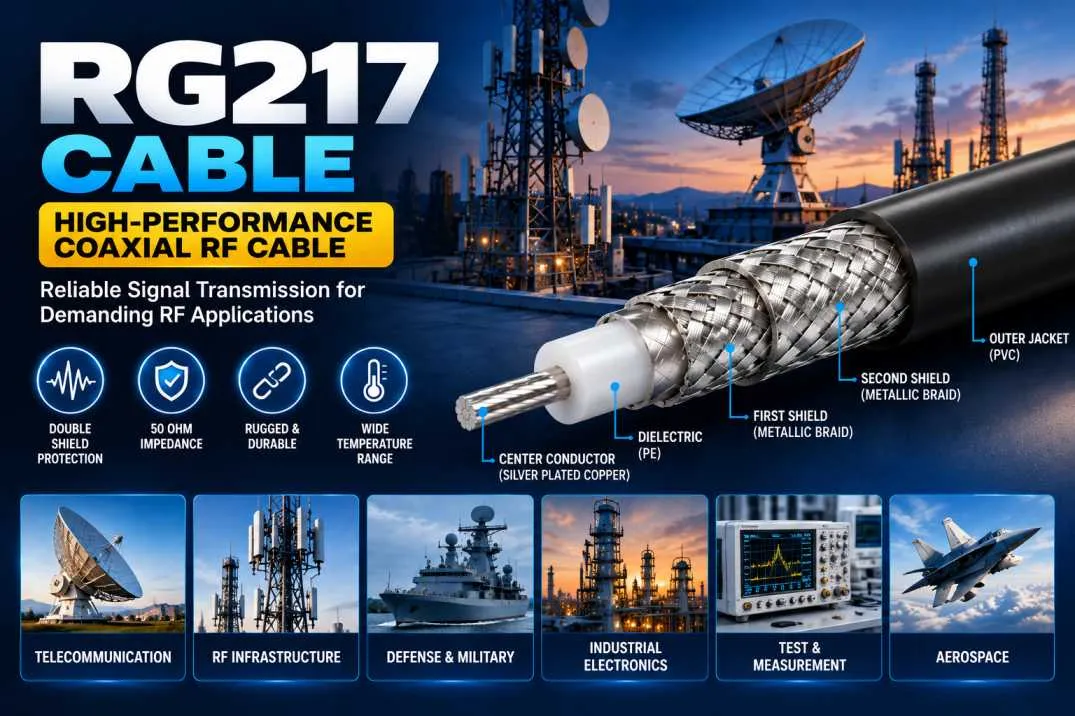
RG217 Cable is a heavy-duty coaxial RF cable designed for applications that require reliable signal transmission, high power handling, and robust mechanical performance. With a 50-ohm impedance, RG217 is commonly considered for RF, microwave, communications, broadcast, military, laboratory, and high-power transmission systems.
Its larger coaxial construction provides improved power-handling capability compared with many smaller-diameter RF cables. The cable consists of a center conductor, dielectric insulation, conductive shielding, and protective outer jacket, with each layer contributing to dependable RF performance.
For demanding communication and RF infrastructure, selecting the appropriate cable construction, frequency range, attenuation, connector configuration, and environmental rating is essential.
What Is RG217 Cable?
RG217 Cable is a 50-ohm coaxial cable designed for RF signal transmission. Its relatively large diameter and robust construction make it suitable for systems where mechanical durability and power-handling capability are important.
Compared with compact coaxial cables such as RG174 or RG316, RG217 generally provides a heavier construction and can be better suited to applications requiring higher power capacity and longer cable runs.
The actual electrical performance of an RG217 Cable can vary depending on the manufacturer, dielectric construction, shielding design, jacket material, and assembly configuration. Therefore, manufacturer-specific datasheets should always be checked before final system selection.
RG217 Cable Construction
A typical RG217 Cable consists of several carefully engineered layers.
Center Conductor
The center conductor carries the RF signal through the cable. Depending on the cable design, the conductor may use copper or a copper-based construction selected for electrical conductivity and mechanical performance.
Dielectric
The dielectric surrounds the center conductor and maintains the required spacing between the conductor and shield. This controlled geometry helps establish the cable's characteristic impedance and influences attenuation and signal performance.
Shielding
The conductive shield provides an electrical return path while helping reduce electromagnetic interference and unwanted signal leakage. Shield construction can vary between manufacturers and cable versions.
Outer Jacket
The outer jacket protects the internal cable structure from mechanical damage, handling, moisture, and environmental exposure. Jacket material and temperature performance depend on the specific RG217 Cable construction.
RG217 Cable Specifications
Typical specifications associated with RG217 Cable may include:
Parameter
Typical Description
Cable Type
Coaxial RF Cable
Characteristic Impedance
50 Ohms
Construction
Heavy-duty coaxial design
Conductor
Copper or copper-based construction
Dielectric
RF-grade dielectric material
Shield
Conductive metallic shielding
Cable Size
Large-diameter construction
Frequency Range
Application and manufacturer dependent
Power Handling
Higher than many small-diameter RF cables
Applications
RF, communications, broadcast, defense, laboratory
Connector Options
Application-dependent
Jacket
Protective polymer jacket
These values should be treated as general characteristics rather than a universal specification. Exact attenuation, maximum frequency, voltage rating, power handling, dimensions, and temperature range should be confirmed from the manufacturer's datasheet.
Key Features of RG217 Cable
1. 50-Ohm RF Impedance
The 50-ohm impedance makes RG217 Cable suitable for many RF and wireless communication systems where impedance matching is important.
2. Robust Construction
Its comparatively large and rugged construction makes the cable suitable for demanding installations and equipment interconnections.
3. High Power Capability
RG217 Cable can be considered for applications where greater RF power handling is required. Actual power capacity depends strongly on frequency, temperature, VSWR, installation conditions, and cable construction.
4. Reliable RF Transmission
The controlled coaxial geometry helps maintain consistent RF signal transmission while reducing unwanted interference and signal leakage.
5. Mechanical Durability
The heavy-duty construction can provide better resistance to mechanical stresses than lightweight coaxial cables, making appropriate installation and cable routing important for long-term performance.
RG217 Cable Applications
RF and Wireless Communication
RG217 Cable can be used for connecting RF equipment, transmitters, receivers, antennas, and associated communication hardware.
Broadcast Systems
Broadcasting equipment can require reliable high-power RF interconnections. RG217 may be considered for suitable transmitter and RF distribution applications where its electrical specifications meet system requirements.
Defense and Aerospace
RF systems used in defense and aerospace environments can require durable coaxial cable assemblies. RG217 Cable may be used for equipment interconnections, RF transmission paths, and specialized communication systems when the required environmental and electrical specifications are met.
Test and Measurement
Laboratories and engineering facilities use coaxial cables to connect RF generators, amplifiers, analyzers, and other test equipment. RG217 can be suitable when the required frequency, attenuation, power, and connector specifications match the test setup.
Industrial RF Systems
Industrial electronics and RF equipment can use RG217 Cable for connections between RF modules, power amplifiers, antennas, and communication equipment.
RG217 Cable and Connector Selection
The connector is an important part of any RG217 Cable assembly. Depending on the application, cable assemblies may be configured with suitable RF connectors such as N-Type, TNC, BNC, or other compatible interfaces.
Connector selection should consider:
- Frequency range
- Impedance
- Power handling
- VSWR
- Mechanical interface
- Environmental requirements
- Installation space
- Connector gender
- Cable diameter compatibility
A properly terminated assembly is essential because even a high-quality cable can experience increased insertion loss or poor return loss when incorrectly assembled.
RG217 Cable Selection Guide
Before purchasing RG217 Cable, evaluate the following parameters:
Frequency: Confirm that the cable supports the complete operating frequency range.
Impedance: For most RF applications, verify the required 50-ohm impedance.
Attenuation: Compare attenuation at the actual operating frequencies and cable length.
Power Handling: Check continuous and peak power requirements, especially for transmitter applications.
Temperature: Verify the operating temperature range for the installation environment.
Mechanical Requirements: Consider flexibility, bend radius, cable routing, and installation conditions.
Connectors: Select connectors that match both the equipment interface and cable construction.
Why Choose RG217 Cable?
RG217 Cable can be a practical option for RF systems that need a combination of robust construction, 50-ohm impedance, reliable signal transmission, and higher power-handling capability than many smaller coaxial cables.
Its suitability depends on the actual system requirements. Frequency, attenuation, power, environmental conditions, cable length, connector type, and mechanical installation should all be evaluated before selection.
Conclusion
RG217 Cable is a robust 50-ohm RF coaxial cable designed for demanding signal transmission applications. Its heavy-duty construction makes it suitable for RF communication, broadcasting, defense, aerospace, test and measurement, and industrial systems where reliable performance is required.
For the best results, always select RG217 Cable according to the complete electrical and mechanical requirements of the application. Manufacturer-specific specifications should be reviewed for exact frequency capability, attenuation, power handling, temperature rating, dimensions, shielding, and connector compatibility.
Frequently Asked Questions About RG217 Cable
1. What is RG217 Cable?
RG217 Cable is a 50-ohm coaxial RF cable designed for reliable signal transmission and demanding RF applications.
2. Is RG217 Cable 50 ohms?
Yes, RG217 is generally associated with a 50-ohm characteristic impedance, making it suitable for many RF and wireless systems.
3. What are the main applications of RG217 Cable?
Common applications include RF communication, broadcasting, defense, aerospace, laboratory test equipment, wireless systems, and industrial RF equipment.
4. Is RG217 Cable suitable for high-power applications?
RG217 can be used in higher-power RF applications, but the allowable power depends on frequency, temperature, VSWR, cable construction, and manufacturer specifications.
5. What connectors can be used with RG217 Cable?
Connector selection depends on the application and cable assembly. Compatible RF connectors may include N-Type, TNC, BNC, and other suitable interfaces.
6. What should be checked before buying RG217 Cable?
Check impedance, frequency range, attenuation, power handling, temperature range, cable dimensions, shielding, bend requirements, and connector compatibility.
7. Is RG217 Cable suitable for telecommunications?
Yes. RG217 Cable can be considered for suitable telecommunications and wireless RF systems when its electrical and mechanical specifications meet the application requirements.
8. How does cable length affect RG217 performance?
Increasing cable length generally increases signal attenuation. The required cable length should therefore be evaluated together with the operating frequency and acceptable insertion loss.
9. Can RG217 Cable be supplied as a cable assembly?
Yes. RG217 can be terminated with suitable RF connectors to create customized cable assemblies for specific equipment and installation requirements.
10. Why is 50-ohm impedance important in RG217 Cable?
Maintaining the required 50-ohm impedance helps achieve proper impedance matching between RF components and can reduce reflections and signal degradation within the transmission system.
Related Reading
Top 10 Hidden Secrets About Business & Finance You Need to Know
Welcome to our in-depth exploration of Business & Finance. In an era defined...
Why Business & Finance is Transforming the Global Industry Landscape
Welcome to our in-depth exploration of Business & Finance. In an era defined...