Prop Firm Ads Agency : Lessons For Good-Looking Ad Can Still Lose Money
By sanaullah
25 Views
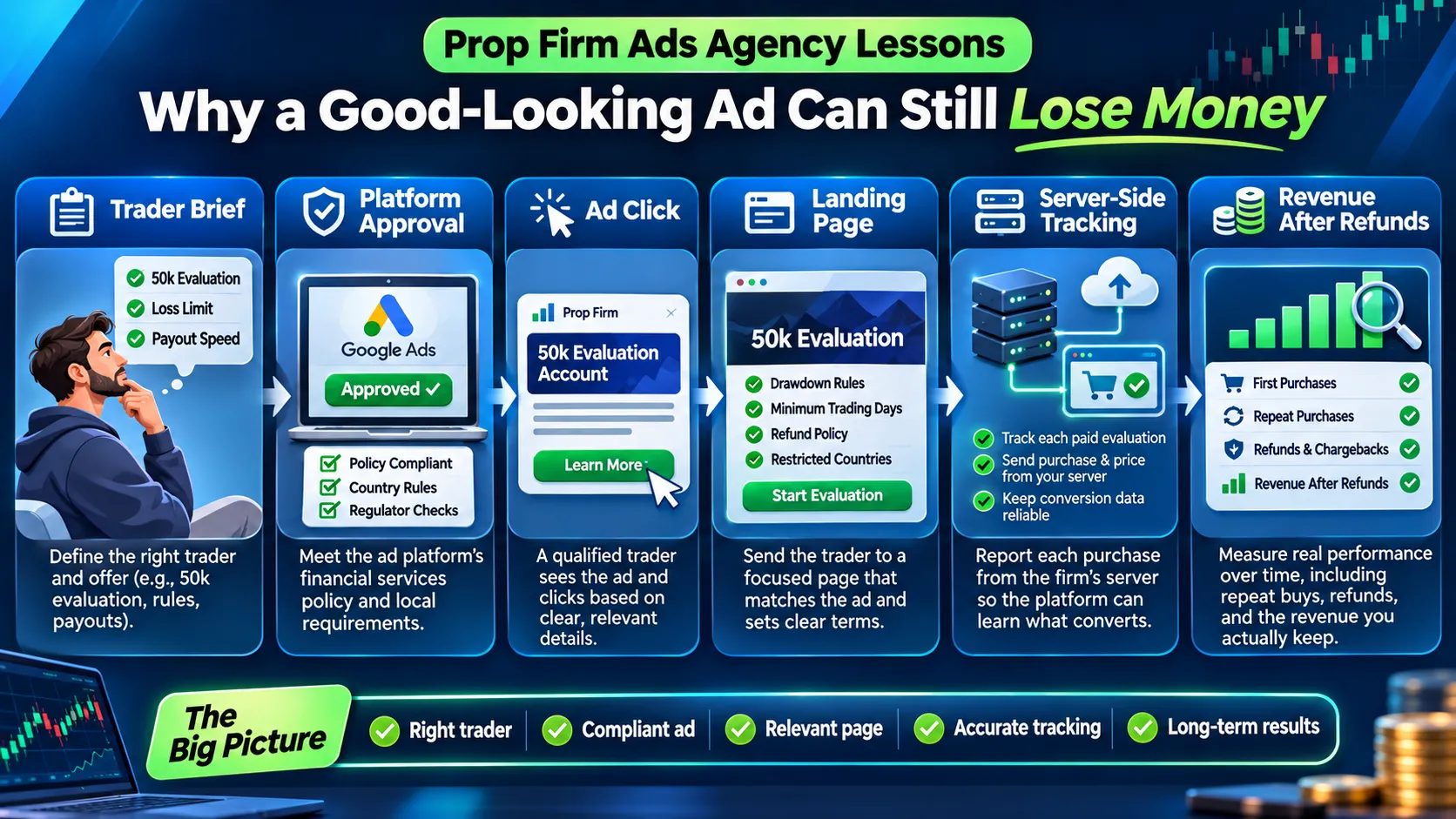
Every prop firm ad has a short and busy life. It gets written, reviewed by the platform, shown to traders, clicked, judged by a landing page, and finally measured against what it earned. Most firms only watch the middle of that path, the clicks. A good prop firm ads agency watches all of it, because a weak spot at any stage can sink an ad that looked fine on paper.
The easiest way to see this is to follow one example ad from start to finish.
The Ad Starts as a Brief About One Trader
Say a firm wants to promote its 50k evaluation to futures traders. A careless brief would say "get more sign-ups." A useful one describes the person on the other end: someone who already trades, has probably failed an evaluation somewhere else, and is comparing firms on rules and payout speed.
That one change shapes everything after it. The headline talks about the daily loss limit and the payout schedule, not about quitting a day job. Ads written for an experienced trader tend to attract experienced traders, and those are the people most likely to pay.
Approval Comes Before Any Trader Sees It
Before the ad runs, the platform reviews it. Google requires financial services advertisers to follow its Financial Products and Services policy and the law in each country they target. In a growing number of countries, it also wants proof that a local regulator has authorized the advertiser, and that program reached 24 more European markets in July 2026, with the US and Canada announced as next.
Whether a given firm falls under those rules depends on its offer, its website, and its target countries. An agency that knows this area checks all three before launch.
A few phrases are a quick way to get flagged anywhere:
- Promises of a set monthly income.
- Words like "guaranteed" or "risk-free" next to trading.
- Payout claims that link to no written terms.
The Click Lands on a Page Made for That Ad
A trader clicks. If the ad mentioned the 50k evaluation and its loss limits, the page should open on exactly that, not on a homepage with six account sizes and a promo banner.
The page also has a second job, which is to turn away the wrong buyer. Showing the drawdown rules, minimum trading days, refund policy, and restricted countries up front means a trader who dislikes the terms leaves now, instead of disputing the charge later.
The Sale Only Counts if the Platform Hears About It
Now the trader pays. On the firm's side, that's a sale. On the ad platform's side, it may be invisible. Ad blockers, privacy settings, and checkout redirects regularly stop browser tags from reporting a purchase.
When the platform never sees the sale, it can't learn which kind of trader converts. It ends up chasing whatever it can see, usually free registrations. Sending each paid evaluation and its price back to the platform from the firm's own server closes that gap, and it's often the single biggest fix in an account.
A Month Later, the Ad Gets Its Real Score
The first purchase isn't the end of the story. Some traders fail and buy a reset or a second evaluation. Some pass and later request a refund. A few file chargebacks.
So the honest score for this ad arrives weeks after launch:
| Measure | Why it matters |
|---|---|
| First purchases | Shows the ad can sell at all. |
| Repeat purchases | Shows the ad found traders who stick around. |
| Refunds and chargebacks | Shows how many buyers were a poor fit. |
| Revenue after refunds | The money the firm gets to keep. |
An ad with fewer first sales but strong repeat buying can be worth far more than a cheap ad that fills the refund queue.
Picking an Agency Comes Down to Who Owns Every Stage
Follow one ad all the way through and the weak points become obvious. Some agencies are great at writing ads and weak on approval. Some run tidy campaigns but never fix the purchase data. Very few look at refunds at all.
When comparing options, ask who on their team handles each stage above, and listen for whether they've thought about the later ones. The firms that win long term usually treat the creative, the approvals, and the data as one job, which is the approach behind this ad creative for prop firms work. The headline might be what traders notice, but it's rarely what decides whether the ad paid for itself.