Progressive Dies Explained: Why Sequential Forming Beats Single Hits
By Shekhar Chaudhary
2 Views
If you've spent any time on a shop floor, you've probably heard someone argue about the "right" way to stamp a part. Should it be one hit and done, or should the strip travel through a dozen stations before the finished component drops out? The honest answer is: it depends on the part. But for medium- to high-volume production, progressive dies win more often than not, and understanding why is worth the ten minutes it takes to read this.
What Progressive Dies Actually Do?
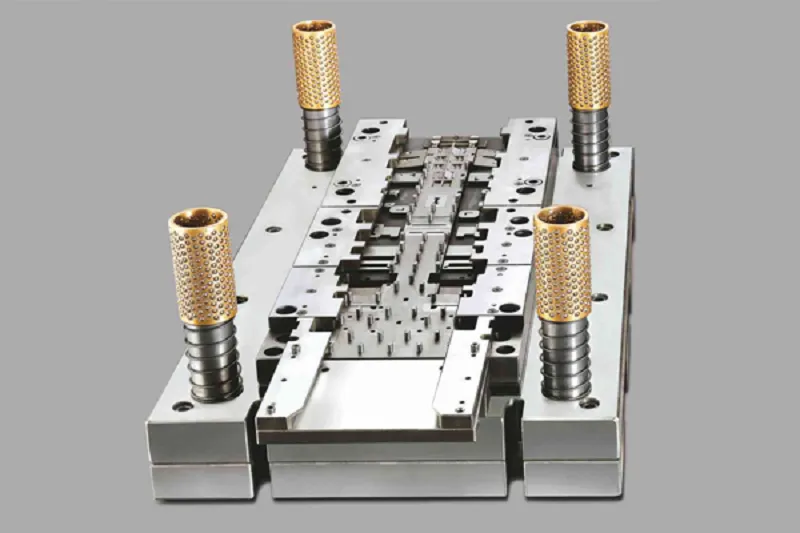
A progressive die isn't a single tool performing one action. It's a coordinated sequence of stations built into one die set, and a continuous metal strip (usually fed from a coil) moves through them one pitch length at a time.
Every press stroke, every station does its job simultaneously: one station might pierce a hole, the next bends a tab, another coins a feature, and the final one separates the completed part from the carrier strip. The part stays attached to the strip the whole way through, which matters more than it sounds like it should. That constant physical connection preserves positional accuracy from the first cut to the last fold, station after station, cycle after cycle.
Compare that with single-hit or single-stage tooling, where one die performs one operation per stroke on an individual blank. It's simpler, cheaper to build, and genuinely the smarter choice for prototypes or short runs. But ask it to produce tens of thousands of identical, multi-featured parts a day, and it starts to show its limits more handling, more setup time between operations, and more chances for part-to-part variation to creep in.
Sequential Forming (The Real Advantage)
The phrase "sequential forming" gets thrown around loosely, so let's be specific about what it buys a manufacturer.
- Repeatability at scale. Because the strip never leaves the die set until the part is finished, there's no re-fixturing, no re-registration, no cumulative handling error. A progressive die running correctly produces part 40,000 the same way it produced part one.
- Speed that compounds. Every press stroke performs several operations across different sections of the strip at once. Multiply that by presses running thousands of strokes an hour, and the throughput advantage over single-hit stamping becomes obvious fast this is precisely why progressive stamping dies dominate automotive, electronics, and appliance component production.
- Lower per-part cost over volume. Yes, progressive tooling costs more upfront. Multiple stations, tighter engineering tolerances, and more complex die design all add to build cost. But spread that investment across a long production run and the economics flip decisively in its favour compared with the labour and handling costs of single-hit methods.
- Complex geometry without extra handling. Parts that need several bends, coined features, or pierced holes in tight relation to one another are exactly where progressive tooling earns its keep. The part builds incrementally, station by station, so features stay in correct relation to each other without a human (or a robot) repositioning anything in between.
Where Single-Hit Still Makes Sense
It would be dishonest to pretend progressive dies are always the answer. Single-hit and compound tooling remain the right call for low-volume runs, prototyping, and parts where the investment in a multi-station die simply isn't justified by the quantity ordered. A compound die, for instance, can blank and pierce a simple washer in one stroke with excellent concentricity no need for a five-station progressive tool to do a job that one station can handle well.
Getting the Engineering Right
None of this works without disciplined tool design. Feed length, press speed, station sequencing, and material behaviour all have to be balanced before a single strip ever runs through the press. Skimp on the design phase and you end up with misfeeds, tool wear, or dimensional drift problems that are far more expensive to fix once a die is in production than when it's still a drawing.
This is where experienced toolmakers separate themselves from the rest. At Eigen Engineering, progressive die development sits at the centre of the business (from strip layout and simulation through to tool build and production tryout) precisely because getting the sequence right the first time avoids costly rework later. A manufacturer that designs its own progressive tooling in-house, rather than outsourcing it, tends to catch these issues earlier simply because the design and production teams are talking to each other constantly, not passing drawings back and forth across a vendor relationship.
At last, progressive dies aren't inherently "better" than single-hit stamping they're better suited to a specific job: high-volume, multi-feature parts that need to come out identical, strike after strike. Once your production volumes justify the tooling investment, sequential forming through a well-designed progressive die will almost always beat single-hit methods on cost-per-part, cycle time, and dimensional consistency. Understanding that trade-off (rather than defaulting to whichever method a shop happens to prefer) is what separates good sourcing decisions from expensive ones.
If you're weighing progressive dies against single-hit tooling for an upcoming part, it's worth getting a toolmaker involved early. The strip layout decisions made in week one often determine whether a production run runs smoothly for the next five years.