Polypropylene Bag vs. Paper, Jute and HDPE: Which Packaging Format Should Your Business Be Specifying?
By AmeliaSmith
72 Views
Introduction
Packaging format selection is a procurement decision with consequences that extend well beyond the warehouse. The bag a business chooses for bulk commodity storage, food ingredient packaging, chemical distribution, or construction material handling directly determines product integrity, regulatory compliance, logistics cost, and the total amount spent on packaging over a full supply chain cycle.
For procurement managers evaluating bulk packaging options, four formats come up most frequently: polypropylene bags, paper sacks, jute bags, and HDPE bags. Each has a legitimate place in the industrial packaging landscape, and each carries trade-offs that are not always visible in a headline price comparison.
This guide compares all four formats across the performance dimensions that matter most for B2B procurement decisions: structural performance, moisture resistance, food safety compliance, print capability, sustainability credentials, and total cost of ownership. The goal is not to declare a universal winner but to give procurement teams the factual comparison they need to match the right format to their specific application.
A brief overview of the four packaging formats
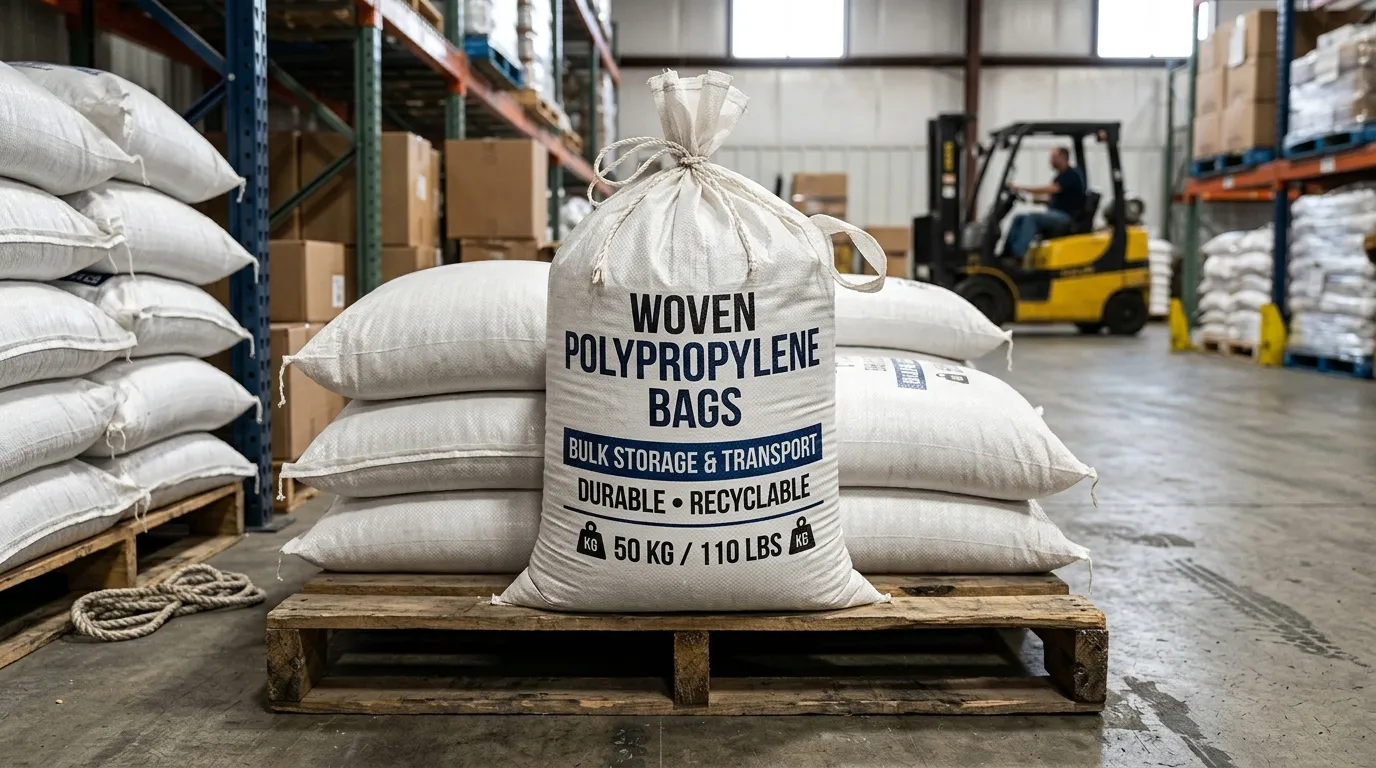
Polypropylene bags are manufactured from woven or laminated polypropylene polymer, a synthetic thermoplastic with high tensile strength, moisture resistance, and chemical inertness. The full range of types of woven bags includes standard unlaminated, laminated, BOPP, valve, inner liner, and anti-static configurations, each engineered for distinct application requirements.
Paper sacks are manufactured from one or more layers of kraft paper, sometimes with an inner polyethylene liner for moisture-sensitive applications. They are widely used in cement, flour, and sugar packaging and offer a good base print surface for compliance labeling.
Jute bags are woven from natural jute fiber and have historically dominated agricultural commodity packaging. They are biodegradable and breathable but carry significant performance limitations in moisture-sensitive, contamination-critical, and high-volume industrial applications.
HDPE bags are manufactured from High-Density Polyethylene, either as woven fabric in a similar construction to PP woven bags or as solid film bags. HDPE offers higher rigidity and chemical resistance than PP in some applications but is generally heavier and less flexible for bulk packaging use cases.
Structural performance and load-bearing capacity
Polypropylene bags deliver the highest combination of tensile strength and puncture resistance across standard fill weights from 25 kg to 100 kg. GSM, tape denier, and weave density can all be engineered to precise load requirements, and batch-to-batch consistency from a controlled synthetic polymer means procurement teams receive the same structural performance across every order.
Paper sacks perform adequately under standard fill weights in dry conditions but lose structural integrity rapidly when exposed to moisture. A wet paper sack can fail entirely during handling, creating product loss and potential safety incidents in busy distribution environments.
Jute bags carry inherent batch inconsistency from natural fiber quality variation between growing seasons and source regions. This inconsistency makes tensile strength difficult to specify precisely for high-volume compliance-critical procurement programs.
HDPE bags offer competitive tensile strength for standard bulk applications, though woven HDPE fabric tends to be stiffer and heavier than equivalent woven PP constructions, making it less practical for high-speed automated filling and handling environments.
Structural verdict: Polypropylene bags lead on consistency and engineered load performance. HDPE is competitive but heavier. Paper and jute trail significantly in wet or high-stress conditions.
Moisture resistance and product protection
Moisture ingress is the leading cause of product quality degradation in bulk commodity packaging. Flour cakes, sugar clumps, animal feed loses nutritional integrity, and fertilizer sets solid when packaging fails to protect against ambient humidity and transit moisture.
Laminated woven polypropylene bags deliver the strongest moisture barrier of the four formats. Single-side or double-side PP lamination combined with an optional inner polyethylene liner creates a multi-layer moisture protection system that maintains product integrity across extended storage and challenging transit conditions including humid shipping containers and outdoor handling.
Paper sacks are highly susceptible to moisture damage. Even single exposure to rain during loading can compromise a paper sack structurally. Polyethylene-lined paper sacks offer improved moisture resistance but at a higher unit cost and with mixed-material end-of-life recyclability complications.
Jute bags absorb moisture as a natural hygroscopic fiber, creating conditions for mold growth, fungal contamination, and accelerated product degradation. For moisture-sensitive commodities, this is a fundamental performance limitation that no post-manufacture treatment fully resolves.
HDPE bags offer good inherent moisture resistance as a synthetic polymer, performing comparably to unlaminated PP woven bags in basic moisture protection applications. Laminated HDPE constructions can match laminated PP performance but at higher weight and cost.
Moisture verdict: Laminated polypropylene bags lead. HDPE is competitive for basic moisture applications. Paper is vulnerable. Jute is unsuitable for moisture-sensitive commodities.
Food safety compliance and regulatory credentials
Woven polypropylene bags manufactured from virgin-grade PP resin under certified quality management systems meet FDA and FSSAI food-contact material approval requirements. Polypropylene is chemically inert, non-toxic, BPA-free, and does not shed fibers into packaged products. It is the most comprehensively food-safe polymer packaging material available for bulk commodity applications.
Paper sacks can satisfy food-contact requirements when manufactured from food-grade kraft paper with approved ink and adhesive systems. However, paper's moisture absorption in humid storage environments creates microbial risk that regulated food safety frameworks treat as a compliance concern.
Jute bags present the most significant food safety compliance risk of the four formats. Natural jute fiber sheds particles into packaged products, a contamination pathway that FSMA, HACCP, and BRC audit frameworks flag as a direct compliance concern. Jute's moisture absorption also creates conditions for mold and mycotoxin development in stored food commodities.
HDPE bags offer a food-safe synthetic polymer platform comparable to PP in chemical inertness and non-toxicity. HDPE meets FDA food-contact standards when manufactured from approved resin formulations, making it a viable alternative to PP in regulated food packaging applications.
Food safety verdict: PP and HDPE are equally strong. Paper is adequate with the right specification. Jute carries compliance risks that most regulated food applications cannot accept.
Print quality and brand communication
Standard woven polypropylene bags support functional flexographic printing for compliance labeling. BOPP-laminated PP woven bags deliver photographic-quality rotogravure printing with a premium gloss finish that matches retail consumer packaging standards, making them the strongest format for branded food and FMCG applications.
Paper sacks offer a clean print surface for standard flexographic printing, making them suitable for commodity compliance labeling. Print permanence on paper degrades in humid conditions, and paper does not support the photographic print quality that competitive retail channels require.
Jute bags offer very limited direct print capability. The coarse natural fiber surface does not accept printing with the resolution or permanence that compliance labeling or brand presentation requires, making separate adhesive labels a practical necessity.
HDPE bags accept flexographic printing on laminated surfaces comparably to standard PP woven bags. HDPE does not support the same BOPP lamination print quality upgrade that positions PP woven bags at the premium end of bulk packaging brand communication.
Print verdict: BOPP-laminated PP bags lead for branded retail and wholesale applications. Paper and HDPE are adequate for commodity labeling. Jute is not a viable print surface for modern packaging compliance requirements.
Sustainability credentials and ESG alignment
Polypropylene bags carry full recyclability credentials as PP5 resin, one of the most widely accepted polymer types in industrial recycling programs. Extended service life reduces per-use material consumption compared to natural fiber alternatives, and lightweight construction reduces transport-related carbon emissions per unit of product delivered.
Paper sacks benefit from paper's established recyclability and biodegradability credentials. Multi-wall constructions with polyethylene liners are more difficult to recycle than single-material formats, and paper manufacturing carries higher water consumption than synthetic polymer alternatives.
Jute bags are biodegradable and sourced from a renewable agricultural crop, giving them a strong natural sustainability narrative for consumer-facing communication. However, their shorter service life means higher material consumption per unit of packaged product over time, and jute cultivation requires significant water and agricultural chemical inputs.
HDPE bags are recyclable but less widely accepted in industrial recycling streams than PP5. HDPE woven fabric is heavier than PP equivalents, generating higher per-unit transport emissions and greater end-of-life material weight in disposal.
Sustainability verdict: Context-dependent. PP wins on recyclability and service life. Jute wins on biodegradability narrative. Paper wins on established recycling infrastructure. HDPE trails PP on recycling acceptance and transport weight.
Total cost of ownership across the supply chain
Unit price comparisons between packaging formats systematically underestimate the real cost difference because they do not account for rejection rates, spoilage losses, freight costs, and compliance audit exposure over the full supply chain cycle.
Woven polypropylene bags deliver the lowest total cost of ownership across most industrial applications. Lower rejection rates from consistent manufacturing quality, reduced product spoilage from superior moisture protection, lower freight costs from lightweight construction, and recyclability at end of life collectively produce a procurement cost profile that unit price comparisons do not reveal.
Paper sacks generate higher hidden costs through moisture-related spoilage losses, structural failures in automated handling environments, and higher freight weight per unit. These costs routinely exceed the apparent unit price advantage that paper holds over PP woven alternatives.
Jute bags generate the highest hidden costs through batch inconsistency-driven rejections, moisture-related product losses, and food safety audit remediation expenses in regulated food applications. For businesses subject to FSMA or BRC compliance, jute's compliance liability represents a financial exposure that unit price comparisons never capture.
HDPE bags carry competitive total costs in chemical and industrial applications where HDPE's specific properties justify the format, but the higher unit weight increases freight costs and the more limited recycling infrastructure can generate higher end-of-life disposal costs than PP alternatives.
Total cost verdict: Woven polypropylene bags deliver the lowest total cost of ownership across the broadest range of industrial bulk packaging applications.
Which packaging format should your business be specifying?
Across five of the six evaluation criteria, polypropylene bags deliver superior or equal performance to paper, jute, and HDPE alternatives. The one area where context shapes the outcome is sustainability, where jute's biodegradability narrative and paper's established recycling infrastructure retain appeal for specific applications and markets.
Specify woven polypropylene bags when:
- Moisture protection is a product integrity requirement across the storage and distribution cycle
- Food safety compliance certification is a supplier qualification criterion
- Consistent tensile strength across high-volume repeat orders is a production planning requirement
- Premium brand communication through retail or branded wholesale channels is a commercial priority
- Total cost of ownership rather than unit price drives the packaging specification decision
- Recyclability and ESG compliance credentials are required for corporate sustainability reporting
Conclusion
The comparison between polypropylene bags, paper sacks, jute bags, and HDPE alternatives is not a close contest across most industrial procurement applications. Polypropylene consistently outperforms on structural integrity, moisture protection, food safety compliance, print quality, and total cost of ownership.
For procurement teams ready to make a specification decision grounded in evidence, the data consistently supports woven polypropylene bags as the packaging format that delivers the most consistent combination of performance, compliance, and total cost of ownership across agriculture, food processing, chemicals, construction, logistics, and retail applications.
The critical next step is identifying the right bag type within the PP woven family for your specific application. Understanding the full range of options available from a qualified manufacturer is the difference between a packaging specification that works and one that simply gets through the approval process.
Related Reading
Top 10 Hidden Secrets About Business & Finance You Need to Know
Welcome to our in-depth exploration of Business & Finance. In an era defined...
Why Business & Finance is Transforming the Global Industry Landscape
Welcome to our in-depth exploration of Business & Finance. In an era defined...