PGDM Business Analytics vs Data Analytics: Which One Fits the Changing Job Market?
By Rakesh Kumar
15 Views

The way companies use data has changed dramatically over the past few years. Businesses once relied mainly on reports and historical numbers to understand their performance. Today, data influences everything from customer experience and marketing to hiring, pricing, product development, and business strategy.
At the same time, artificial intelligence is changing how companies collect, process, and interpret information. This has created a new question for students planning their careers: Should they focus on data analytics, or choose a broader management-focused path such as PGDM Business Analytics?
Both fields offer opportunities, but they prepare students for somewhat different career directions. Understanding that difference can make it easier to decide which path fits the changing job market.
Why Are Analytics Skills Becoming So Important?
Data is no longer limited to large technology companies. Retailers, banks, healthcare organizations, manufacturers, educational institutions, and even small businesses use data to make everyday decisions.
A marketing team may analyze customer behavior before launching a campaign. A retailer may study purchasing patterns to decide which products to stock. A manufacturing company may use operational data to identify inefficiencies.
The challenge is that having access to data does not automatically lead to better decisions.
Businesses need people who can look at information, understand what it means, and connect it with a practical business problem.
This is where the difference between data analytics and business analytics becomes more noticeable.
Data Analytics and Business Analytics: What's the Difference?
Data analytics is primarily concerned with examining data to identify patterns, trends, relationships, and useful insights. Professionals in this area often work with tools such as SQL, Excel, Python, Power BI, Tableau, and statistical techniques.
Business analytics takes a wider view. It uses analytical methods to help answer business questions and support decisions. Along with data skills, it requires an understanding of areas such as marketing, finance, operations, strategy and management.
For example, imagine an online store notices that its sales have dropped.
A data analyst may investigate the sales data, identify when the decline started, and determine which products or customer groups were affected.
A business analytics professional may take the analysis further by asking what caused the decline and what the company should do next. They might examine pricing, customer behavior, marketing performance, competitors, and product demand before recommending a course of action.
The difference is subtle, but important: data analytics focuses strongly on understanding the data, while business analytics connects that understanding to business decisions.
Where Does a PGDM Business Analytics Fit In?
A PGDM in Business Analytics can appeal to students who don't want to choose between management and analytics.
Instead of treating data as a purely technical subject, the approach connects analytics with real business functions. Students can develop an understanding of how analytical insights influence areas such as marketing, finance, operations, customer management, and strategy.
This can be particularly useful as companies increasingly expect employees to work across departments.
A professional may need to communicate with a technical data team one day and explain analytical findings to a marketing or management team the next.
That requires more than technical knowledge. It requires the ability to understand the business problem and communicate the solution clearly.
What Skills Are Employers Looking For?
The changing job market is also changing the skill mix expected from analytics professionals.
Technical abilities remain important, but employers increasingly value professionals who can combine those abilities with problem-solving and business thinking.
Some useful skills include:
- Data interpretation
- Analytical thinking
- Business communication
- Problem-solving
- Data visualization
- Statistical understanding
- Business intelligence
- Decision-making
- Knowledge of AI and automation
- Understanding of industry-specific challenges
This is one reason students should look beyond the course title when comparing different programs. The real question is not simply whether a program contains the word "analytics," but what skills it actually develops.
PGDM Business Analytics vs Data Analytics: Which Direction Is Right for You?
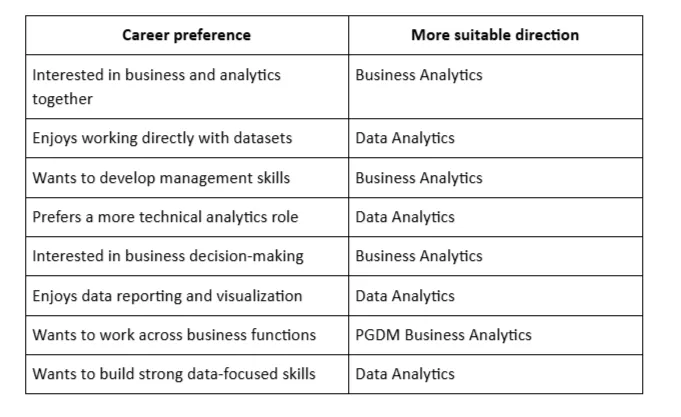
There is no universal winner between the two. The better choice depends on the kind of work a student wants to do.
How AI Is Changing the Analytics Job Market
AI has added another layer to this discussion.
Many repetitive tasks involved in reporting and basic data analysis can now be completed faster with AI-powered tools. This means professionals may need to move beyond simply producing reports or dashboards.
Instead, they may be expected to understand:
- Which questions are worth asking
- Whether an analytical result is reliable
- How data relates to a business objective
- What action should follow from an insight
- How to explain findings to non-technical stakeholders
In other words, AI may make some analytical tasks easier, but it does not remove the need for people who can apply judgment and understand business context.
For students, this means learning a tool is useful, but learning how to use that tool to solve a real problem can be even more valuable.
What Should Students Consider Before Choosing a Program?
Choosing between business analytics and data analytics should not be based solely on salary figures or current job trends.
Students should first think about the kind of professional they want to become.
Consider questions such as:
Do you enjoy business problems?
If you are interested in understanding why a business is growing, losing customers, reducing costs, or changing its strategy, business analytics may be a natural fit.
Do you enjoy technical analysis?
If working with datasets, SQL, statistical methods, programming, and visualization sounds more interesting, data analytics may suit you better.
Do you want management exposure?
Students interested in combining analytics with management, strategy, and business functions may prefer a PGDM Business Analytics route.
Are you willing to keep learning?
Analytics is not a field where learning stops after graduation. Tools, technologies, and employer expectations continue to change, so continuous learning is important regardless of the path chosen.
The Real Advantage Is Combining Skills
The future of analytics may not belong to people who know only one tool or one technique.
A professional who understands data but cannot explain its business impact may struggle to influence decisions. Similarly, a manager who understands business but cannot interpret data may find it difficult to work effectively in a data-driven environment.
The strongest combination can be the ability to understand both sides.
That means developing technical awareness while also building communication, critical thinking, and business decision-making skills.
For students considering PGDM Data Analytics, business analytics, or related programs, this broader skill set is worth keeping in mind.
So, Which One Fits the Changing Job Market?
The answer depends on where you want your career to go.
Data analytics can be a good direction for someone who enjoys working closely with data and analytical tools. A PGDM Business Analytics pathway can be more suitable for someone who wants to combine analytics with management and business decision-making.
But the most important factor is not the name of the program. It is whether the education helps you develop skills that businesses actually need.
As AI continues to automate routine analytical work, professionals who can interpret information, understand business problems, communicate insights, and make informed decisions may have an advantage.
IMT Centre for Distance Learning (IMT CDL), Ghaziabad offers an online PGDM in Business Analytics that combines theoretical concepts with practical learning, helping students gain industry-relevant knowledge and exposure to real-world business and analytics applications.
Related Reading
Expert Insights: Navigating the Complex World of Education & Learning
Welcome to our in-depth exploration of Education & Learning. In an era defin...
Why Education & Learning is Transforming the Global Industry Landscape
Welcome to our in-depth exploration of Education & Learning. In an era defin...