Online Quran Classes: A Complete Guide to Learning Quran from Home
By ShiaEdu Online Shia Quran Academy
68 Views
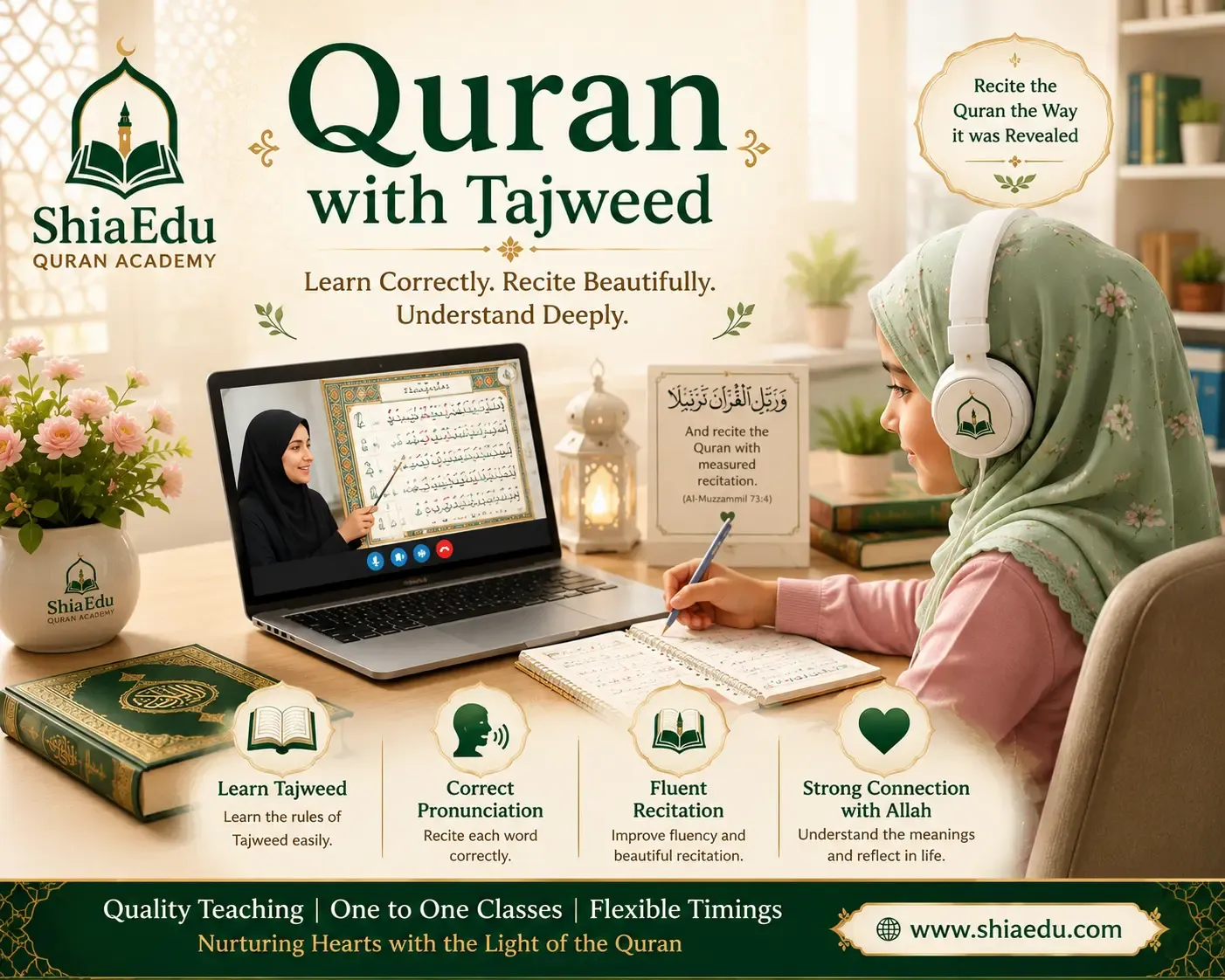
A few years ago, if someone told you their child was "learning Quran on a laptop," you might have raised an eyebrow. Today, it's just how millions of families do it — and honestly, once you understand why, it stops sounding unusual and starts sounding obvious. Online Quran classes didn't replace traditional learning so much as they removed everything that used to get in its way: distance, rigid timings, and the luck of having a good teacher nearby.
If you've been considering online Quran classes for yourself or your children and want the full picture before committing to anything, this guide walks through exactly what they involve, who they're for, and what actually makes them work.
What Are Online Quran Classes, Really?
At their core, online Quran classes are one-on-one or small-group lessons conducted over video call, where a qualified Quran teacher guides a student through Quran recitation, Tajweed rules, and often broader Islamic studies — all from wherever the student happens to be. No commute, no fixed classroom, no waiting for a local Quran teacher to have an opening.
What makes this format genuinely effective, rather than just convenient, is the one-on-one structure most reputable academies use. A teacher watching a student's mouth movements over video can correct Makharij (the precise pronunciation points of Arabic letters) just as accurately as they could sitting across a room — and without a group of other students waiting their turn, there's no rushed pacing and no child quietly falling behind unnoticed.
Who Actually Benefits From Learning Quran Online
It's easy to assume online Quran classes are mainly for kids, but the reality is far broader.
Young beginners typically start with Noorani Qaida or Yassarnal Qaida — learning the Arabic alphabet, correct pronunciation, and basic reading rules before ever touching full Surahs. This foundation matters enormously; skipping it or rushing through it is one of the most common reasons children struggle with Quran recitation later on.
School-age children usually move into structured Quran reading with Tajweed, learning the rules that govern how the Quran is meant to be recited — elongation, stopping rules, correct articulation — rather than reading quickly without attention to how each letter should actually sound.
Adults, including converts and reverts, form a growing share of online Quran students. Many adults feel self-conscious learning something "from scratch" in a group setting, and one-on-one online classes remove that discomfort entirely — there's no one to compare yourself to, just steady, private progress at your own pace.
Families pursuing Hifz (Quran memorization) increasingly use online classes as well, since consistent daily sessions with a dedicated teacher are often more sustainable online than coordinating a fixed daily commute to a physical Hifz program.
The Core Subjects Covered in Most Online Quran Programs
A well-rounded online Quran academy typically structures learning around a few key areas:
- Noorani Qaida / Yassarnal Qaida — the essential starting point for absolute beginners
- Tajweed — the rules of correct Quranic pronunciation and recitation
- Quran recitation with translation — reading fluently while understanding meaning, not just sound
- Quran memorization (Hifz) — structured, revision-based memorization programs
- Islamic studies — covering Aqaid, history, and daily practice in age-appropriate depth
The best programs don't treat these as separate, disconnected classes. They build one into the next, so a child who starts with Qaida naturally progresses into confident, correct recitation, and eventually into deeper understanding through translation and Islamic studies.
Why Online Quran Classes Actually Work Better for Many Families
There's a quiet assumption that in-person learning is automatically "more serious" than online learning, but that doesn't hold up once you look at how families actually use these classes day to day.
Flexibility that fits real life. Classes can be scheduled around school, work, and family commitments rather than forcing a household to rearrange its evenings around a fixed class time.
Access regardless of location. A family in a small town with no local Quran teacher has exactly the same access as a family in a major city — this alone has changed Quran education for thousands of households that previously had no structured option at all.
Individual attention. One-on-one sessions mean a teacher can slow down for a difficult Tajweed rule or speed up for a quick learner, rather than teaching to the middle of a group.
Comfort and confidence. Children (and adults) often relax and engage more openly in a private, one-on-one setting than in a classroom where mistakes feel more exposed.
Consistency. A dedicated online Quran teacher, seen regularly, tends to build a stronger, more personal learning relationship than rotating teachers or inconsistent attendance at a physical madrassa.
How to Choose the Right Online Quran Academy
Not all online Quran classes are built the same, so a few things are worth checking before enrolling:
- Teacher qualifications — ask about the tutor's ijazah, teaching experience, and command of Tajweed specifically, not just general Quran reading ability.
- Trial classes — a genuine academy will offer a free trial so you can see how your child responds before committing.
- Structured curriculum — progress should be trackable, not just "reading whatever comes next" with no clear plan.
- Flexible scheduling — confirm the academy can genuinely accommodate your time zone and routine, not just claim to.
- Teaching style fit — a teacher who's a great fit for one child may not suit another; look for academies willing to match or adjust based on how your child learns.
Bringing It All Together
Online Quran classes aren't a compromise on tradition — they're simply tradition adapted to how families actually live today. Whether the goal is learning Noorani Qaida from scratch, mastering Tajweed, working toward Hifz, or building a deeper understanding of the Quran through translation and Islamic studies, the right online Quran teacher can meet a student exactly where they are and guide them forward, one session at a time, from wherever home happens to be.
Frequently Asked Questions
Are online Quran classes effective for young children? Yes, especially in a one-on-one format. Teachers can observe pronunciation closely over video and adjust pacing to suit a young learner's attention span far more easily than in a group class.
Do I need any special equipment for online Quran classes? No — a stable internet connection, a phone, tablet, or computer with a camera, and a quiet space are usually all that's needed.
How long does it take to learn Tajweed properly online? This varies by student, but with consistent weekly sessions, most students build a solid grasp of core Tajweed rules within several months, continuing to refine fluency over time.
Can adults start learning Quran from scratch online? Absolutely. Many adults, including converts, begin with the same foundational steps as children — Noorani Qaida and basic pronunciation — in a private setting built entirely around their own pace.
Related Reading
Expert Insights: Navigating the Complex World of Education & Learning
Welcome to our in-depth exploration of Education & Learning. In an era defin...
Why Education & Learning is Transforming the Global Industry Landscape
Welcome to our in-depth exploration of Education & Learning. In an era defin...