Omegle Alternative Websites Ranked by Privacy
35 Views
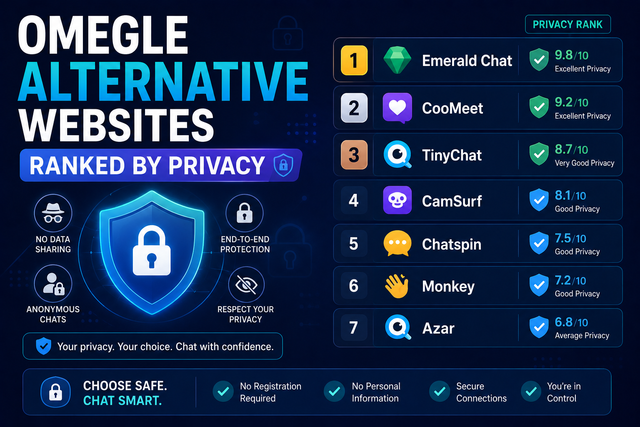
Privacy gets mentioned constantly in reviews of chat platforms, but it's rarely broken down into anything concrete. "Privacy-focused" ends up meaning whatever the platform wants it to mean, with no real way for users to compare one site against another.
So rather than throwing out a vague ranking with no explanation behind it, let's actually walk through the criteria that matter, and how different platforms measure up against each one specifically.
Why Privacy Is Harder to Judge Than Safety
Safety features are relatively visible — you can see whether a report button exists, whether detection catches something, whether moderation seems active. Privacy is quieter. A lot of it happens behind the scenes, in ways users can't directly observe.
That's exactly why it's worth being deliberate about how you evaluate it, instead of just trusting a homepage claim that a site "respects your privacy" without explaining what that actually means in practice.
The Criteria That Actually Matter
Here's a more useful framework than a vague overall score. These are the specific things worth checking on any platform before deciding how private it really is.
1. Account Requirements
The first and most obvious signal is whether a platform requires an account to use it at all. Every piece of information you're asked to provide upfront — email, username, password — is data the platform now holds about you.
Platforms that skip this entirely have a real structural advantage here, simply because there's less to collect in the first place. Spoqi falls into this category, requiring no account or email before you can start chatting.
2. Recording and Storage Practices
This is arguably the most important privacy question of all, and one of the least discussed. Is your video session being recorded? If so, for how long is it stored, and who has access to it?
A platform that keeps no recordings removes an entire category of privacy risk. There's simply nothing to be breached, leaked, or misused later, because nothing was saved in the first place. Spoqi operates this way, with no recordings kept of any chat session.
3. What Happens With Reported Content
Reporting is a safety feature, but it also touches on privacy — specifically, how much of the interaction gets logged or reviewed as part of that process, and whether that data lingers afterward.
A platform that lets you report an issue after a chat has ended, like Spoqi does, generally suggests a more thoughtful approach to how interactions are handled overall, since it implies the system is designed with accountability in mind rather than just deleting everything the moment a session closes.
4. Data Collection Beyond the Chat Itself
Some platforms collect more than just what's needed to run the video connection — browsing behavior, device fingerprinting, third-party trackers for advertising. This is harder for the average user to detect without digging into a privacy policy, but it's worth being aware that it happens.
Simpler platforms, especially ones without account systems tying activity to a persistent identity, tend to have less incentive to build out this kind of tracking infrastructure in the first place.
How to Actually Check These Things Yourself
You don't need to be technical to do some basic due diligence. A few practical steps:
- Try to use the site without an account first. If it forces sign-up before you've even seen how it works, that's worth noting.
- Look for any explicit statement on recordings. Reputable platforms will say clearly whether sessions are saved.
- Check what happens after you close a chat. Does reporting disappear immediately, or stay available?
- Skim the privacy policy for third-party sharing language. It's dense, but a quick search for terms like "third parties" or "advertising partners" can tell you a lot fast.
None of this takes long, and it tells you far more than a vague "we value your privacy" banner ever will.
Where Spoqi Stands on These Criteria
Running through the framework above, Spoqi checks most of the boxes that actually matter for privacy specifically. No account or email is required to use the platform. No recordings are kept of any chat session. Reporting stays functional even after a conversation ends, suggesting the platform is built with accountability in mind rather than just erasing everything on exit.
On top of the privacy fundamentals, it also includes automatic nudity and age detection running both in-browser and on the server — which, while primarily a safety feature, also reflects a platform that's investing in active protection rather than passive policy language.
If you're specifically comparing options through a privacy lens, it's worth looking at how a modern Omegle Alternative handles these same questions, since account requirements and data retention policies vary a lot more between platforms than people expect.
How Other Platforms Compare on These Same Points
It's worth applying this same framework to the other major names in the space, rather than just taking a single platform's word for how it stacks up.
OmeTV
OmeTV's filtering features are a genuinely useful part of its appeal, but filtering by nature usually requires the platform to know a bit more about your preferences to work well. If privacy is a top priority for you, it's worth checking how a current Ometv Alternative handles data tied to that filtering system specifically.
Emerald Chat
Emerald Chat's interest-based matching similarly depends on the platform holding onto some information about what you're looking for in a conversation. Comparing it against an Emerald Chat Alternative is worth doing if you want that same matching experience without as much data tied to your account.
Neither of these approaches is inherently bad — matching and filtering genuinely improve the experience for a lot of users. It's just a tradeoff worth understanding, since more personalization usually means more data being held somewhere.
A Word on "Free" and What It Actually Means for Privacy
It's worth pointing out that "free" doesn't automatically mean privacy-friendly. Some platforms make up for the lack of a subscription fee by leaning harder into advertising and data collection instead.
That's not a knock on free platforms generally — plenty of them, including Spoqi, are genuinely built with privacy in mind rather than treating user data as the actual product. But it's a distinction worth checking rather than assuming, since "free" and "private" aren't automatically the same thing.
Final Thoughts
Privacy isn't really something you can boil down to a single ranking number, but it is something you can evaluate with a bit of structure. Account requirements, recording policies, what happens to reported content, and how much data gets collected beyond the chat itself — those four things tell you more than any vague marketing claim ever will.
If you want to see how a platform built around minimal data collection and no recordings actually feels in practice, it's worth giving Spoqi a try.