Offshore Company Formation in the UAE - Structure, Benefits, Requirements & Compliance
By egconsulting
20 Views
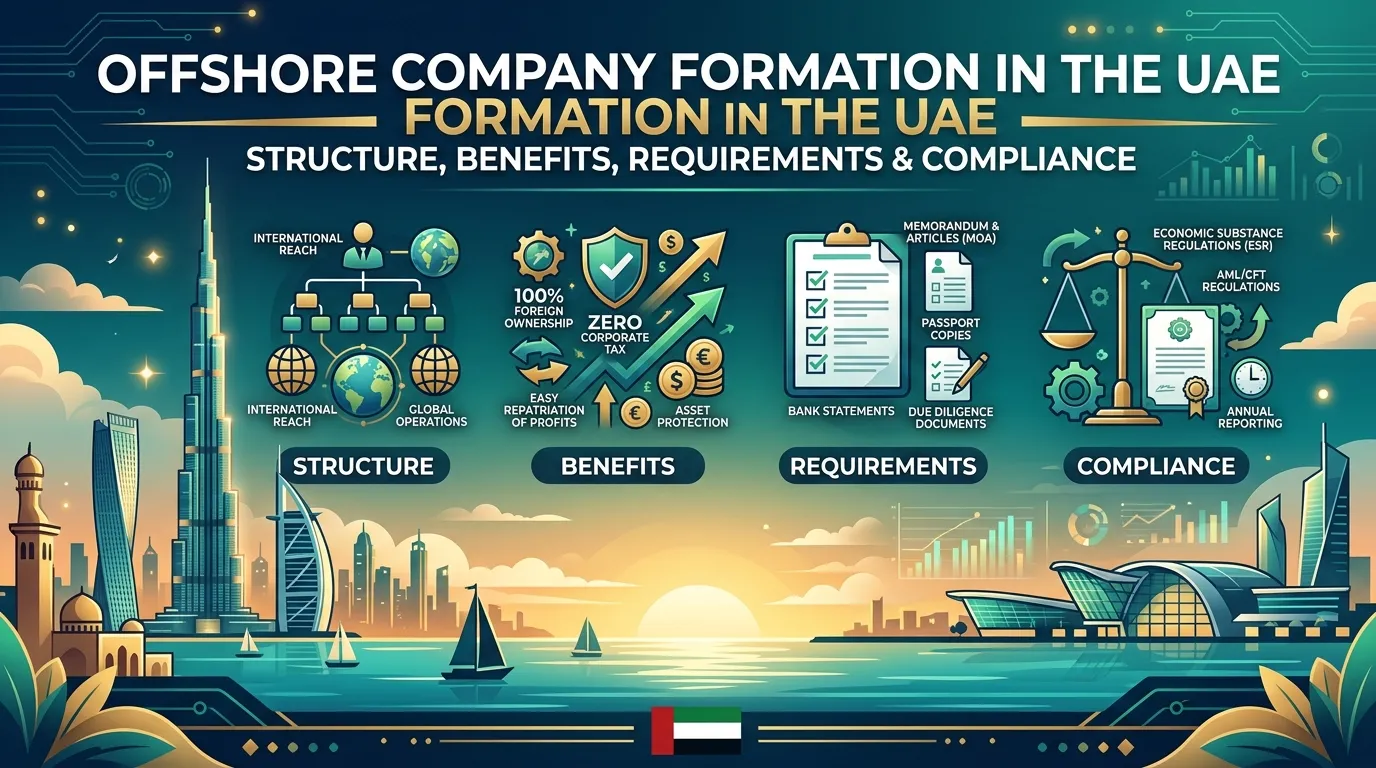
If you're considering offshore company formation in the UAE, the first thing to understand is that an offshore company isn't simply a cheaper version of a mainland or free-zone business. It's a corporate structure designed for specific international, investment, holding, and asset-ownership purposes, with its own regulatory and tax considerations.
For entrepreneurs and international groups, the right structure can help separate assets, organize cross-border ownership, facilitate international business arrangements, and create a more structured corporate framework. However, an offshore company isn't suitable for every business. If you need to actively trade in the UAE, employ staff locally, operate a physical office, or obtain UAE residency visas through the company, a mainland or conventional free-zone structure may be more appropriate.
The most important decision, therefore, isn't simply whether you can establish an offshore company. It's whether the structure matches your business activity, ownership objectives, tax position, banking requirements, and long-term plans.
EGC Consulting provides company formation and structuring guidance alongside tax, regulatory, and compliance advisory services, helping businesses assess their requirements before selecting an appropriate structure.
Table of Contents
- What Is an Offshore Company in the UAE?
- Who Uses an Offshore Company?
- Why Consider Offshore Company Formation?
- Offshore vs Mainland vs Free Zone
- Common UAE Offshore Jurisdictions
- How Offshore Company Formation Works
- Documents Usually Required
- Tax and Compliance Considerations
- Corporate Banking Considerations
- Common Mistakes to Avoid
- Is an Offshore Company Right for Your Business?
- How EGC Consulting Can Help
- Frequently Asked Questions
- Conclusion
What Is an Offshore Company in the UAE?
An offshore company is a legal entity established in a designated UAE offshore jurisdiction for purposes that generally involve international business, holding structures, investments, or assets rather than ordinary UAE domestic-market operations.
The distinction matters because an offshore entity shouldn't automatically be treated as equivalent to a UAE mainland company or a normal commercial free-zone company.
For example, JAFZA provides an offshore company registration framework through registered agents. Its official guidance states that offshore registration must be processed through JAFZA Registered Agents and lists documentation such as the offshore application, Memorandum and Articles of Association, appointment of a registered agent, and identification documents.
The appropriate structure depends on what you're actually trying to achieve.
You might be considering an offshore structure to:
- Hold shares in another company
- Structure international investments
- Hold certain assets
- Organize international business interests
- Separate ownership from operating activities
- Create a corporate holding structure
- Manage cross-border ownership arrangements
The legal and tax consequences can differ significantly depending on the exact structure and where the company is effectively managed.
Who Uses an Offshore Company?
Offshore structures are generally more relevant to businesses and investors whose activities extend beyond the UAE domestic market.
Typical situations include:
International Entrepreneurs
An entrepreneur with businesses or investments in several countries may use a holding structure to organize ownership of different assets or companies.
International Investment Groups
Investors may consider offshore structures for holding shares, investments, or other assets where the structure is legally and commercially appropriate.
Business Owners With Cross-Border Operations
Companies operating across multiple jurisdictions often need to consider corporate ownership, tax residence, reporting obligations, and intercompany relationships together rather than separately.
Holding Companies
A holding structure can be useful when the primary purpose is owning interests in other companies or assets rather than directly operating a local business.
The key point is that offshore company formation should start with the business objective, not with a generic promise of tax savings.
Why Consider Offshore Company Formation?
There are several reasons an international investor may evaluate an offshore structure.
1. International Ownership Structuring
An offshore company can provide a corporate vehicle for holding interests in businesses or investments, subject to the laws of the relevant jurisdiction and the underlying assets.
This can make ownership structures easier to organize when multiple businesses, investors, or jurisdictions are involved.
2. Asset Holding
Certain offshore structures can be used for holding assets where permitted by the relevant jurisdiction.
JAFZA's official offshore guidance, for example, identifies holding companies and real-estate ownership among potential uses of its offshore framework.
However, asset ownership rules shouldn't be assumed. The type and location of an asset can affect whether ownership is permitted and what approvals or taxes apply.
3. International Business Structuring
An offshore company may be considered when the underlying commercial arrangements are international rather than focused on the UAE domestic market.
The structure can help create a clearer separation between an operating company and a holding or investment entity.
4. Corporate Separation
Separating ownership and operations can sometimes make a corporate group easier to manage.
For example, a business owner might have:
Holding entity → Operating company → Business operations
The appropriate structure depends on the commercial, legal, tax, and regulatory circumstances.
5. Long-Term Planning
Corporate structures are often created with future ownership changes, investments, acquisitions, succession planning, or expansion in mind.
That doesn't mean an offshore company is automatically the best solution. It means the structure should be evaluated as part of a broader corporate plan.
Offshore Company vs Mainland vs Free Zone
One of the most important decisions is choosing the correct type of UAE entity.
FactorOffshore CompanyFree Zone CompanyMainland CompanyPrimary purposeInternational structuring/holdingCommercial operationsUAE/local-market operationsUAE domestic operationsGenerally restrictedDepends on licence and regulationsGenerally permittedPhysical officeDepends on jurisdiction/rulesTypically structured around free-zone requirementsGenerally required according to licensing requirementsUAE residency visasGenerally not the primary purposeAvailable depending on setupAvailable depending on setupInternational activitiesSuitable where permittedGenerally suitableSuitableLocal-market accessRestrictedSubject to applicable rulesBroadest local operating flexibilityTax treatmentMust be assessed based on factsDepends on Corporate Tax rules and qualifying conditionsSubject to UAE Corporate Tax rulesBest forHolding/international structuresOperating businessesLocal UAE operations
This distinction is important because businesses sometimes choose an offshore structure when they actually need a conventional operating licence.
If your objective is to open a UAE office, employ employees, obtain visas, invoice UAE customers through a local operating business, or actively conduct regulated activities in the UAE, you should evaluate mainland and free-zone options before deciding on an offshore entity.
Which UAE Offshore Jurisdictions Are Available?
The UAE has established offshore corporate frameworks in specific jurisdictions.
JAFZA Offshore
Jebel Ali Free Zone provides a formal offshore company registration framework. According to JAFZA's current guidance, offshore registration is handled through approved Registered Agents, and the application requires prescribed corporate and identification documentation. JAFZA states a standard processing time of 5–7 working days for its new offshore company registration service, subject to the application and documentation requirements.
JAFZA's own guidance also identifies international trade, holding companies, real-estate ownership, intellectual property ownership, and international consulting among potential offshore uses.
RAK International Corporate Centre
RAK International Corporate Centre, commonly known as RAK ICC, is another UAE corporate registry responsible for incorporating International Business Companies.
The Ras Al Khaimah government describes RAK ICC as responsible for the registration and incorporation of International Business Companies.
The appropriate jurisdiction should be selected based on the company's purpose, ownership structure, asset requirements, banking needs, compliance obligations, and long-term objectives—not simply the lowest formation cost.
How Does Offshore Company Formation Work?
Although exact procedures vary by jurisdiction, the formation process generally follows a structured sequence.
Step 1: Define the Business Objective
Before choosing an offshore structure, identify what the company will actually do.
Ask:
- Will it hold shares?
- Will it own assets?
- Will it be part of an international group?
- Where will customers be located?
- Where will management decisions be made?
- Where will the underlying business operate?
- Will a bank account be required?
- Will the company receive international payments?
These questions can materially affect the appropriate structure.
Step 2: Select the Jurisdiction
The next step is selecting the jurisdiction that matches your objectives.
The decision should consider:
- Permitted activities
- Ownership structure
- Asset-holding requirements
- Corporate governance
- Registered-agent requirements
- Documentation
- Banking considerations
- Tax implications
- Ongoing compliance
Step 3: Choose and Reserve the Company Name
The proposed company name must comply with the relevant authority's naming rules.
It's better to confirm availability and regulatory acceptability before preparing the full application.
Step 4: Prepare Corporate Documents
The required documents depend on the applicant and jurisdiction.
JAFZA, for example, identifies documents including the offshore application, Memorandum and Articles of Association, registered-agent appointment, and passport copies for relevant company officers. Corporate shareholders may have additional notarization and attestation requirements.
Step 5: Complete KYC and Due Diligence
Offshore does not mean anonymous or exempt from regulatory scrutiny.
Authorities, registered agents, and financial institutions can require information about:
- Shareholders
- Directors
- Beneficial owners
- Business activities
- Source of funds
- Corporate ownership
- Expected transactions
Complete and consistent documentation can help avoid unnecessary delays.
Step 6: Submit the Application
The registered agent submits the relevant documents to the offshore authority.
The authority may request additional information or documentation during its review.
Step 7: Receive Incorporation Documents
Once approved, the company receives the relevant corporate documentation.
Depending on the jurisdiction and structure, this may include incorporation documentation, constitutional documents, and share-related records.
Step 8: Plan Banking and Ongoing Compliance
Company formation is only the beginning.
You should separately evaluate corporate banking, accounting records, tax registration or filing requirements, regulatory obligations, annual renewals, and changes in ownership or management.
What Documents Are Usually Required?
The exact list varies, but an offshore company application may require:
- Passport copies
- Proof of residential address
- Shareholder information
- Director information
- Company name options
- Business activity details
- Memorandum and Articles of Association
- Registered-agent appointment
- Corporate shareholder documents, where applicable
- Board resolutions, where applicable
- Power of attorney, where applicable
For corporate shareholders, additional documents may need notarization, legalization, or attestation depending on the jurisdiction and origin of the documents.
JAFZA specifically notes that corporate applicants can be required to provide documents such as certificates of incorporation/formation, certificates of good standing, incumbency documentation, constitutional documents, board resolutions, and powers of attorney.
What Are the Tax and Compliance Considerations?
This is one of the most important parts of offshore company formation in the UAE.
It's inaccurate to assume that registering an offshore company automatically means 0% tax in every situation.
The UAE Corporate Tax framework applies to UAE juridical persons, while the treatment of income depends on the company's status, activities, income, and other applicable rules. The Federal Tax Authority states that UAE-incorporated juridical persons are within the Corporate Tax framework, and foreign entities can also fall within UAE Corporate Tax in circumstances such as having a UAE permanent establishment or being resident for Corporate Tax purposes.
Corporate Tax Requires a Fact-Based Assessment
The UAE's standard Corporate Tax framework includes:
- 0% on taxable income up to AED 375,000
- 9% on taxable income exceeding AED 375,000
Special rules apply to Qualifying Free Zone Persons, including 0% on qualifying income where the relevant conditions are satisfied.
An offshore structure therefore shouldn't be marketed or selected solely on the assumption that it is automatically outside the tax system.
Substance and Management Matter
Where a company is effectively managed and controlled can be relevant to its UAE Corporate Tax status.
The Federal Tax Authority explains that a foreign-incorporated juridical person may be considered resident for UAE Corporate Tax purposes depending on the facts, including where key management and commercial decisions are regularly and predominantly made.
This is why international owners should assess the actual management and operating arrangements rather than looking only at the place of incorporation.
Record Keeping Still Matters
Compliance doesn't disappear because a business uses an offshore structure.
For example, the FTA's guidance for Free Zone Persons states that qualifying free-zone entities remain taxable persons for Corporate Tax purposes and must maintain relevant records and documents for seven years following the end of the relevant tax period.
Your exact record-keeping and filing obligations should be assessed according to the structure and applicable legislation.
What About Corporate Banking?
Opening a corporate bank account is a separate process from incorporating the company.
A bank may assess:
- Nature of business
- Countries involved
- Expected transaction volumes
- Source of funds
- Beneficial ownership
- Customer and supplier profiles
- Corporate structure
- Business model
- Supporting contracts or invoices
A company being legally incorporated does not guarantee that a particular bank will approve an account.
This is why banking requirements should be considered before incorporation rather than after the company has already been established.
A clear business model and consistent corporate documentation can make the banking assessment easier to navigate.
Common Mistakes to Avoid
Choosing the Cheapest Structure
The cheapest incorporation isn't necessarily the most suitable.
A low initial cost can become expensive if the structure doesn't support your banking, tax, ownership, or operational requirements.
Assuming Offshore Means Tax-Free
Tax treatment must be assessed based on the actual company and its circumstances.
The UAE's Corporate Tax regime has specific rules for resident juridical persons, non-residents, free-zone entities, and different categories of income.
Using an Offshore Entity for Local Operations
If your real objective is to run an active UAE business, an offshore company may not provide the operating permissions you need.
Consider mainland or conventional free-zone structures where appropriate.
Ignoring Beneficial Ownership and KYC
Corporate structures still need transparent ownership and appropriate documentation.
Trying to hide the ultimate beneficial owner can create serious compliance and banking problems.
Treating Incorporation as the End of the Process
Formation is only one part of maintaining a company.
You also need to consider:
- Renewals
- Accounting
- Tax compliance
- Corporate records
- Regulatory filings
- Banking documentation
- Changes in directors or shareholders
Is Offshore Company Formation Right for Your Business?
An offshore structure may be worth evaluating if your primary objective involves international ownership, holding, investment, or asset structuring.
It may be less appropriate if you need:
- A UAE operating office
- Local employees
- Residency visas
- Regular UAE domestic trading
- Local-market operations
- A conventional commercial licence
A useful way to think about the decision is:
What does the company need to legally do?
Then ask:
Which structure allows it to do those things while keeping tax, compliance, banking, and governance requirements manageable?
That approach is much more reliable than selecting a structure simply because it appears cheaper or offers a particular tax headline.
How EGC Consulting Can Support the Structuring Process
Choosing a corporate structure often requires more than completing an incorporation form.
EGC Consulting provides company formation and structuring guidance, including support around free-zone versus mainland structures, company registration, licensing, and ongoing compliance. Its tax and compliance practice also covers VAT and Corporate Tax advisory, regulatory filings, cross-border tax support, compliance reviews, and risk mitigation.
For international businesses evaluating an offshore structure, this broader perspective can be valuable because formation, taxation, regulatory compliance, accounting, and risk shouldn't be treated as completely separate decisions.
EGC's wider service offering includes finance and accounting support, tax and compliance, risk and audit advisory, ESG and physical asset management, human capital, and technology services.
If you're unsure whether an offshore, free-zone, or mainland structure fits your plans, discuss the intended business activity, ownership structure, operating jurisdictions, and compliance requirements with EGC Consulting before proceeding.
Frequently Asked Questions About Offshore Company Formation
1. What is offshore company formation?
Offshore company formation is the process of establishing a legal entity in a designated offshore jurisdiction for purposes such as international business structuring, holding investments, or owning certain assets. The exact permitted activities depend on the jurisdiction and applicable regulations.
2. Is an offshore company the same as a free-zone company?
No. Offshore companies and conventional free-zone companies serve different purposes. A free-zone company is generally established to conduct licensed business activities, while an offshore structure is commonly used for international holding, investment, and structuring purposes.
3. Can an offshore company operate in the UAE?
This depends on the specific offshore jurisdiction, permitted activities, and applicable regulations. An offshore company shouldn't automatically be assumed to have the same UAE operating rights as a mainland or conventional free-zone company.
4. Is an offshore company automatically exempt from UAE Corporate Tax?
No. Corporate Tax treatment depends on the company's legal and tax status, activities, income, management, and other applicable rules. UAE-incorporated juridical persons are within the Corporate Tax framework, subject to the relevant provisions.
5. Can an offshore company open a bank account?
An offshore company may apply for a corporate bank account, but approval is subject to the bank's own due diligence and compliance requirements. Incorporation itself doesn't guarantee banking approval.
6. What documents are needed to form an offshore company?
Requirements vary by jurisdiction but can include passports, proof of address, shareholder and director details, constitutional documents, company information, and corporate documents where a company is a shareholder. Additional notarization or attestation may be required.
7. How long does offshore company formation take?
The timeline depends on the jurisdiction, application, document quality, due diligence, and whether additional information is requested. JAFZA currently states a processing time of 5–7 working days for its new offshore company registration service, subject to its requirements.
8. Should I choose offshore or free-zone company formation?
It depends on your objectives. If you're establishing an operating business, a conventional free-zone or mainland structure may be more appropriate. If your purpose is primarily international holding or structuring, an offshore option may be worth evaluating.
9. Do offshore companies have ongoing compliance requirements?
Yes. Companies need to maintain appropriate corporate records and meet applicable renewal, regulatory, accounting, tax, and documentation requirements. The exact obligations depend on the jurisdiction and structure.
10. Should I get tax advice before establishing an offshore company?
Yes. Tax implications can depend on incorporation, management and control, activities, income sources, connected entities, and the jurisdictions involved. Getting the structure reviewed before incorporation can help avoid costly restructuring later.
Conclusion
Offshore company formation in the UAE can be a useful corporate structuring option for international entrepreneurs, investors, and businesses with suitable cross-border objectives. But it isn't a universal replacement for mainland or free-zone company formation.
The right decision starts with your intended activity, ownership structure, asset requirements, banking expectations, management arrangements, and tax obligations.
Most importantly, don't choose an offshore company simply because of a headline tax benefit. UAE Corporate Tax and international tax rules can interact with the structure in ways that depend on the facts and circumstances.
A well-planned structure should be commercially useful, legally appropriate, bankable, and manageable from a compliance perspective.
If you're evaluating your options, EGC Consulting can help you review your business requirements and navigate company formation, structuring, tax, and compliance considerations.
Ready to evaluate the right structure for your business? Contact EGC Consulting to discuss your requirements with the team.
Related Reading
Top 10 Hidden Secrets About Business & Finance You Need to Know
Welcome to our in-depth exploration of Business & Finance. In an era defined...
Why Business & Finance is Transforming the Global Industry Landscape
Welcome to our in-depth exploration of Business & Finance. In an era defined...