Nurse Call System: Things to Consider While Planning Modern Hospital Building Infrastructure
40 Views
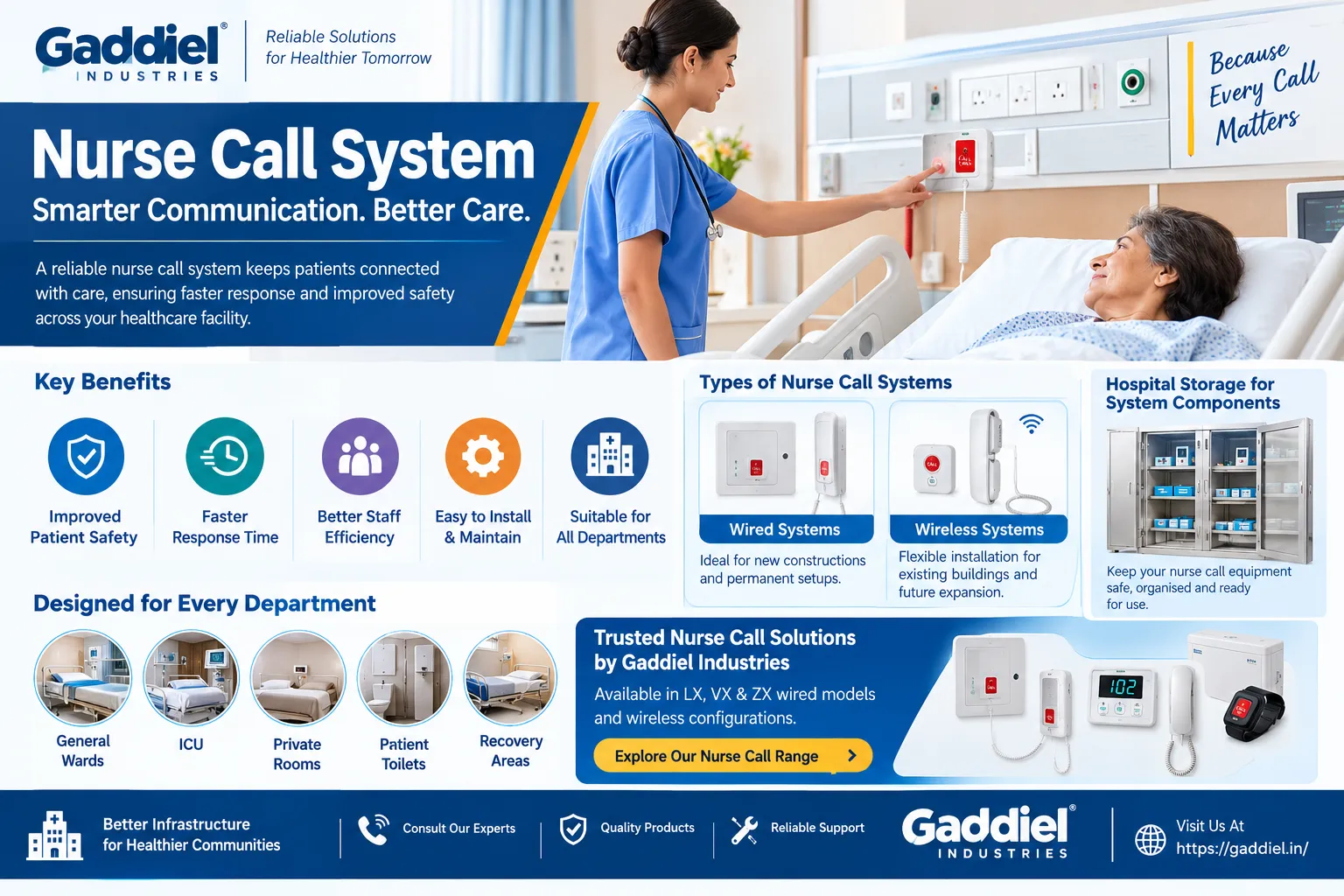
A hospital is an intricate structure where all units need to work harmoniously. Whether it is patient rooms, intensive care units, recovery wards, or the emergency ward, medical facilities require infrastructure that can accommodate safe and systematic day-to-day functioning. Although hospital planning and budgeting processes prioritise medical equipment and clinical equipment, various smaller communication units are also essential for a healthcare facility.
A nurse call system is one such requirement. It should not be treated as an isolated electrical installation but as part of the hospital’s overall infrastructure. Its placement, accessibility, capacity and integration need careful consideration before a new facility becomes operational.
Why Nurse Call Infrastructure Should Be Planned Early
Very little can be changed in the hospital infrastructure once patients are in. The electrical plan, bed head panels, room sizes and corridor design are more or less completed during construction.
Retrofit nurse call wiring, wall cuts and installation costs. When you add a nurse call system at a later date, it may require extra wiring, wall cuts and other installation costs. By incorporating the call system early, hospital architects and engineers can determine where you will locate calling points and how you will use each department’s calls.
For instance, a shared general ward with multiple beds would have varying installation requirements from a private patient room. An ICU may need more calling options than a different clinical location because of the clinical workflow.
If these things can be taken into account during the design stage, the installation process will be more organised, and there will be less chance of incorrect alteration.
Patient Accessibility Should Influence System Design
Because a hospital has to cater to all sorts of people, with their various ages, physical limitations and medical conditions, a calling device shouldn’t add to anyone’s worries.
Positioning and accessibility of patient call units should be considered in the planning phase.
Some important considerations include:
- Place calling controls within easy reach of the patient.
- Offering an accessible call system in patient toilets.
- Fitting clearly defined buttons and easy-to-operate instructions.
- Choosing appropriate handset styles for patients with mobility concerns.
- Making sure calling devices don’t cause a problem with other bedside equipment.
Such factors also apply to the elderly care centres, rehab centres and hospitals with long-term patients.
Wired or Wireless: Making the Infrastructure Decision
Wired or wireless technology, which is important, should be decided during the purchase.
Both methods of purchasing the systems have their own installation requirements, and choosing the right one will depend on the building’s construction, operational requirements and plans for growth.
Wired systems
Fibre installations may be preferable for new hospitals since once the electrical and communication infrastructure has been built, the cable run can be installed with the bed head panels and fixed infrastructure.
They are also well suited for establishments where the commitment to fixed installation points and structured cabling is higher.
Wireless systems
Wireless arrangements may be valuable in hospitals that are presently in use, repurposed buildings, and facilities where further wiring may be problematic.
Flexible when inserting call points and configuring room arrangements. They need to check signal coverage, battery care, and interference before the installation.
Whether to go for the technology that works for that building, or to adopt a new technology under the impression that it would work for that building.
Department-Wise Requirements in Healthcare Facilities
An installation across the whole hospital has to be thought about department-wise, rather than uniformly everywhere.
- Multi-bed Wards: multi-bed rooms with a design that allows each patient’s location to be found at a glance.
- Intensive Care Units: ICU planning involves the clinical environment as well as the density of equipment and need for support.
- Private Rooms: Calling controls should be easily accessible and well-placed without adding undue complexity.
- Patient Toilets: It is important to have different arrangements for emergency calls due to patients’ needs when not in bed.
- Recovery areas: Due to their condition, patients in recovery may be limited in their walking. Accessible calling facilities are also an important aspect of infrastructure.
However, by mapping these requirements prior to procurement, this allows the number and placement of calling points to be determined.
Understanding System Capacity and Future Expansion
It's not that a hospital is ever stuck with the same capacity, year after year. You may be adding new wards, expanding existing departments, and requiring more beds.
Thus, the planning of infrastructure needs to focus on future needs and not only on the first installation.
Prior to buying a nurse call solution, hospital management must compare:
- Current and proposed bed capacity.
- Number of patient rooms and departments.
- Additional calling points required in future.
- Compatibility of existing and new equipment.
- Access to technical advice and replacement parts.
This includes offering different types of wired options such as LX, VX and ZX as well as wireless options. This gives hospitals different options to take into account when installing.
Installation, Testing and Staff Familiarisation
The equipment installation is just one phase of completing the hospital communication project. It is necessary to test the system as it is operating before handing it over to the hospital.
Ensure controls and displays are working and that calls are accepted at each designated calling point. The relevant power arrangements should be confirmed.
Staff must know how to operate the system, including the manner in which it gives acknowledgement and the call-reset sequence.
Hospitals need to make sure they have a system in place for reporting faults. Regular inspection can identify any damaged switches, loose connections and other problems before they cause any disruption.
These measures enhance the lifetime reliability of the installation.
What Hospitals Should Discuss With Manufacturers
Selecting a manufacturer is not only about comparing product prices. Hospital procurement teams need to grasp the technical specifications of the solution and its installation feasibility for a specific building.
Prior to confirming an order, consider discussing the following:
- Available wired and wireless configurations.
- Total beds supported by the existing arrangement.
- Installation drawings and technical specifications.
- Compatibility with existing hospital infrastructure.
- Product testing and commissioning arrangements.
- Warranty, replacement parts and after-sales assistance.
You can also try to ask for product demonstrations and technical documentation to help decision-makers decide on various configuration choices prior to purchase.
Gaddiel Industries: Nurse Call Solutions for Healthcare Facilities
Gaddiel Industries is the manufacturer of hospital infrastructure products and electronic systems for the healthcare industry. Its nurse call line offers wired and wireless systems to suit the various hospital needs.
You can choose between LX, VX and ZX wired models and wireless configurations. Hospitals have options such as bedside calling controls, patient handsets, toilet emergency units and central display configurations, based on which model you choose.
These options give the hospital planners a way to evaluate a range of alternatives during the process of identifying their need for new space.
Please visit the Nurse Call System for Hospitals page for further details of the various configurations and product details.
Conclusion
Having the latest medical equipment is only part of a state-of-the-art hospital. All hospital infrastructures have to facilitate the in- and out-patients, irrespective of the treatment provided and the changing needs of the hospital.
Choosing the right system can be difficult without considering factors such as building design, patient proximity, departmental requirements, installation constraints and expansion plans.
By taking these aspects into account, the designers can create a more organised facility and avoid the need for further adjustments in the future. Consult with an experienced manufacturer like Gaddiel Industries to assess the appropriate options for your hospital project.