NAFTA Certificate: Understanding Certificates of Origin Today
24 Views
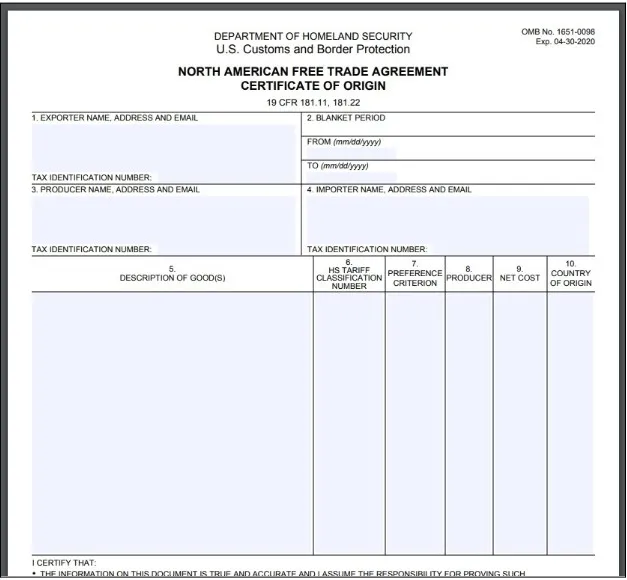
However, businesses handling cross-border shipments should understand that NAFTA was replaced by the United States-Mexico-Canada Agreement (USMCA) on July 1, 2020. A NAFTA certificate is commonly used to describe documentation that establishes where goods originate for North American trade. The older Certificate of Origin, historically associated with CBP Form 434, is therefore different from the current USMCA certification process.
What Was a NAFTA Certificate of Origin?
Under NAFTA, the Certificate of Origin was used to determine whether goods imported between the United States, Canada, and Mexico qualified for preferential tariff treatment. The exporter was responsible for completing and signing the certificate, while the importer needed to have the documentation when claiming the preferential tariff treatment.
The document included information about the exporter, producer, importer, goods, and applicable origin criteria. The certification helped customs authorities determine whether products met NAFTA's rules of origin.
For businesses that still encounter older documentation, understanding this historical terminology can be important when reviewing previous transactions, records, or customer requirements.
NAFTA Versus the USMCA
The most important consideration today is that NAFTA is no longer the governing trade agreement. USMCA replaced NAFTA in 2020, introducing updated rules and certification procedures.
Unlike the former NAFTA certificate, USMCA does not require a specific government-issued certificate form. A certification of origin can be provided in a document containing the required data elements, and it may be completed by the importer, exporter, or producer when the applicable requirements are satisfied.
This means companies should avoid automatically using an old Form 434 for current USMCA claims. Instead, they should determine whether the shipment qualifies under current USMCA rules and provide the appropriate certification information.
Why Certificates of Origin Matter
A certificate or certification of origin provides evidence concerning where a product qualifies as originating under the applicable trade agreement. This information can affect whether an eligible shipment receives preferential tariff treatment.
For manufacturers, distributors, and importers, accurate origin information can therefore be an important part of cross-border compliance. Documentation should be supported by records showing the origin of the goods and, where relevant, materials used in their production.
Under the former NAFTA rules, exporters and importers had specific record-retention obligations. U.S. exporters and importers were generally required to retain relevant NAFTA records for five years.
What Information Should Businesses Check?
Before requesting or preparing origin documentation, businesses should verify several details:
- Product identity: Clearly identify the goods covered by the certification.
- Country of origin: Determine whether the goods satisfy the applicable rules of origin.
- Exporter or producer information: Confirm the responsible parties and supporting documentation.
- Import value: Check whether simplified certification provisions may apply.
- Tariff classification: Review the product's applicable tariff classification when determining origin requirements.
- Supporting records: Maintain documentation that supports the origin claim.
USMCA rules can vary according to the type of product, its tariff classification, and how it was produced. Consequently, origin should not be assumed simply because a product was purchased or assembled in one of the three participating countries.
Machine Parts and Certificates of Origin
For companies purchasing machinery components internationally, origin documentation can become particularly relevant when customs requirements or preferential tariff claims apply. Because Form 434 is associated with the former NAFTA framework, customers handling current imports should confirm which documentation their customs broker or importing authority requires for the applicable shipment.
Conclusion
The term certificate remains common in international trade discussions, but businesses should recognize that Machine Parts Toolbox has been replaced by USMCA. The former Certificate of Origin was used to support preferential tariff claims, while current USMCA transactions follow updated certification requirements rather than relying automatically on the old Form 434. For machinery and replacement-part transactions, maintaining accurate product-origin information and confirming current customs requirements can help support smoother cross-border processing.
Related Reading
Top 10 Hidden Secrets About Business & Finance You Need to Know
Welcome to our in-depth exploration of Business & Finance. In an era defined...
Why Business & Finance is Transforming the Global Industry Landscape
Welcome to our in-depth exploration of Business & Finance. In an era defined...