Molded Rubber Products for Reliable Industrial Applications
22 Views
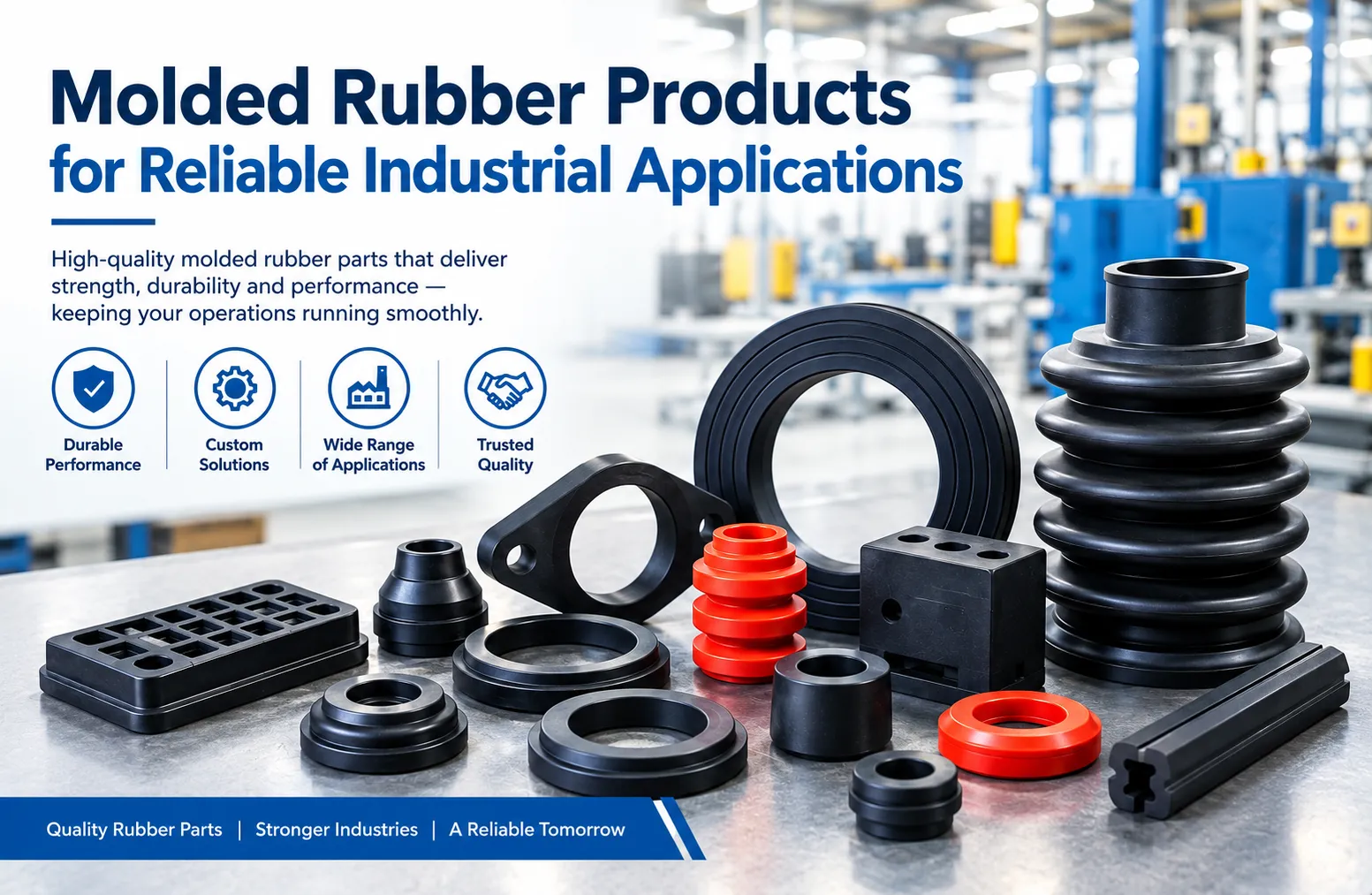
Rubber molding is one of the modern industrial manufacturing processes. It is required in various industries, such as the automotive, aerospace, oil and gas, construction, and heavy machinery sectors. The molded rubber products are resistant to chemical environments, heat, vibration, and constant pressure.
Precision shaping ensures very close tolerances and a long service life under all operating conditions. These are essential for industries to ensure their daily operations. The global rubber molding market was estimated at $49.1 billion in 2026 and is projected to reach $74.7 billion by 2032, growing at a 6.2% CAGR.
Molded rubber products play a functional role in all phases of industrial production. The molded rubber products mitigate unwanted downtime caused by component failure. Further molded rubber products fit into even the most demanding industrial system designs.
How Are Molded Rubber Products Made?
The three main production processes for these components are compression, transfer, and injection molding. Each process is selected based on part geometry, order volume, and required tolerance levels.
- Compression molding places raw rubber into an open mold before heat and pressure are applied evenly across the cavity.
- Transfer molding pushes raw rubber through a sprue port into a fully closed mold under consistent pressure.
- Injection molding injects rubber at very high pressure to form complex shapes with fine internal features.
The vulcanization process cross-links rubber molecules to build final structural strength and durability. Curing time and temperature are calibrated precisely to impact final product quality.
What Types of Rubber Materials Are Used in Industrial Molding?
The manufacturers formulate the compound to match the exact operating conditions the part will face during service. Different material grades offer unique performance benefits for specific use case requirements. Rubber molded products use each of these compounds based on stated project performance needs.
- EPDM: Delivers excellent weathering, ozone, and UV resistance for externally exposed applications
- Neoprene: Balances good oil and flame resistance with strong general durability
- Nitrile (NBR): Is the ideal compound for components that come into contact with fuel and oil
- Silicone: Offers consistent high-temperature performance up to 230°C and above
- Viton (FKM): Provides unmatched chemical resistance for the harshest operating environments
- Natural rubber: Has very high tensile strength and elasticity for dynamic load applications
Then, they finalise the material selection based on the expected operating environment and media exposure levels. All rubber molded products go through material validation before production commences. They maintain stock of all these standard material grades for fast order turnaround.
Key Industrial Sectors That Rely on Molded Rubber Components
A wide range of industrial sectors depend on these components for consistent daily operation. Each sector has unique performance requirements that dictate compound and design choices. Another 2026 market analysis estimates the global industrial rubber market at $47.04 billion in 2026, with a projected 6.7% CAGR through 2030. Molded rubber parts are custom-built for the specific needs of each individual industry.
High Growth End Sectors
- Automotive: Uses seals, grommets, bushings, and vibration dampers across all vehicle systems
- Oil & Gas: Relies on blowout preventer seals, pipeline gaskets, and valve seat components
- Aerospace: Uses fuel system seals and anti-vibration mounts for aircraft system stability
- Construction: Installs expansion joints, bearing pads and weatherstripping across building envelopes
- Food & Beverage: Uses FDA-grade rubber components for all hygienic sealing applications
- Marine: Fits hatch seals, shaft seals, and water-resistant gaskets across vessel systems
- Mining: Uses abrasion-resistant liners and protective covers for processing equipment
The manufacturers test all the molded rubber parts for industry-specific compliance prior to shipment. Their facility maintains separate material stock for each regulated industry segment.
What Makes Molded Rubber Products Reliable Under Extreme Conditions?
Molded rubber components outperform metal and plastic alternatives across extreme operating conditions. Rubber absorbs shock far more effectively than rigid material options of equal size. It maintains flexibility at low temperatures and structural stability at high temperatures.
Parts resist continuous mechanical stress and cyclic loading over thousands of operational cycles. Consistent sealing capability under high pressure prevents leaks and system contamination.
Non-conductive properties provide reliable protection for adjacent sensitive electrical components. Corrosion-free performance extends overall component service life by multiple years.
Key Performance Benefits
- High Shock Absorption
- Wide Temperature Range
- Up to 700% Elongation
- Strong Sealing Performance
- Excellent Fatigue Resistance
- Electrical Insulation
Common Types of Molded Rubber Products Used in Industry
A standard set of component types appears across the vast majority of industrial system designs. Each part type serves one specific core function within the larger operational system. Custom rubber gaskets rank among the most widely produced components across all industry segments.
- O-rings
- Gaskets
- Diaphragms
- Grommets
- Bushings
- Custom molded profiles
- Vibration mounts
How Do Custom Molded Rubber Parts Differ From Standard Parts?
Stock standard parts are for a very narrow set of common generic applications. Custom-built components are engineered to meet exact specifications, tolerances, and compound requirements. Custom gasket manufacturing processes support both standard and fully custom part designs.
- Custom tooling is designed from CAD drawings or physical sample parts provided
- Compound is formulated to match specific temperature, pressure, or chemical exposure demands
- Shorter lead times apply when existing tooling already exists for the required design
- Prototyping allows full performance testing before any full production run commences
- Industries with unique operating requirements always prefer custom molded solution options
What Role Do Molded Rubber Products Play in Sealing and Vibration Control?
Function
How It Helps
Sealing
Prevents fluids, gases, dust, and other contaminants from entering operating assemblies.
Dynamic Sealing
Keeps moving components properly sealed while allowing them to move during operation.
Static Sealing
Creates a secure seal between fixed joints and connected surfaces.
Vibration Control
Absorbs mechanical vibrations and helps protect equipment from long-term fatigue and wear.
Rubber Mounts
Reduce noise and vibration transferred through machinery frames and supporting structures.
Anti-Vibration Pads
Help isolate heavy, stationary industrial machinery from surrounding floors and structures.
Reduced Maintenance
Consistent sealing and vibration control can help reduce equipment downtime and maintenance needs.
Molded rubber products deliver consistent sealing performance across all pressure ranges. The necessary and small improvements in seal performance can cut annual maintenance costs.
How Does Rubber Hardness Affect Performance in Industrial Applications?
Material hardness forms one of the most critical design choices for every molded rubber component. Hardness is measured on the Shore A scale for soft compounds and the Shore D scale for hard, rigid compounds.
- Low Shore A (20–40): Used for flexible seals, soft grommets, and thin diaphragm components
- Mid Shore A (50–70): Applied for general gaskets, O-rings, and standard sealing parts
- High Shore A (80–95): Selected for structural pads, heavy-duty bushings, and load-bearing components
Custom rubber extrusions are always formulated to match specified hardness requirements. The engineering team provides hardness selection guidance for all new project requests.
Upcoming Industry Trends
- Growing demand for application-specific rubber components.
- Greater use of heat-, chemical-, and wear-resistant rubber compounds.
- Automated molding and inspection for faster, consistent production.
- Rising demand for specialized seals, gaskets, mounts, and protective parts.
- Tighter tolerances and improved dimensional accuracy.
Conclusion
Molded rubber products are critical to industrial reliability and operational safety. The right material paired with the correct molding process delivers long-lasting high-performance parts. Both custom and standard solution options are available across all major industrial sectors.
The rigorous quality testing confirms parts will perform as expected under operating conditions. Partnering with an experienced rubber molder reduces overall unplanned component failure risk. The manufacturers support projects of all sizes from initial prototype runs through full-scale production.
Related Reading
Top 10 Hidden Secrets About Business & Finance You Need to Know
Welcome to our in-depth exploration of Business & Finance. In an era defined...
Why Business & Finance is Transforming the Global Industry Landscape
Welcome to our in-depth exploration of Business & Finance. In an era defined...